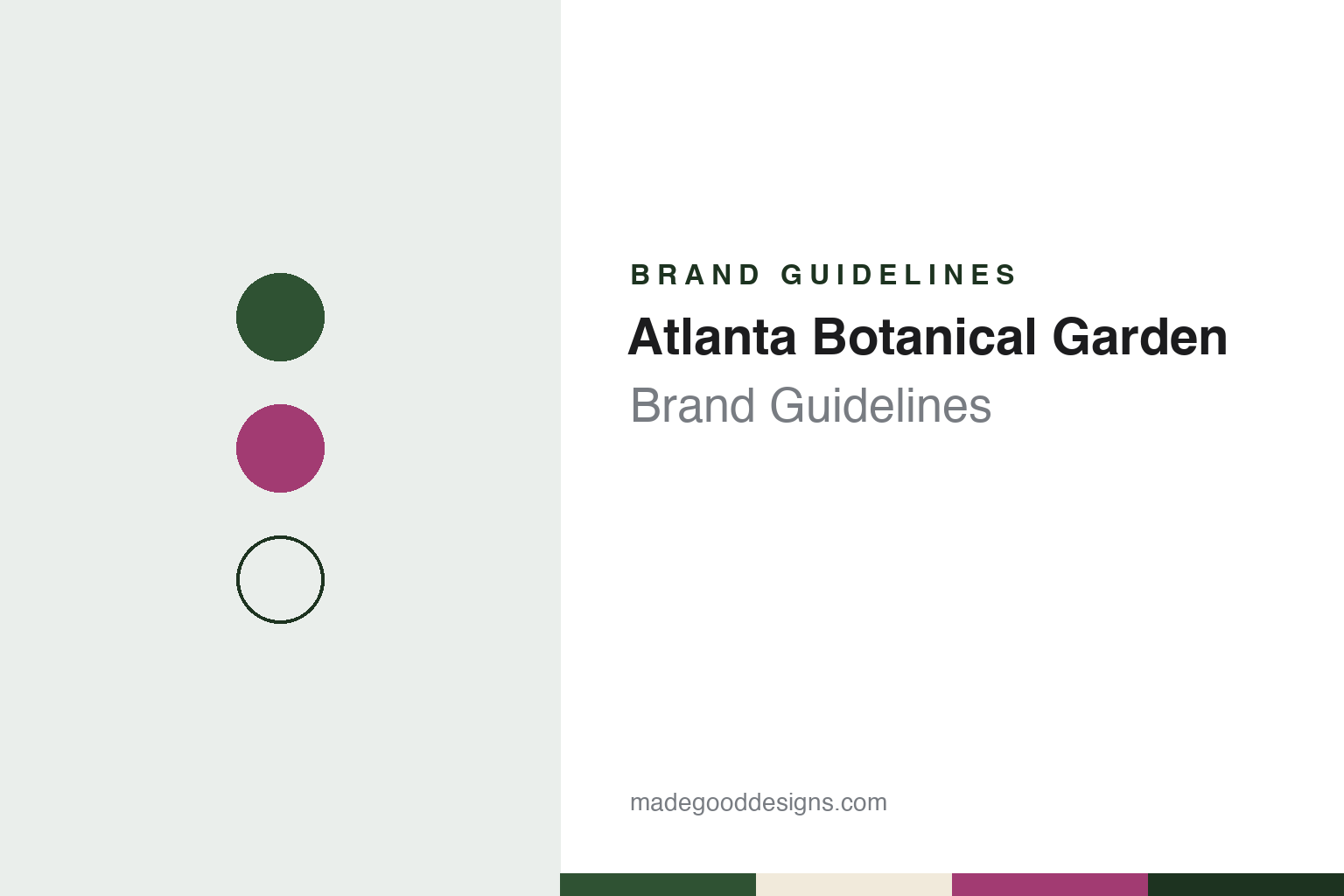
Atlanta Botanical Garden Brand Guidelines
A Midtown garden of glasshouses, treetops and named seasons.
Aa
Two constants: a Storza green, warm cream and orchid magenta palette and a soft serif register. Abstract homage — not an Atlanta Botanical Garden asset; no logo, sign or photograph is reproduced.
A garden in Piedmont Park
Proposed in 1973, incorporated in 1976.
The Atlanta Botanical Garden grew out of a citizens’ proposal. The garden’s own timeline says civic-minded Atlantans proposed a botanical garden for the city in 1973, and that Atlanta Botanical Garden, Inc. was incorporated in 1976. English Wikipedia describes it as a private non-profit corporation and puts the garden at about 30 acres (12 hectares) beside Piedmont Park in Midtown Atlanta, Georgia.
The garden began small. English Wikipedia says it took in an existing bonsai garden, the Dr. A. Leslie Stephens Memorial Bonsai Garden, which is now its Japanese Garden. The timeline records a double-wide trailer as the first office in 1977, the year the garden appointed its first full-time executive director, who came from the Holden Arboretum. In 1980 a 50-year lease was signed with the City of Atlanta, securing the site. English Wikipedia says the garden welcomed its 50,000th visitor within three years of the lease, before any permanent building had gone up; the first permanent structure, the Gardenhouse, opened in 1985.
Glass came next. The Dorothy Chapman Fuqua Conservatory opened in 1989, the timeline says. English Wikipedia gives it 16,000 square feet of tropical rainforest and desert displays, with tropical birds, turtles and poison dart frogs in the rainforest room, the frogs part of conservation work with Zoo Atlanta. The garden’s own pages list the conservatory’s Tropical Rotunda, Orangerie and Desert House. The Fuqua Orchid Center followed in 2002, with separate houses for tropical and high-elevation orchids; English Wikipedia says its Tropical High Elevation House recreates conditions found at 6,000 to 10,000 feet, using an air-washer system adapted from the textile industry alongside conventional greenhouse heating and cooling.
Colour
An expansion through the treetops.
The main change to the Midtown site came in 2010. The garden’s timeline records the opening that year of the Canopy Walk, the Edible Garden and the Cascades Garden as the completion of an expansion that nearly doubled the garden’s size, following a new visitor centre in 2009. English Wikipedia describes the Kendeda Canopy Walk as a 600-foot skywalk about 40 feet up in the Storza Woods, running from a bluff into oaks, hickories and poplars, and says the expansion included an underground cistern, installed in December 2007, that waters about 40 per cent of the new gardens. The Skyline Garden opened in 2017, and the Southeastern Center for Conservation, a base for regional research, opened in 2019, the timeline says.
The Midtown garden is a sequence of themed spaces. English Wikipedia lists formal gardens near the entrance, among them the Japanese Garden and the rose garden, and two woodland areas, the 5-acre Upper Woodland and the 10-acre Storza Woods. A children’s garden opened in 1999; the timeline says it reopened after renovation in 2016 as the Lou Glenn Children’s Garden. The garden’s own pages also list a Conifer Garden, a Conservation Display Garden and a Skyline Garden among its outdoor spaces.
The garden also has a second site. Its timeline says the Smithgall family donated 168 acres in Gainesville, north of Atlanta, in 2000, and that Atlanta Botanical Garden, Gainesville, opened its first phase in 2015. Collin Kelley of Rough Draft Atlanta reported in July 2015 that the first phase, a little more than five acres on the donated land, was open to visitors, about an hour and a half north of the city. Three concerts in that year’s summer series were being held in the new amphitheater, he wrote. He described a visitor centre, a Forest Pond of water lilies, the Ivester Amphitheater with grass terraces for 2,200 people, an Overlook Garden, a Stream Garden with a cascading waterfall, a Model Train Garden and half-mile woodland trails. The Ada Mae Pass Ivester Children’s Garden opened there in 2020, according to the timeline.
Typography
Design and documentation.
Botanic gardens tend to carry their place in their names. Many take a city, a state or a country, some carry a royal title, and some are better known locally by a founder’s name or a short form. Edinburgh’s garden received a royal warrant in 1699 and is called “the Botanics” in the city; St. Louis has long called the Missouri Botanical Garden “Shaw’s Garden”, after Henry Shaw, who created it. Initials such as RBGE stand in for a long formal name on websites and publications.
Glasshouses often act as the visual signature. Edinburgh’s Tropical Palm House dates from 1834 and its Temperate Palm House from 1858, and the pair reopened in October 2026 after five years of restoration; in St. Louis the Climatron, a geodesic dome opened in 1960, has given the garden a shape that its anniversaries are built around. Newer visitor buildings, such as Edinburgh’s John Hope Gateway, add a contemporary entrance alongside the historic houses.
The institutions behind the names differ. Some gardens are public bodies, as the Edinburgh garden is in Scotland; some are run by trusts and boards of trustees, as Shaw’s will arranged for St. Louis in 1889; others belong to cities, national institutes, horticultural societies or families. Many manage more than one site, from regional gardens to nature reserves, and heritage registers list several of their grounds and buildings.
Named seasonal events extend the identity beyond the gates. Illuminated winter trails such as Christmas at the Botanics in Edinburgh and Garden Glow in St. Louis carry the garden’s name into the evening, alongside festivals and concert series. This guide sets out what can be checked about each garden — when it was founded, who runs it, what it built and when — and marks clearly what rests on the garden’s own account.
Aa
A soft, rounded serif for a garden of glasshouses. (Specimen set in Fraunces, a serif STAND-IN; NOT the Atlanta Botanical Garden logo.)
Atlanta Botanical Garden
Exhibitions, lights and a city name.
Much of the garden’s public face is its exhibition calendar. English Wikipedia dates its run of summer exhibitions to 2003 and lists Chihuly in the Garden in 2004, which drew an estimated 425,000 visitors over its eight-month run, and its return on 30 April 2016 with 19 installations. Other shows included model trains in 2005, kinetic sculpture in 2008 and Imaginary Worlds, a show of mosaiculture plant sculptures, in 2013. The Earth Goddess, a 25-foot figure from Imaginary Worlds, has stayed on as a permanent part of the Cascades Garden.
The seasonal shows carry the garden’s name through the year. The timeline lists Atlanta Blooms!, a spring display of bulbs that began in 2011, and Garden Lights, Holiday Nights, which opened the same year; English Wikipedia says the first edition used more than one million lights, most of them LED, and that the following year’s show grew past 1.5 million lights and drew more than 160,000 visitors. The garden’s calendar also lists Orchid Daze in February and Scarecrows in the Garden in October, and its timeline records a biennial Atlanta Botanical Garden Flower Show, staged in 2018, 2020 and 2022. The 2026 edition of Garden Lights, Holiday Nights runs from 14 November to 10 January, the garden’s website says.
The name is plain and geographical, and the second site keeps it: the garden calls its outpost Atlanta Botanical Garden, Gainesville, and uses the short web address atlantabg.org.
For a design guide, the Atlanta Botanical Garden shows how an urban non-profit garden can build an identity from glasshouses, a treetop walk and named seasonal shows. Compare Missouri Botanical Garden, another American botanical garden, and the New York Botanical Garden. For this guide we use a deep woodland green, an orchid magenta and a warm cream with a serif, an unofficial interpretation; no product or logo is reproduced.
Explore & save
Keep Atlanta Botanical Garden’s identity on hand — save it to a board in the Made Good inspiration library.
Atlanta Botanical Garden identity set
Pin the Atlanta Botanical Garden Storza green, warm cream and orchid magenta palette and the soft serif register to your own board.
Source & notes
Frequently Asked Questions
What font can I use to match the Atlanta Botanical Garden look?
This guide describes Atlanta Botanical Garden’s type as “A soft, rounded serif for a garden of glasshouses”. Its type specimen is set in Fraunces from Google Fonts as a stand-in; Fraunces is not Atlanta Botanical Garden’s own lettering.
What colours are in the Atlanta Botanical Garden palette?
This guide’s Atlanta Botanical Garden palette is Storza green #2F5233, Woodland ink #1D3320, Orchid magenta #A23B72, Warm cream #F1EADB and Paper #FAF8F3. The tones are the guide’s own unofficial interpretation, not official Atlanta Botanical Garden hex codes.
When was Atlanta Botanical Garden founded?
Atlanta Botanical Garden was founded in 1976 (incorporated), in Atlanta, Georgia, USA.