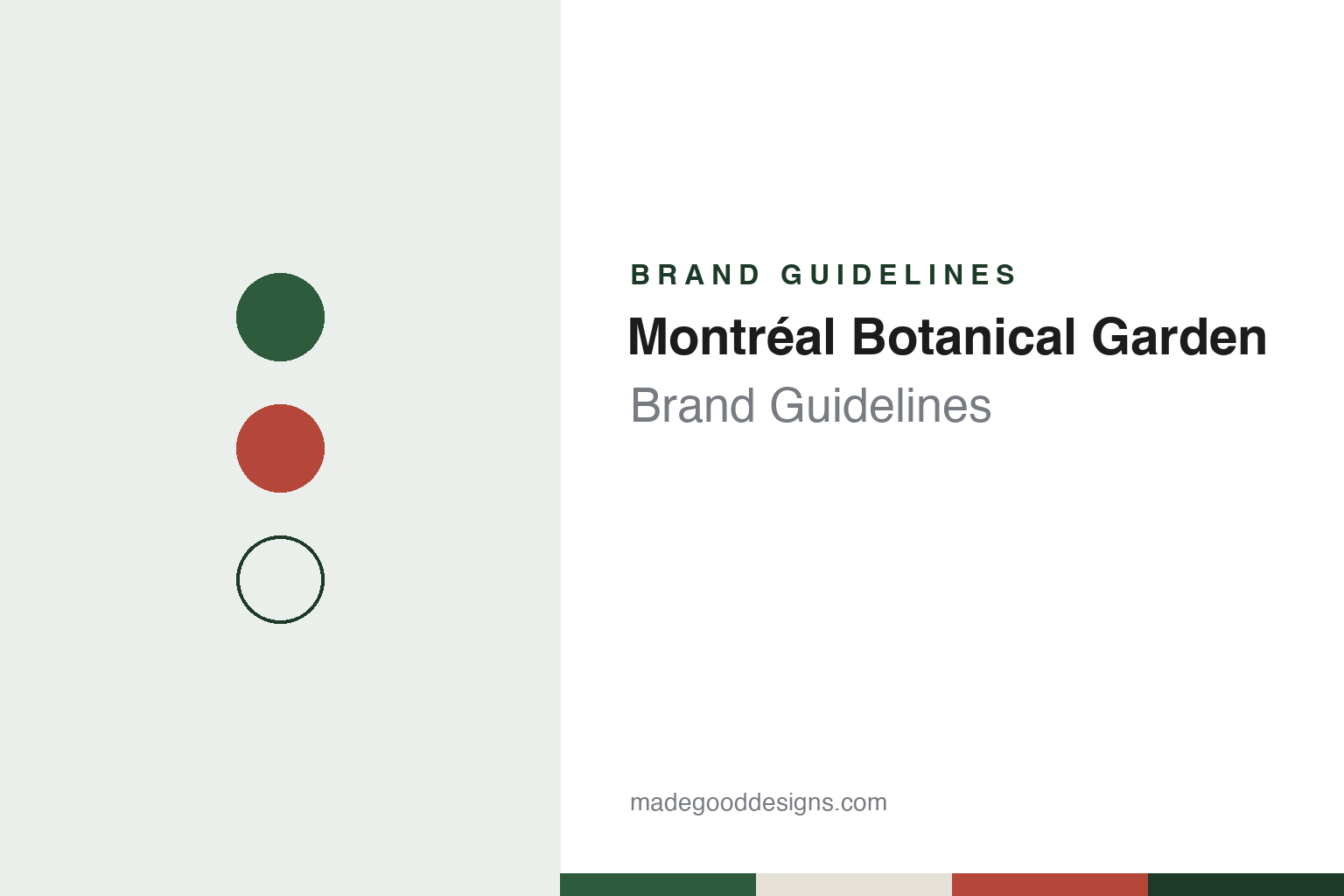
Montréal Botanical Garden Brand Guidelines
A botanist’s garden in the east of Montréal, lit by lanterns each autumn.
Aa
Two constants: an arboretum green, limestone and lantern red palette and a geometric sans register. Abstract homage — not a Montréal Botanical Garden asset; no logo, sign or photograph is reproduced.
A garden for a botanist
Founded in 1931 on part of Maisonneuve Park.
The Montréal Botanical Garden — in French the Jardin botanique de Montréal — was founded in 1931 in the east of the city. French Wikipedia gives the date of its official founding as 9 June 1931. Parks Canada, in the text of its national historic site designation, describes the garden as the work of the botanist Brother Marie-Victorin, who initiated and directed the project, and the landscape architect Henry Teuscher, who conceived its design. The same text says the two set out to create an “ideal botanical garden” in its aesthetic, scientific, educational and social roles.
The idea had a long run-up. According to French Wikipedia, Marie-Victorin, then a professor at the Université de Montréal and the author of the Flore laurentienne, proposed a botanic garden for the city in 1925; a garden association was formed in 1930 and delivered a report setting out the project the following year. The site chosen was part of Maisonneuve Park, north of Sherbrooke Street. The garden now covers about 75 hectares in the borough of Rosemont–La Petite-Patrie, across from the Olympic Stadium, according to Parks Canada and English Wikipedia.
Building went on through the 1930s. French Wikipedia says the Art Deco administration building designed by the architect Lucien F. Kéroack, now called the Marie-Victorin building, was begun in 1931 and finished in 1938, with sculpted decorative themes on its facades. The entrance gardens were laid out between 1936 and 1939, and Parks Canada dates the garden’s opening to the public to 1936. In 1938 Marie-Victorin founded a horticultural apprentice school on part of the grounds, Parks Canada says, reserving space for young students and researchers. French Wikipedia adds that the large exhibition greenhouses were inaugurated in 1956, and that the north part of the site was later laid out as an arboretum.
Colour
Thirty gardens and ten greenhouses.
Parks Canada describes the site as a cultural landscape “of formal and picturesque character” made up of some thirty thematic gardens, about ten exhibition greenhouses, an arboretum and an H-shaped administrative pavilion in the Beaux-Arts and Art Deco styles. Its designation text counts 22,000 plant species and cultivars. The Historic Sites and Monuments Board of Canada considered the garden in July 2007, and it was formally recognised as a National Historic Site of Canada in 2008, according to Parks Canada and the Canadian Register of Historic Places, which added it to the register in 2010. Parks Canada says many original features of the plan survive.
Several of its gardens arrived later. English Wikipedia dates the Japanese Garden to 1988 and says the Chinese Garden, about 2.5 hectares laid out along the lines of a Ming dynasty garden, was built in 1990 and 1991 by artisans from the Shanghai Institute of Landscape Design and Architecture, with stone brought from Lake Tai. French Wikipedia lists a new reception complex and the Molson reception greenhouse in 1995, the Tree House (Maison de l’arbre) in 1996 and the First Nations Garden in 2001, with a pavilion by the architects Saucier + Perrotte. A cast lion from Lyon, one of four castings made for that city’s Feuillée bridge, was given by Lyon in 1992 for Montréal’s 350th anniversary and stands at the entrance to the rose garden, English Wikipedia says.
The garden belongs to a city-run group of nature museums. French Wikipedia says it joined Espace pour la vie — in English, Space for Life — in 2009, alongside the Biodôme, the Insectarium and the Planétarium, and that the Biosphère on Île Sainte-Hélène was added to the group in 2021. The grounds also hold the Insectarium, a university plant-biology research institute and the Biodiversity Centre, which opened in 2010, as well as the Marie-Victorin Herbarium, which French Wikipedia lists among the larger herbaria in Canada.
Typography
Design and documentation.
Botanic gardens tend to carry their place in their names. Many take a city, a state or a country, some carry a royal title, and some are better known locally by a founder’s name or a short form. Edinburgh’s garden received a royal warrant in 1699 and is called “the Botanics” in the city; St. Louis has long called the Missouri Botanical Garden “Shaw’s Garden”, after Henry Shaw, who created it. Initials such as RBGE stand in for a long formal name on websites and publications.
Glasshouses often act as the visual signature. Edinburgh’s Tropical Palm House dates from 1834 and its Temperate Palm House from 1858, and the pair reopened in October 2026 after five years of restoration; in St. Louis the Climatron, a geodesic dome opened in 1960, has given the garden a shape that its anniversaries are built around. Newer visitor buildings, such as Edinburgh’s John Hope Gateway, add a contemporary entrance alongside the historic houses.
The institutions behind the names differ. Some gardens are public bodies, as the Edinburgh garden is in Scotland; some are run by trusts and boards of trustees, as Shaw’s will arranged for St. Louis in 1889; others belong to cities, national institutes, horticultural societies or families. Many manage more than one site, from regional gardens to nature reserves, and heritage registers list several of their grounds and buildings.
Named seasonal events extend the identity beyond the gates. Illuminated winter trails such as Christmas at the Botanics in Edinburgh and Garden Glow in St. Louis carry the garden’s name into the evening, alongside festivals and concert series. This guide sets out what can be checked about each garden — when it was founded, who runs it, what it built and when — and marks clearly what rests on the garden’s own account.
Aa
A geometric sans in the spirit of the garden’s 1930s pavilion. (Specimen set in Josefin Sans, a sans STAND-IN; NOT the Montréal Botanical Garden logo.)
Jardin botanique
Lanterns, light and a bilingual name.
The garden’s autumn evenings carry their own name. French Wikipedia says that since 1992 the Chinese Garden has been lit each September and October for La Magie des lanternes, with silk lanterns designed in Montréal and made by hand in the traditional Chinese way before being shipped to the city. That display is now one part of Jardins de lumière (Gardens of Light), which lights the garden’s three cultural gardens — Japanese, First Nations and Chinese — after dark. Narcity reported in August 2026 that the 14th edition would run from 3 September to 1 November 2026, with a new route called Résonance in the First Nations Garden for that garden’s 25th anniversary, and lanterns on the Chinese Garden’s lake inspired by the Shan Hai Jing, a founding text of Chinese mythology.
Other seasonal programmes are listed by French Wikipedia: the Temps des sucres maple tasting at the Tree House in early March and the Odyssée des monarques, a monarch butterfly tagging and release in late summer. It also notes that the long-running Butterflies Go Free display in the main greenhouse ended in 2018.
The name works in two languages. The French Jardin botanique de Montréal and the English Montréal Botanical Garden, which keeps the accented “é,” are both used by Parks Canada and the Canadian Register of Historic Places. Within Space for Life the garden shares its public setting with four sibling institutions, so its name sits inside a wider museum family.
For a design guide, the Montréal Botanical Garden shows how a 1930s civic garden, an Art Deco pavilion and an autumn light festival can share one bilingual name. Compare The Butchart Gardens, another Canadian garden, and Kew Gardens, a botanic garden with historic glasshouses. For this guide we use a deep arboretum green, a lantern red and a pale limestone with a geometric sans, an unofficial interpretation; no product or logo is reproduced.
Explore & save
Keep Montréal Botanical Garden’s identity on hand — save it to a board in the Made Good inspiration library.
Montréal Botanical Garden identity set
Pin the Montréal Botanical Garden arboretum green, limestone and lantern red palette and the geometric sans register to your own board.
Source & notes
Frequently Asked Questions
What font can I use to match the Montréal Botanical Garden look?
This guide describes Montréal Botanical Garden’s type as “A geometric sans in the spirit of the garden’s 1930s pavilion”. Its type specimen is set in Josefin Sans from Google Fonts as a stand-in; Josefin Sans is not Montréal Botanical Garden’s own lettering.
What colours are in the Montréal Botanical Garden palette?
This guide’s Montréal Botanical Garden palette is Arboretum green #2E5B3C, Pine ink #1C3A27, Lantern red #B4473A, Limestone #E6E1D6 and Paper #F7F5F0. The tones are the guide’s own unofficial interpretation, not official Montréal Botanical Garden hex codes.
When was Montréal Botanical Garden founded?
Montréal Botanical Garden was founded in 1931, in Montréal, Quebec, Canada.
Who founded Montréal Botanical Garden?
Montréal Botanical Garden was founded by Brother Marie-Victorin and Henry Teuscher in 1931.