Mirasol Brand Guidelines
The Peruvian yarn created to fund an Andean school.
Aa
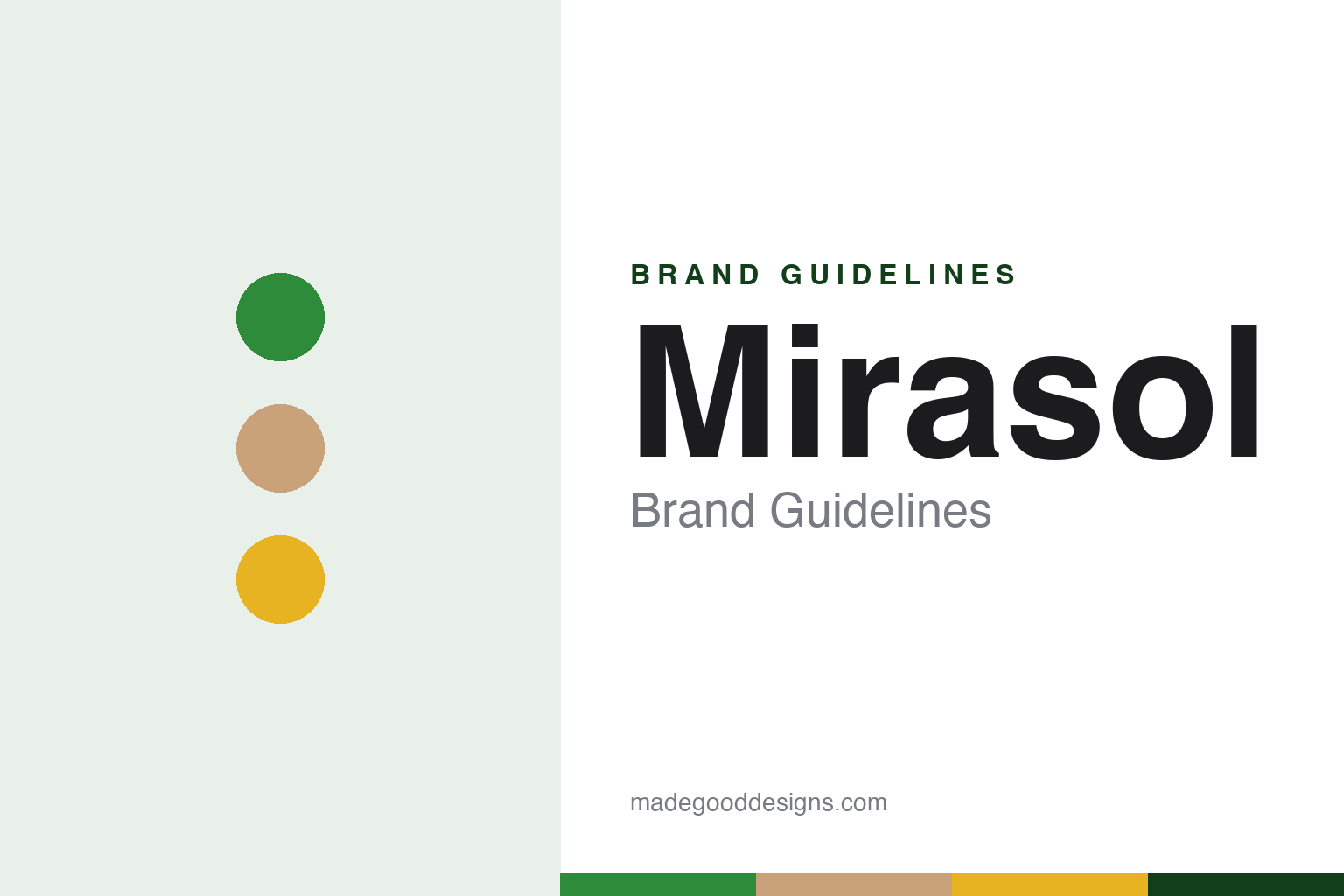
Two constants: a Mirasol Andean green and alpaca fawn palette and a Rounded sans register. Abstract homage — not a Mirasol product or mark; no yarn band, logo or label is reproduced.
A school first
A ranch, a boarding school and a yarn.
Mirasol began as a school, not a yarn. Its brand website says the project started with Kari Hestnes and Per Svendsen, then the owners of the Norwegian yarn company Du Store Alpakka, during a 2006 visit to an alpaca ranch in the Puno region of the Peruvian Andes. There they met children of the ranch’s shepherds who, the website says, walked two to three hours a day to get to school. The couple proposed a boarding house where children from the surrounding communities could stay during the week.
The ranch belongs to Michell & Cía., the alpaca company of Arequipa. Michell says it was founded there in 1931 by Frank W. Michell, as a sorter and exporter of raw alpaca fibre shipped to Bradford and Boston, and that in 1947 it set up the first combing and spinning plant in Peru. The project’s own website, which carries the Michell Group name in its footer, describes Mirasol as an educational and social project at Fundo Sorani, “part of Michell Group in Muñani, Puno”; the yarn website names the ranch as Mallkini. The sources also differ on the first visit: Michell’s page gives 2005, the project and yarn websites 2006.
The name came from the ranch. Michell says the project was first named after a shepherd’s daughter the couple had met there, and that “owing to formalities and language problems” it became Mirasol — Spanish for sunflower — and was registered as the Asociación Civil Mirasol, a non-profit civil association.
Colour
A collection made to fund a school.
The project website’s timeline runs from 2006 to 2019. It says the civil association was created in 2007, when building began on a plot of about 12,200 square metres provided by Michell — Michell’s own page says about 12,600 — and that the school opened in 2008 with 38 pupils in early and primary education. Later stages added classrooms, a library, a sports court and, in 2019, satellite internet. The website now describes three classrooms, a multipurpose hall, a room for English teaching, two dormitories with about fifteen bunk beds each, and a nutrition programme supervised by a nutritionist. It says the project has reached more than 800 children in eighteen years; the yarn website says the school has more than 50 primary pupils. We give those figures as the project’s own.
The yarn came after the school. According to Michell, the project was first funded by Hestnes and Svendsen, through Du Store Alpakka, and by Michell itself. Other companies then joined: Knitting Fever of the United States, Fil Diamond Yarn of Canada, Fil Katia of Spain and Designer Yarns Ltd. of the United Kingdom. “These companies, along with Michell, with the sole purpose of supporting the programme, created a collection of hand knitted yarns called MIRASOL,” Michell says, distributed in the USA, Canada and Europe, with the partners agreeing to donate a percentage of profits. Michell put sponsors’ contributions from 2007 to December 2013 at more than US$800,000.
The yarn website tells the story from the brand’s side: the “Mirasol Yarns” brand, it says, “was created to support the Mirasol Project,” and has funded it “year after year, for over nineteen years.” Its product descriptions repeat that a portion of every sale goes to the school. The project website now runs a programme it calls “Yarns of Change,” inviting textile companies and partner brands to donate a percentage of their sales.
Typography
Design and documentation.
The seven brands in this group all sell yarn for hand knitting and crochet, and they come from seven countries: Purl Soho from the United States, Dale Garn from Norway, Schoppel from Germany, Puppy from Japan, King Cole from the United Kingdom, Mirasol from Peru and Fonty from France. What links them is less a fibre or a price point than the question of who actually stands behind the label on the ball.
Some yarn brands begin as shops, where a retailer’s taste in colour and pattern becomes a house range that others then spin to order. Some are spinners first, mills whose brand name is simply the name over the factory door, and whose shade cards grew out of what their machines and dye houses could make. Others are built around a social purpose, using the sale of yarn to fund work, training or schooling in the places where the fibre is grown and the yarn is made. Many sit somewhere between these models, and some have moved from one to another as owners changed.
Each guide separates what independent sources record from what the company says about itself — who founded it, who owns it now and where its yarn is made — and marks plainly what rests only on the company’s own word.
Aa
A rounded sans — Quechua names on every ball. (Specimen set in Nunito, a sans STAND-IN; NOT the Mirasol logo.)
Mirasol
Quechua names, more than one mill.
Who makes Mirasol yarn is less clear than whom it supports. Michell is a spinner, but its Mirasol page describes a collection created by a group of companies rather than one made in Michell’s own mills, and we found no statement of who holds the Mirasol trademark today. The yarn website makes its claims yarn by yarn: Phullu, a blend of baby alpaca and merino, is “spun in Peru”; Chirapa, an organic cotton, was “designed in Peru & Spun in Italy.” We give both as the brand’s claims and do not describe the whole range as made in Peru.
The partners have changed. Designer Yarns, the British partner, was a West Yorkshire wholesaler incorporated in 2001; Companies House records that it went into administration in December 2017 and again in June 2022, and that it was dissolved in September 2023. The current yarn website lists stockists in sixteen countries, from Australia to the United States, and its newsletter sign-up runs through Knitting Fever, the American distributor named as an early partner.
The range is small — fifteen yarns on the current website — and each takes its name from Quechua, the Indigenous language of the Andes: Amaru, which the brand glosses as “flowing silky movement”; Chirapa, “rainbow”; Phullu, “soft hair or down.” The project’s website is set in a rounded sans with a bright green, a pink and a turquoise; we found no published guidelines for the yarn brand itself.
For a design guide, Mirasol shows a brand built around a cause, with its story told by the companies that fund it. Compare Katia, the Spanish yarn company named as one of its partners, and Debbie Bliss, another brand once distributed in Britain by Designer Yarns. For this guide we use an Andean green and an alpaca fawn with a rounded sans, an unofficial interpretation; no product or logo is reproduced.
Explore & save
Keep Mirasol’s identity on hand — save it to a board in the Made Good inspiration library.
Mirasol identity set
Pin the Mirasol Andean green and alpaca fawn palette and the Rounded sans register to your own board.