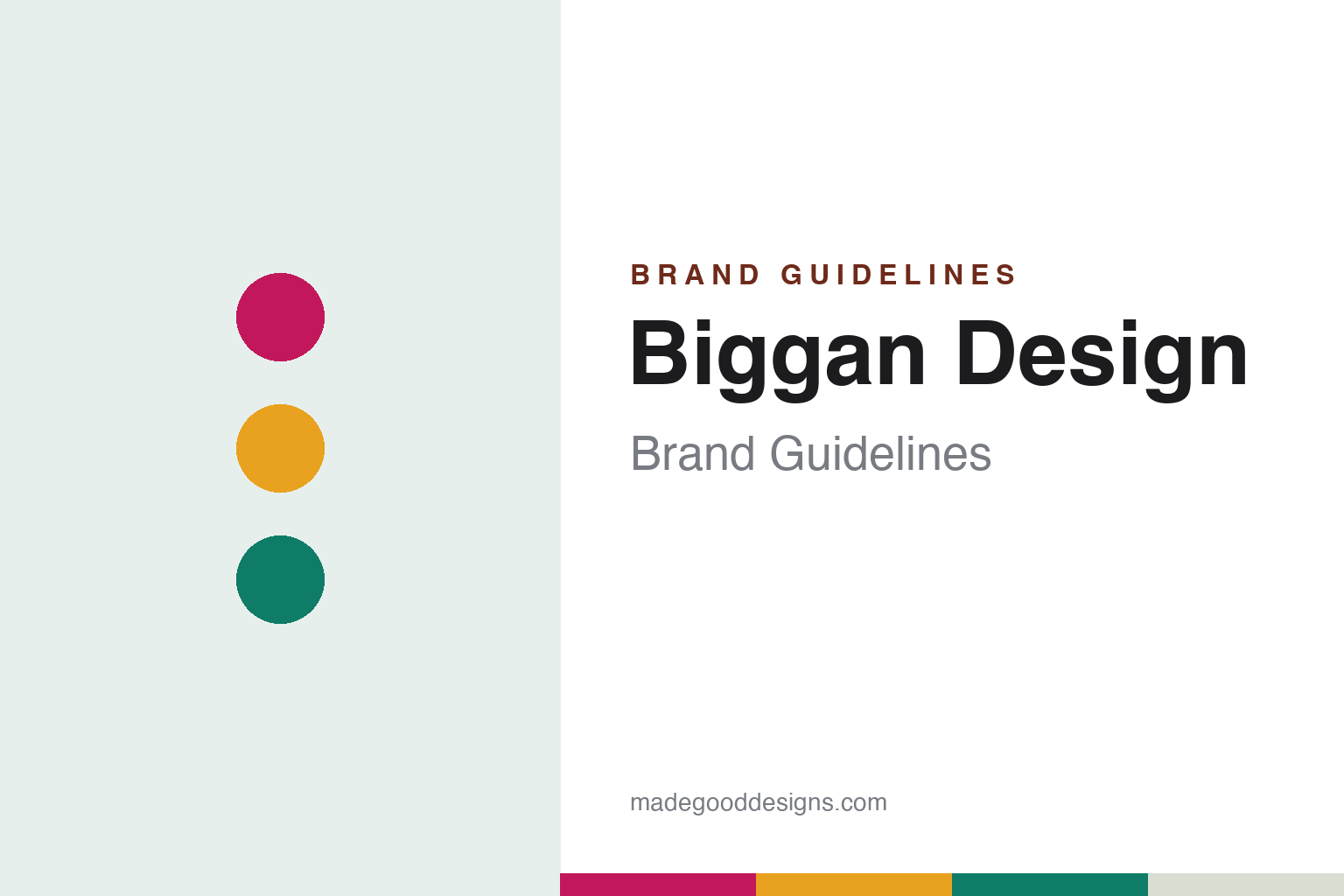
Biggan Design Brand Guidelines
Australian merino, a Swedish designer’s eye, sixty-four colours.
Aa
Two constants: a cerise, saffron and jade palette drawn from a long solid-colour card, and a clean geometric sans register. Abstract homage — not a Biggan Design product or mark; no yarn, ball band or logo is reproduced.
A Swedish eye on Australian wool
A designer who could not find the yarn she wanted, so made her own.
Biggan Design is a small hand-knitting label from Brisbane, Queensland, built around one fibre and a great many colours. Its yarns were made from 100% Australian merino, sold in a double-knit weight and a finer 4 ply, and backed by knitting patterns written for them. Although the name and the founder’s training point to Sweden, the business itself is Australian: the company behind it, Biggan Design Pty Ltd, is registered in Australia as a private company with its main business location in Queensland, according to the Australian Business Register.
The label is the work of Biggan Ryd-Dups, a designer who describes herself on her professional profile as a “trained fashion designer specialising in knitwear & Merino yarn production.” The same profile lists her education at the Anders Beckman School of Fashion & Design in Stockholm and gives her role at Biggan Design Pty Ltd as founder and creative director from April 2002; that date is her own account, and we found no independent record of when the yarn line itself was launched. Knitting bloggers described her the same way. A 2009 post on the blog Thoughts At The Bus Stop said the company “was founded by Swedish designer Biggan Dups” and was based in Australia, while noting that knitters in the UK could buy the yarn through a British stockist.
The founding story is told most fully by a Queensland knitter. Writing on her blog The Duchess in November 2011, during the annual Wovember celebration of wool, she said the Scandinavian designer had found it hard to source good wool for her designs after moving to Australia, “despite all our sheep,” and had therefore started her own “niche luxury merino yarn label.” The same post set the scene: a country that grows huge quantities of merino but exports most of it, with only a handful of woollen mills still working at home. Biggan Design’s answer was to put Australian wool and a designer’s colour sense into a ball sold directly to hand knitters.
Colour
Two weights, one fibre and a long colour card.
The range was deliberately narrow. Ravelry, the knitting database, lists only two Biggan Design yarns, and both are pure merino. First Cross Merino DK came in 50-gram balls of about 105 metres, and the description on its Ravelry page says it was “available in 64 brilliant, harmonising colors,” soft enough to wear next to the skin and machine washable on a gentle wool cycle. First Cross Merino 4 Ply, about 179 metres to 50 grams, followed; its Ravelry entry was created in May 2010 and quotes 47 colours, with the fibre given as “100% Australian merino first cross wool.”
Colour was the point. The shade names on the card leaned on Australian landscape and on bright, saturated solids: Ghost Gum and Red Earth sat alongside Saffron, Imperial Jade, Cerise, Hot Pink and Deep Turquoise. On Ravelry the DK yarn alone is linked to more than a thousand finished projects and carries a rating of 4.5 from over two hundred votes, a sizeable following for a label of this size.
The yarns travelled through the knitting press as well as through shops. Biggan Design yarns are specified in patterns in the magazines Creative Knitting and Australian Knitting, and Biggan Design Pty Ltd appears among the advertisers in PieceWork in 2012 and in the Australian magazine Yarn the same year. Ryd-Dups also published her own designs: Ravelry credits her with about forty patterns, from hats and shawls to vests and pullovers, many written for her yarns. A former staff member described the business in similar terms on a professional profile, as a do-it-yourself hand-knitting label for Australian merino 8 ply and 4 ply “supported by an annual knitwear collection of patterns.” She also taught technique on screen, in a Craft Daily video course on continental knitting.
Where the yarn was spun is less clear. The brand stressed Australian wool, and a 2020 customer post refers to “their Australian mill,” but we found no source naming the mill, so we do not name one.
Typography
Seven countries, seven kinds of fibre.
The seven brands in this group all sell yarn for hand knitting and crochet, and they come from seven countries: Stylecraft from the United Kingdom, Araucania from Chile, Tukuwool from Finland, Cardiff Cashmere from Italy, Wollmeise from Germany, Blue Sky Fibers from the United States and Biggan Design from Australia. What separates them most is not the shape of a ball or the length of a colour card but the question every knitter eventually asks: where does the fibre come from?
Yarn brands answer that question in very different ways. Some tie their identity to the sheep of one country or even one local breed, and put the farm and the flock at the centre of the story. Some build a name on a single luxury fibre such as cashmere, where sourcing and finishing matter as much as colour. Some are defined by the dye pot, turning bought-in yarn into one-of-a-kind hand-dyed skeins, while others make affordable acrylic in large volumes, for knitters who want bright colour, easy washing and a low price.
Each guide separates what independent sources record from what the company says about itself — who founded it, who owns it now, where its fibre is grown and where its yarn is spun — and marks plainly what rests only on the company’s own word.
Aa
A clean, open geometric sans — the uncluttered register of a Scandinavian-trained designer’s label. (Specimen set in Jost, a sans STAND-IN; NOT the Biggan Design logo.)
Biggan Design
A small label, and the mill it depended on.
Biggan Design’s story shows how a small yarn brand depends on others to make its product. In April 2020 a Brisbane craft artist who bought the yarn wrote on her Facebook page that the company would be closing down, “as their Australian mill has found them too small a business to produce for any longer,” and pointed readers to a closing-down sale on the brand’s website. That is one customer’s account rather than a company statement, but the record since then fits it. Ravelry now lists both Biggan Design yarns as discontinued, and in October 2026 the brand’s web address, biggandesign.com, no longer loaded. The company remains on the Australian Business Register, which records a business entity, not whether it is still selling yarn.
For a design guide, Biggan Design shows how far a narrow product can be carried by colour: one fibre in two weights, a card of several dozen clean solids with Australian names, and patterns written to show them off, all shaped by a designer trained in Stockholm. Compare Järbo, a Swedish yarn brand rooted in a mill village, and malabrigo, another merino label built on colour. For this guide we use cerise, saffron and imperial jade with a geometric sans, an unofficial interpretation; no product or logo is reproduced.
Explore & save
Keep Biggan Design’s identity on hand — save it to a board in the Made Good inspiration library.
Biggan Design identity set
Pin the Biggan Design cerise, saffron and jade palette and the clean geometric sans register to your own board.