malabrigo Brand Guidelines
The Uruguayan hand-dyed yarn that began in a kitchen pot.
Aa
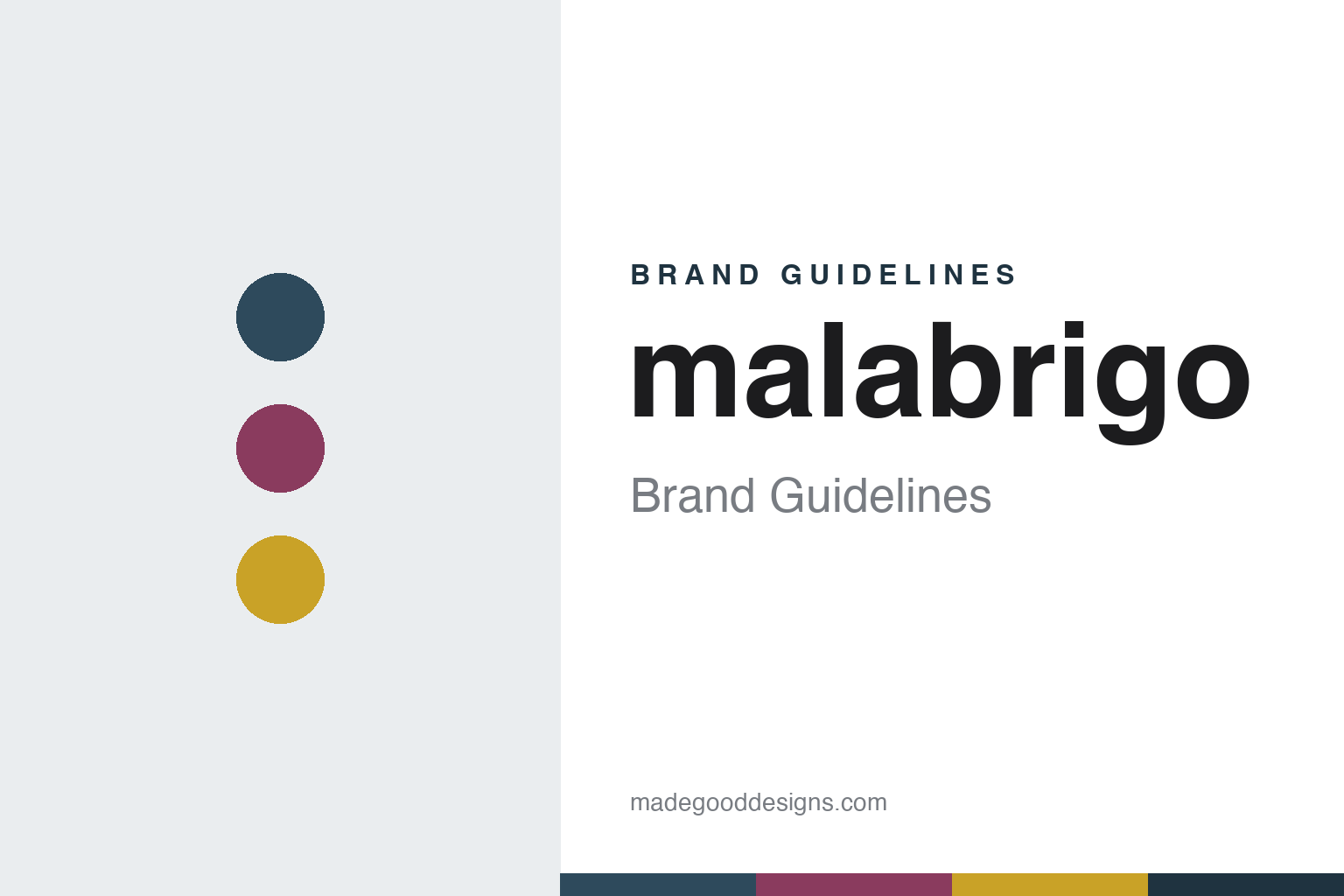
Two constants: a malabrigo slate, plum and gold palette and a Soft serif register. Abstract homage — not a malabrigo product or mark; no skein, label or logo is reproduced.
A kitchen pot
Two brothers-in-law and a pot of wool.
malabrigo — the company writes its name in lower case — began in Montevideo in 2005. Its own account is short: it “started small, when two brothers-in-law started dyeing wool in a kitchen pot.” They sold a few skeins to the United States, and, the company says, “before they knew it” the yarn was selling in Europe and beyond, so they moved to larger premises and took on staff.
The founders are named in the company’s 2026 pattern book, Timeless Knits by Malabrigo, published by Quadrille, an imprint of Penguin: the publisher gives them as Tobias Feder, Marcos Feder and Antonio Gonzalez-Arnao, and says the business began with hand-dyeing wool in a home kitchen. The company describes itself as family-owned, and Tobias Feder has been quoted as its owner or co-owner by The Washington Post in 2025 and by the American public-radio programme Marketplace in 2026.
The name is a joke with a map behind it. “Mal abrigo” roughly means “bad shelter,” and the company says it borrowed it partly from the small village of Mal Abrigo in Uruguay, so called because it was so windy that riders who had to stop there for the night found it a poor place to rest. It also cites three novelists who invented towns — Gabriel García Márquez’s Macondo, Juan Carlos Onetti’s Santa María and William Faulkner’s Yoknapatawpha County — and calls malabrigo “an imaginary and chilly place where the weather drives everyone inside to knit.” It even gives a pronunciation: “maul-ah-bree-go.”
Colour
From Montevideo to Peru.
For most of its history malabrigo was a Montevideo manufacturer. In November 2018 Craft Industry Alliance, the American trade publication, described a facility in the Parque Tecnológico Industrial del Cerro, an industrial park on the edge of the city, employing 20 to 25 people, “mostly Uruguayan women,” and exporting almost all of its yarn — to the United States, Europe, Australia and Japan. It called malabrigo “one of the few companies that has successfully executed hand-dyeing on a massive scale.”
That has changed. The company now says it has “moved all production to Peru, keeping the laboratory in Montevideo expressly for product development,” and that “the spinning, dyeing, classification and tagging process takes place in Peru.” Its wool, it says, still comes mostly from Uruguayan farms, and most of its yarns are 100% Uruguayan merino; its alpaca comes from Peru and its silk from Italian suppliers. The company also says that the practice of mulesing does not exist in Uruguay and that any merino of other origin it uses is mulesing-free; we give these as its own statements. Its website footer still reads Montevideo, Uruguay.
The move fits the company’s market. In September 2025 The Washington Post reported that about 70 percent of malabrigo’s yarn is sold in the United States, shipped from Peru to a distribution centre in Miami, and quoted Feder calling the new American tariff on that route “painful.” In March 2026 Marketplace reported that a red knitted hat pattern adopted as a protest symbol in Minnesota that January had drained the company’s red yarn: “We keep always a few months’ supply for each color, and in one week, we were out of red,” Feder said, adding that a hand-dyer needs about six weeks to answer such a surge.
Typography
Design and documentation.
The seven brands in this group all sell the same basic thing — yarn for knitting and crochet — and come from seven countries: Rowan from the UK, DROPS from Norway, Malabrigo from Uruguay, Lang Yarns from Switzerland, Schachenmayr from Germany, Lion Brand from the United States and Noro from Japan. A ball of wool looks simple, but the businesses behind these names are not alike.
Among yarn makers in general there are family firms still carrying a founder’s name, brands that sit inside larger corporate groups, dye houses that colour fibre by hand in small batches, and companies that sell as much through free patterns as through the yarn itself. Some spin their own fibre; others design and dye, and buy in the spinning. Some sell direct, and some reach most of the world through distributors, so the company that makes a yarn and the company whose name appears in a shop are not always the same.
This guide sets out what can be checked about each brand — who founded it, who owns it, and what it says about where its yarns are spun and dyed — and marks clearly what rests only on the company’s own word.
Aa
A soft serif — a lower-case name for a chilly imaginary town. (Specimen set in Fraunces, a serif STAND-IN; NOT the malabrigo logo.)
malabrigo
Colour that varies by design.
malabrigo’s product is colour. The company says it offers 21 yarn varieties in more than 400 colours, hand-dyed and named after landscapes, places, art and everyday life. Its bases include Worsted, Rios, Rasta and Sock; Craft Industry Alliance noted in 2018 that it had added a machine-washable line, Washted. Other bases blend its merino with silk, Peruvian baby alpaca, cashmere or Pima cotton, the company says.
Hand-dyeing is also the brand’s caveat. The company explains that it uses the same formula every time but that every batch gets its own dye-lot number, and that the differences between lots “can be very subtle, or extremely noticeable, specially on variegated yarns” — a variation it presents as a feature of a handmade process rather than a fault. On environmental matters it says it uses as few chemicals as possible in the Peruvian mill and plans the order of colours dyed each day to save water and energy; we give these as its claims.
In May 2023 the company became an owner of another brand: Craft Industry Alliance reported that malabrigo had bought Blue Sky Fibers, the Minnesota yarn maker founded by Linda and Chad Niemeyer some 26 years earlier, and that the two companies would operate separately, with Blue Sky’s team staying in Minnesota. “We are very excited to see our family growing,” Feder said. In 2026 the company published a pattern collection with Quadrille, putting its name on a mainstream craft book.
We found no published brand guidelines, colour codes or typeface. Its website sets the name in lower case and signs off from Montevideo.
For a design guide, malabrigo shows how a hand-dyer can make variation itself the brand. Compare Noro, the Japanese yarn known for its long colour changes, and Rowan, the English yarn brand. For this guide we use a slate blue, a plum and a gold with a serif, an unofficial interpretation; no product or logo is reproduced.
Explore & save
Keep malabrigo’s identity on hand — save it to a board in the Made Good inspiration library.
malabrigo identity set
Pin the malabrigo slate, plum and gold palette and the Soft serif register to your own board.