Godiva Brand Guidelines
The Brussels praline house that became a global gift brand.
Aa
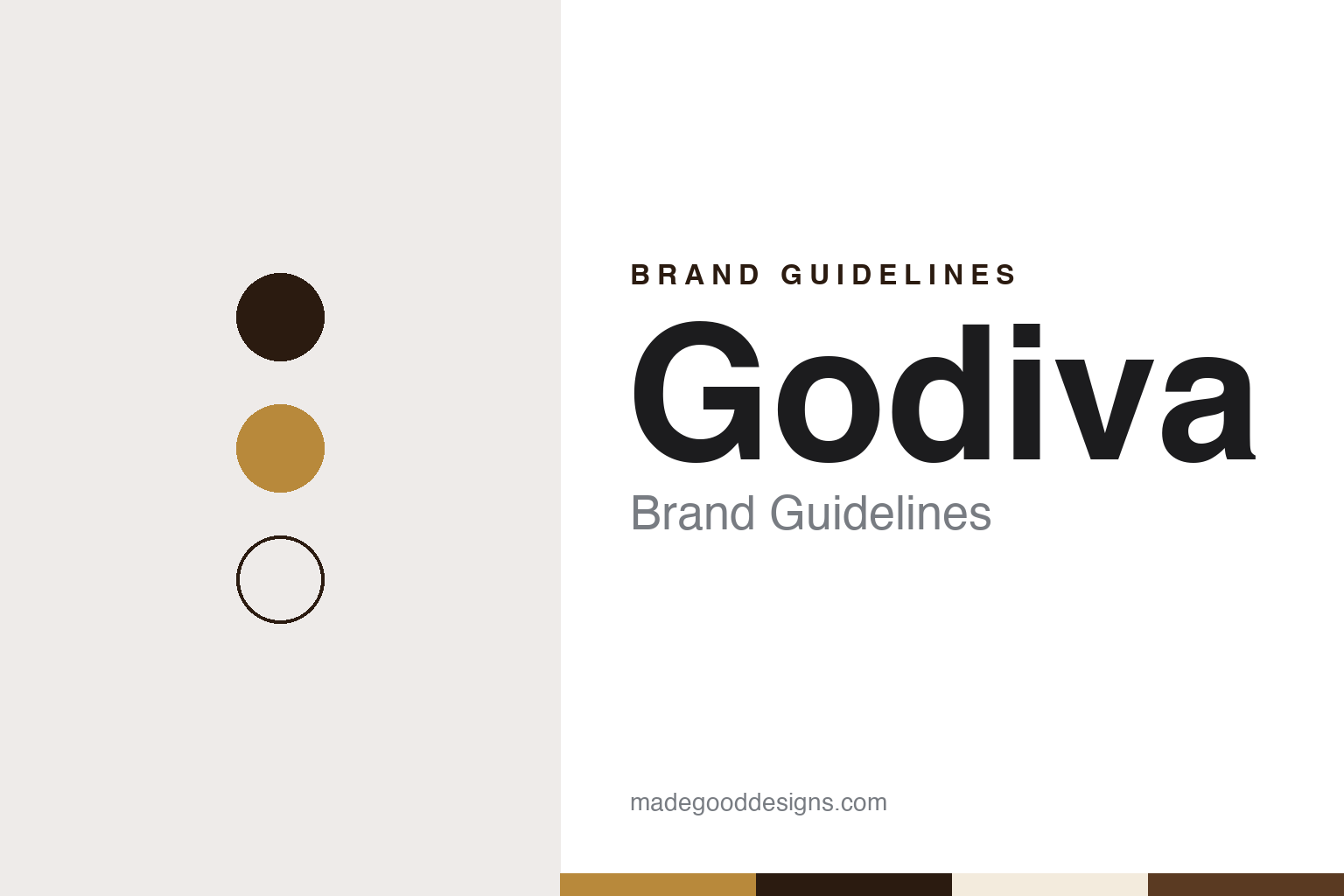
Two constants: a Godiva gold and dark brown palette and a Classical serif register. Abstract homage — not a Godiva product or mark; no box, logo or emblem is reproduced.
Pierre Draps
A home workshop in Brussels.
Godiva began in Brussels in 1926, when Pierre Draps Sr. started making pralines in his home workshop, the company says. English Wikipedia adds that he sold them to the Brussels department store Sarma among other retailers. His three sons, Joseph, François and Pierre Jr., worked in the business from an early age and took it over after their father’s death; Wikipedia places that shortly before the Second World War and the workshop on the ground floor of the family home in Molenbeek.
The name came after the war. The family was “deeply inspired by the legend of Lady Godiva and named the company in her honor,” the company says, dating the change to 1946; English Wikipedia gives 1945 and credits the idea to Joseph Draps’s wife, Gabrielle. The legend is English — the eleventh-century noblewoman of Coventry who rode through the town to have her husband lift a tax — so a Belgian chocolatier took an English heroine as its name and figurehead.
The first Godiva shop opened in Koekelberg, on the Boulevard Léopold II, followed within months by a second at the seaside resort of Knokke, according to Wikipedia. By 1958 there were twenty shops in Belgium and a first shop abroad, in Paris on the Rue Saint-Honoré, and the chocolates were shown at that year’s Brussels World Exhibition. In 1968, the company says, Godiva was named an official supplier to the Belgian royal court.
Colour
Campbell, then Yıldız.
Godiva’s ownership left Belgium early. In 1966 the American Campbell Soup Company took a one-third stake and began selling the chocolates in the United States, producing them for that market at a plant in Reading, Pennsylvania, according to English Wikipedia; it bought the Draps family out completely in 1974. By 1972 Godiva had boutiques in Paris, on New York’s Fifth Avenue and in the Nihonbashi Mitsukoshi department store in Tokyo, the company says.
Under Campbell the brand became a fixture of American malls and gift-giving. On 9 August 2007 Campbell announced it would explore “strategic alternatives, including possible divestiture” for Godiva, which then had annual sales of about $500 million; its chief executive, Douglas Conant, said the premium chocolate business “does not fit with Campbell’s strategic focus on simple meals.” On 20 December 2007 an agreement was signed with Istanbul’s Yıldız Holding, owner of the Turkish food maker Ülker, which announced a price of $850 million; English Wikipedia says the deal completed in March 2008.
In 2019 Yıldız split the business geographically. On 20 February it agreed to sell Godiva’s retail and distribution operations in Japan, South Korea and Australia, with future rights to New Zealand, to the South Korean private equity firm MBK Partners, together with “the GODIVA production facility in Brussels” that supplied those markets, according to the company’s release; the sale completed on 3 June 2019. Yıldız kept exclusive ownership of the brand worldwide, granting MBK a perpetual licence, and kept its European headquarters, Belgian shops and research centre in Brussels. The price was not disclosed; English Wikipedia, citing Nikkei Asia, puts it at roughly $1 billion or more.
Typography
Belgian chocolate as a category.
The seven brands in this group are all Belgian: Neuhaus, Leonidas, Godiva, Côte d’Or, Guylian, Galler and Wittamer. Together they show how wide the phrase “Belgian chocolate” has become, from a filled praline chosen piece by piece over a shop counter to a bar or a box sold in supermarkets and airport shops around the world.
The praline — in Belgium, a shell of chocolate around a filling such as ganache, nut paste or cream — is the country’s signature, and the ballotin, the small card box it is packed into, is part of the same ritual. At one end of the trade are names that grew into large groups, with factories, franchise shops and global distribution, and whose identity has to work on a shelf as well as in a window. At the other are pâtissier-chocolatiers on squares such as the Grand Sablon in Brussels, where the name rests on one address, a workshop nearby and a long local history.
Each guide separates what independent sources record from what the company says about itself — who founded it, who owns it now and where its chocolate is made — and marks plainly what rests only on the company’s own word.
Aa
A classical serif — the register of the gold gift box. (Specimen set in Cormorant Garamond, a serif STAND-IN; NOT the Godiva logo.)
Godiva
One name, two operators.
Since 2019 Godiva has been, in effect, two companies sharing one name. The Yıldız side planned a large café expansion in 2019, then in January 2021 said it would close all 128 of its shops in North America by the end of March, citing the pandemic’s effect on in-person shopping, while keeping online, grocery and wholesale sales, English Wikipedia reports, citing NBC News and CNN. In April 2024, Food Processing reported, Godiva was folded into pladis, the London-based snacks company Yıldız created in 2016 as the home of United Biscuits and Ülker, with Steve Lesnard, formerly of Nike and Sephora, appointed to lead the brand from 1 May. Wikipedia names the United States and China as its largest markets. MBK’s side runs Godiva in Japan, Korea and Australia, where Wikipedia counts more than 300 shops in Japan alone in March 2025, including cafés and bakeries.
Where the chocolate is made is a sensitive point for a brand that sells Belgium. The company says it honours its “Belgian roots” and that its “Belgium 1926” logo pays “homage to the time and place where our story first began.” English Wikipedia lists factories in Brussels, Reading and Turkey, and says chocolate sold in the United States has been made in Reading since the 1960s and that most of it now comes from Turkey. A US class action filed in 2019 alleged that Godiva’s marketing implied its chocolate was made in Belgium; in 2022 a federal court approved a settlement under which Godiva agreed to pay up to $15 million to claimants, Wikipedia reports, citing the legal press. Wikipedia also reports that in 2017 Yıldız stopped using alcohol in the liqueur-based praline fillings, which enabled halal certification.
The visual constant through all this has been the gift box and the name itself. The company says Godiva is sold in more than 100 countries, and in our reading its gift packaging leans on gold, deep brown and a formal wordmark with the Belgian date beneath — a register meant to read as old-world luxury whoever owns the business.
For a design guide, Godiva shows how a heritage date on a logo can carry a brand long after its ownership and production have moved. Compare Neuhaus, another Brussels praline house, and Pierre Marcolini, a younger Brussels chocolatier. For this guide we use gold, deep brown and cream with a serif, an unofficial interpretation; no product or logo is reproduced.
Explore & save
Keep Godiva’s identity on hand — save it to a board in the Made Good inspiration library.
Godiva identity set
Pin the Godiva gold and dark brown palette and the Classical serif register to your own board.