Côte d’Or Brand Guidelines
The elephant bar Belgium bought for a century.
Aa
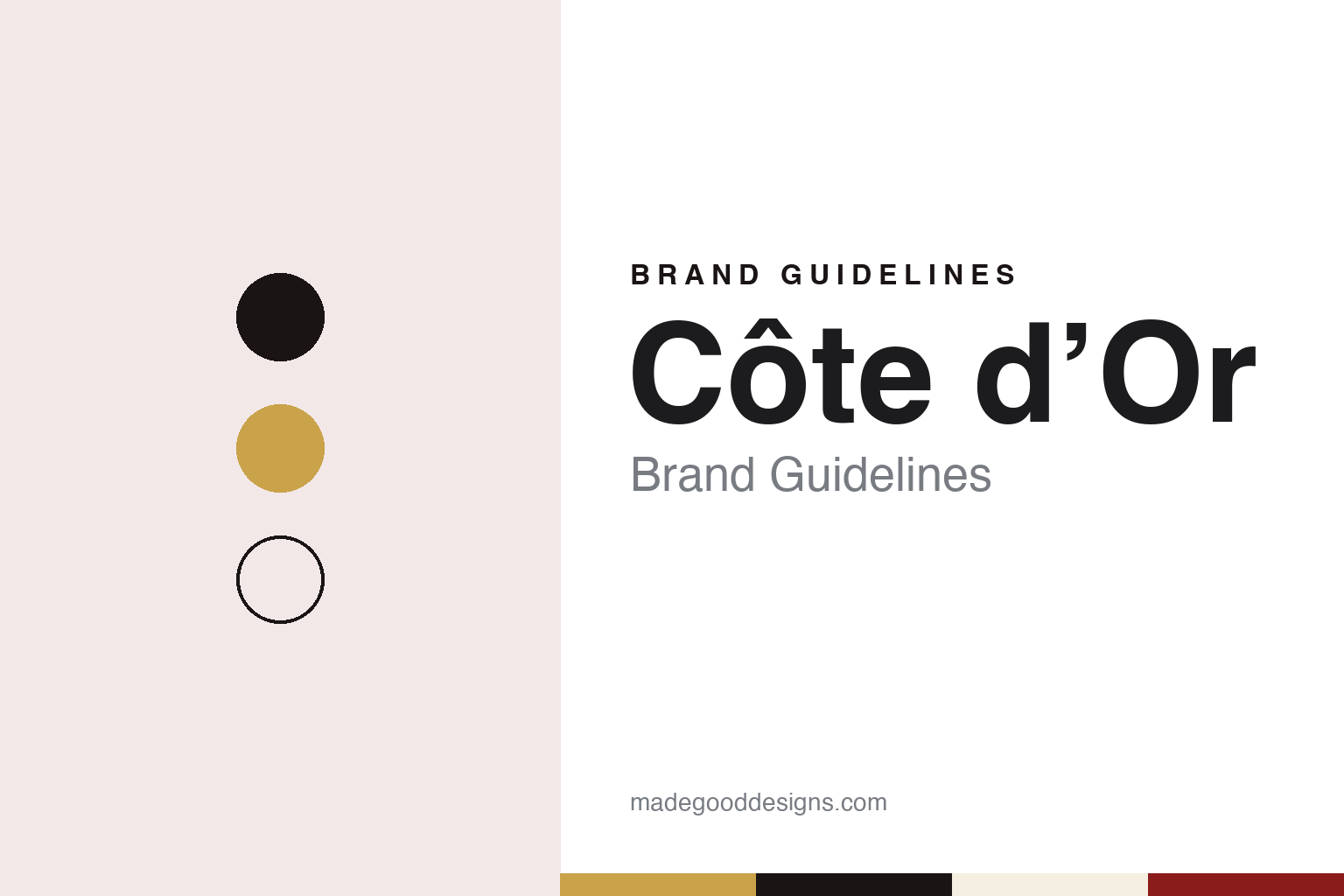
Two constants: a Côte d’Or gold, black and red palette and a Didone serif register. Abstract homage — not a Côte d’Or product or mark; no wrapper, elephant or logo is reproduced.
The Gold Coast
A Brussels chocolatier names his bar after Africa.
Côte d’Or dates itself to 1883, when the brand was created and registered, the company says. The name means “Gold Coast,” the colonial name of what is now Ghana, where, in the company’s words, part of the cocoa beans were selected. English Wikipedia names the founder as Charles Neuhaus, a chocolate maker in Schaerbeek, Brussels; Dutch Wikipedia says he conceived the brand in 1870 and registered it in 1883, so we give 1883 as the documented date.
The business soon changed hands. In 1889 Neuhaus retired and sold it to Joseph Bieswal and his wife Maria Leclef, English Wikipedia says; their company merged with the chocolate maker Michiels and from 1899 worked in the buildings of a former mill on the Rue Bara in Anderlecht, opposite the Brussels-Midi station, where production stayed until the 1980s. In 1906 the partners formed S.A. Alimenta.
The same year produced the mark the brand still uses. The company says the 1906 logo showed an elephant, a palm tree and three pyramids; English Wikipedia says Lambert Michiels borrowed it from a Gold Coast postage stamp, and that today’s logo keeps only the elephant. Dutch Wikipedia reads the elephant as standing for the strength of the brand. In 1911 came the “paquet,” two tablets in a white-and-gold wrapper, which the company still lists among its milestones.
Colour
Toffees, fairs and a war-time pause.
Between the wars Côte d’Or grew into a national brand. The company lists the Supertoff caramel in 1929, a US trademark registration in 1931, the Chokotoff chocolate-coated toffee in 1934, and international attention at the 1935 Brussels World Exhibition; English Wikipedia says the Mignonnette, a small tablet, was created for that fair, and that the Anderlecht works employed 350 people by 1930.
The Second World War interrupted it. From 1940 to 1946, with the occupation cutting off the cocoa it needed, the company withdrew the Côte d’Or name and sold chocolate as Congobar instead — the brand, it says, wanted its name used only for chocolate of irreproachable quality. After the war came the Pastador spread in 1952, the Dessert 58 bar for the 1958 World Exhibition, and in 1965 the title of supplier to the Belgian royal court. Sales offices opened in France and the Netherlands in 1972 and in Switzerland and Britain in 1978, the company says.
In 1984 the company was listed on the Brussels stock exchange, though the Bieswal, Leclef and Michiels families kept a majority, according to English Wikipedia. Three years later it became the target of rival bids from Nestlé and Jacobs Suchard, a hostile contest that Wikipedia says shook a Brussels market unused to such takeovers. The families accepted Jacobs Suchard, which valued the company at 4.7 billion Belgian francs, bought 66 per cent in 1987 and the remainder in February 1989, when the shares were delisted.
Typography
Belgian chocolate as a category.
The seven brands in this group are all Belgian: Neuhaus, Leonidas, Godiva, Côte d’Or, Guylian, Galler and Wittamer. Together they show how wide the phrase “Belgian chocolate” has become, from a filled praline chosen piece by piece over a shop counter to a bar or a box sold in supermarkets and airport shops around the world.
The praline — in Belgium, a shell of chocolate around a filling such as ganache, nut paste or cream — is the country’s signature, and the ballotin, the small card box it is packed into, is part of the same ritual. At one end of the trade are names that grew into large groups, with factories, franchise shops and global distribution, and whose identity has to work on a shelf as well as in a window. At the other are pâtissier-chocolatiers on squares such as the Grand Sablon in Brussels, where the name rests on one address, a workshop nearby and a long local history.
Each guide separates what independent sources record from what the company says about itself — who founded it, who owns it now and where its chocolate is made — and marks plainly what rests only on the company’s own word.
Aa
A Didone serif — the register of a classic gold wrapper. (Specimen set in Bodoni Moda, a serif STAND-IN; NOT the Côte d’Or logo.)
Côte d’Or
From Jacobs Suchard to Mondelēz.
Côte d’Or’s ownership has since followed the consolidation of the global food industry. In 1990 Jacobs Suchard was bought by the tobacco group Philip Morris, which placed it with its Kraft General Foods business as Kraft Jacobs Suchard; the group took the name Kraft Foods in 2000, and when Kraft split in 2012 its confectionery brands went to Mondelēz International, the Chicago-based owner of Milka and Cadbury, according to English Wikipedia. The brand’s Belgian website now carries the line “Côte d’Or est une marque de Mondelez International.” Wikipedia says the new owner cut 264 jobs in its first restructuring but also invested heavily and set out to make Côte d’Or a global brand of the group.
The main Belgian works is at Halle, south-west of Brussels. The company says it opened a “Temple du Chocolat” at its Halle factory in 1996 — an interactive museum for primary-school children, Dutch Wikipedia says — and English Wikipedia says the plant has turned out around two million Chokotoffs a day; the same article says the Mignonnettes once made there are now produced in Poland. We could not confirm in the sources checked when production moved from Anderlecht to Halle, or which other products are made outside Belgium.
On cocoa, the brand’s website points to Cocoa Life, Mondelēz’s sourcing programme, and features a farmer from a Cocoa Life community in Ghana — a link back to the coast in its name. In 2009, Wikipedia reports, Kraft launched Côte d’Or dark chocolate as the first mainstream chocolate in Europe to carry the Rainforest Alliance seal.
Visually the brand has changed little for a century: the gold-and-white wrapper of 1911, the elephant of 1906 reduced to a single animal, and a name that is itself a piece of colonial-era geography.
For a design guide, Côte d’Or shows how one animal and one wrapper colour can hold a mass-market bar together through four owners. Compare Galler, another Belgian tablet brand, and Tony’s Chocolonely, a supermarket bar built on a very different wrapper. For this guide we use gold, black and a deep red with a serif, an unofficial interpretation; no product or logo is reproduced.
Explore & save
Keep Côte d’Or’s identity on hand — save it to a board in the Made Good inspiration library.
Côte d’Or identity set
Pin the Côte d’Or gold, black and red palette and the Didone serif register to your own board.