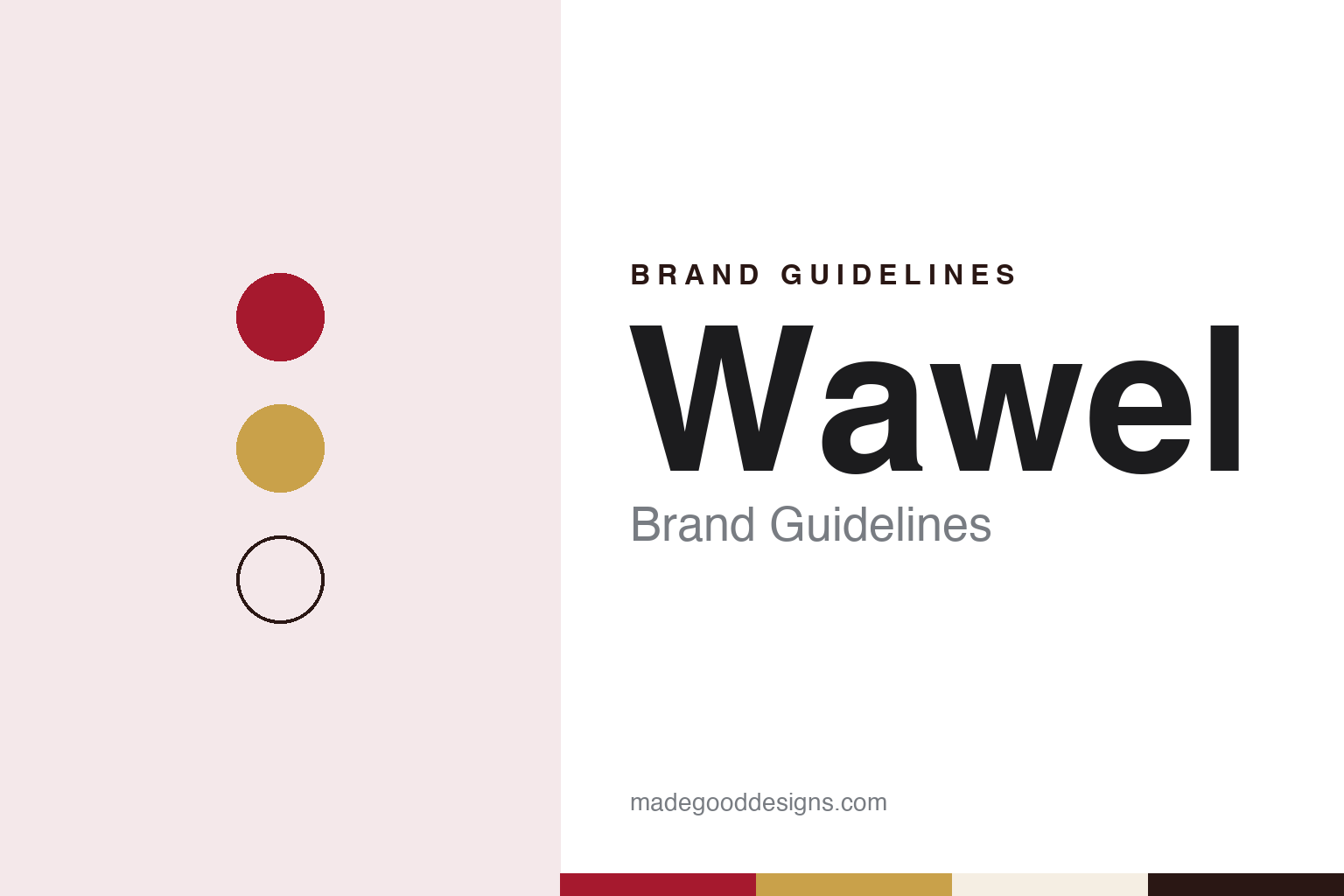
Wawel Brand Guidelines
A Kraków chocolate house that outlived its century.
Aa
Two constants: a Wawel crimson, gilt and cream palette and a classic serif register. Abstract homage — not a Wawel product or mark; no wrapper or logo is reproduced.
Piasecki’s Kraków
A confectioner’s shop, a “King of Chocolate” and a state merger.
Wawel dates its story to 1898, when, the company says, the young confectioner Adam Piasecki — who had passed his journeyman’s exam at about twenty — bought his first workshop and shop at Długa Street 20 in Kraków, then part of Austria-Hungary. Business grew quickly. Early in 1910 he bought a property on Szlak Street and converted it into a factory, which opened that November making 600 to 700 kilograms of sweets a day. By 1914, the company says, Piasecki — by then nicknamed the “King of Chocolate” — employed a Swiss master confectioner and 22 workers, and turned out 1,500 kilograms a day “in elegant company packaging.” A 2012 profile on the Polish promotion site Link to Poland adds that he opened a shop in a tenement on Kraków’s Main Market Square in 1910.
Piasecki’s best-remembered creation is Danusia, a chocolate with a grillage, or nut-brittle, filling. The company’s timeline places it under 1918 but says it was devised “at the height of success, in the twenties” and named after one of his employees; Link to Poland also dates it to the early 1920s. Polish Wikipedia says the firm became a joint-stock company in 1923 and moved to Wrocławska Street.
The Wawel name — that of Kraków’s royal castle hill — arrived with nationalisation. In January 1951 the state formed Zakłady Przemysłu Cukierniczego “Wawel,” the Wawel Confectionery Works, by merging three pre-war Kraków businesses: Piasecki’s factory, the Pischinger chocolate works and the Polish plant of the Swiss firm Suchard, Polish Wikipedia and Link to Poland say. The company says the first new product of the merged works was Malaga, a chocolate with a raisin cream filling first shaped by hand; Link to Poland dates Malaga to the late 1960s, so the sources differ. At launch, the company says, the range ran to 36 kinds of caramels, 24 of chocolate confectionery, 12 of solid chocolate and 8 of baked goods.
Colour
Three city factories, then one in Dobczyce.
For the next half-century Wawel’s sweets came from three factories inside Kraków, each with its own speciality, the company says: Wrocławska Street for filled chocolates, chocolate sweets and bars; Masarska Street for solid chocolate, caramels and cocoa; and Kącik Street for wafers and Michałki. Two more classics were made by machine rather than by hand: Kasztanki, a cocoa filling with wafer pieces in a shell-shaped chocolate, and Tiki Taki, with layers of nougat and coconut filling — both dated to the 1970s by Link to Poland.
In 2006, after more than a hundred years inside the city, production moved to a single new factory at Dobczyce, a town south of Kraków, built on nearly six hectares in an industrial zone; the head office stayed in Kraków. The company says the Dobczyce plant has been extended in five stages and makes nearly 45,000 tonnes of sweets a year, and that a second plant, begun in 2015 in a special economic zone and linked to the first by a technical bridge, was finished in 2017 with renewable sources for its hot water. It adds that one room has been kept apart: a caramel kitchen where machines moved from the old Kraków plants still make caramels by a method from a century ago. Its English website says that “all our products are made in an ultramodern factory” near Kraków.
The company says about 1,000 people worked at Wawel SA in 2022, and since June 2008 it has run a charitable foundation, “Wawel z Rodziną” (Wawel with the Family). Polish Wikipedia says its products are sold in 54 countries. The Wawel pages we checked do not say where its cocoa comes from, and we found no published credit for the designers of its wrappers or its logo.
Typography
Design and documentation.
The seven brands in this group all make chocolate, and they come from six countries across the Nordic region and Central Europe: Anthon Berg from Denmark, Marabou from Sweden, Fazer from Finland, Freia from Norway, Kalev from Estonia, and Wawel and E. Wedel from Poland. Most are the kind of name a shopper in their home country grows up with: the everyday milk-chocolate bar, the boxed assortment brought out for guests, the sweet that friends abroad ask to have sent home.
Many of these national brands no longer belong to the families or towns that started them. Over the past century, and especially since the 1990s, chocolate makers across Northern and Central Europe have been bought, merged and sold again, and several of the names in this group now sit inside multinational food companies or regional confectionery groups, while others have stayed closer to home. A brand can outlive several owners while keeping its wrapper, its lettering and its place on the shelf, and that continuity is often the most valuable thing a buyer acquires.
Each guide separates what independent sources record from what the company says about itself — who founded it, who owns it now, where its beans come from and where its chocolate is made — and marks plainly what rests only on the company’s own word.
Aa
A classic serif with a pre-war confectioner’s poise. (Specimen set in Cormorant Garamond, a serif STAND-IN; NOT the Wawel logo.)
Wawel
Listed in Warsaw, controlled from Germany.
Wawel’s modern ownership runs through the stock market. The company says the decision to privatise came in 1992, when the state works became a joint-stock company, Zakłady Przemysłu Cukierniczego Wawel SA. The securities commission admitted its shares to public trading in 1997, and they made their debut on the main market of the Warsaw Stock Exchange on 11 March 1998. In 2005 the company shortened its name to Wawel SA. English Wikipedia lists it in the sWIG80 index of smaller listed companies.
Control lies in Germany. Polish Wikipedia, citing Wawel’s own shareholder page as archived in 2016, says the largest shareholder is Hosta International AG of Stimpfach-Randenweiler, in Baden-Württemberg, with 52.13% of the share capital, and lists Polish pension funds among the other holders. Hosta’s own website lists confectionery brands including Nippon, Mr. Tom and Romy. English Wikipedia gives the stake as 52.12% and dates it to 2007; we have not confirmed that year, and the most recent shareholder figure we found dates from 2016, so the current holding should be checked on Wawel’s investor pages. Both Wikipedias name Dariusz Orłowski as chief executive.
That leaves Wawel with an unusual profile among central European chocolate brands: a recipe heritage rooted in one family firm and two foreign-founded works, a name taken from the city’s castle, a public listing at home and a German majority owner — with all of its production, the company says, still in the Kraków region.
For a design guide, Wawel shows how a city name and a handful of long-lived recipes — Danusia, Malaga, Kasztanki — can hold a brand together through private ownership, nationalisation, privatisation and a move out of town. Compare E. Wedel, the Warsaw chocolate house, and Zotter, an Austrian maker with a very different model. For this guide we use crimson, gilt and cream with a serif, an unofficial interpretation; no product or logo is reproduced.
Explore & save
Keep Wawel’s identity on hand — save it to a board in the Made Good inspiration library.
Wawel identity set
Pin the Wawel crimson, gilt and cream palette and the classic serif register to your own board.