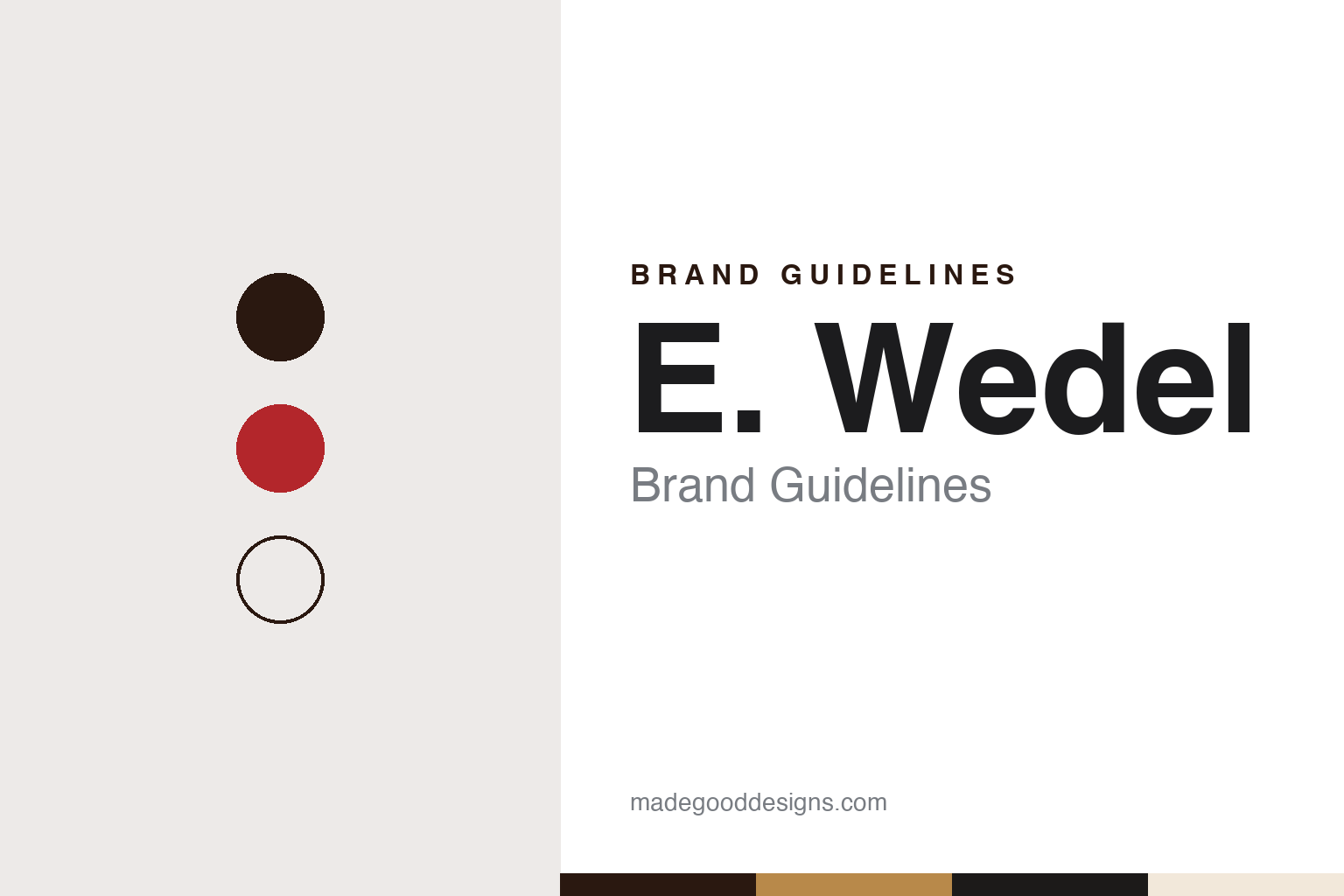
E. Wedel Brand Guidelines
Warsaw’s chocolate signature since 1851.
Aa
Two constants: an E. Wedel cocoa, gold and zebra-stripe palette and a signature serif register. Abstract homage — not an E. Wedel product or mark; no bar, wrapper, logo, poster or photograph is reproduced.
Three generations of Wedels
A Warsaw confectioner’s shop becomes a chocolate factory.
E. Wedel is one of Poland’s best-known chocolate names, and the company says its history begins in 1851. Its founder was Karol Wedel, born Karl Ernst Heinrich Wedel in Mecklenburg, in today’s Germany: a confectioner who, Polish Wikipedia says, trained in London, Paris and Berlin before arriving in Warsaw in 1845 to work with the confectioner Karol Grohnert. In 1851 he opened his own confectioner’s shop and workshop on Miodowa Street, where, the company says, he and his wife Karolina served drinking chocolate alongside cough caramels and peppermint pastilles. Polish Wikipedia notes that an 1877 advertisement gave 1850 as the founding year, but that Wedel’s first press notices date from 1851, the year later owners have used. It says chocolate was made in quantity only from 1854, after a steam-driven roller machine arrived from Paris.
The business passed to his son, Emil Wedel, who had trained abroad. Polish Wikipedia says Karol gave him the factory as a wedding present in 1872 and that the handover was complete by 1878; the company’s own timeline has Emil in control from 1865. We give both. Under Emil the firm moved to Szpitalna Street, where a factory opened in 1879 and, in 1894, a factory shop with a chocolate drinking room, the “old-fashioned shop” (Staroświecki Sklep), which still trades at the same address.
The third generation, Jan Wedel, ran the company from 1923. Polish Wikipedia says he held a doctorate in chemistry, and that between 1927 and 1931 he had a new factory built on Zamoyskiego Street in Warsaw’s Kamionek district, east of the Vistula, designed by the engineer Napoleon Czerwiński and fitted with machines from Britain and Belgium; production moved there from Szpitalna Street during the 1930s. The same article counts 30 Wedel shops in Poland in 1933, a shop in Paris, and about 1,300 employees in 1938. In 1936, the company says, Jan Wedel introduced Ptasie Mleczko (“bird’s milk”), soft milk-foam squares covered in chocolate, inspired by a journey to France.
Colour
Nationalised, privatised, then sold on.
War and the postwar state interrupted the family story. Polish Wikipedia says the Zamoyskiego Street factory kept working under the German occupation, was partly blown up by retreating German forces in September 1944, and was put back to work by returning employees. In 1949 the company was nationalised, and in 1951 it was renamed after 22 July, the date of the communist July Manifesto. Yet the old name never left the wrapper: throughout the communist period, Polish Wikipedia says, packs carried the distinctive E.Wedel lettering, marked as the factory’s former name. Jan Wedel died in 1960.
The ownership chain since 1989 is well documented. After the fall of communism the Wedel name was restored and the business privatised; in 1991 PepsiCo took control, and the shares were listed on the Warsaw Stock Exchange in November that year. Polish Wikipedia says PepsiCo took the company off the exchange in 1997 and split it into separate businesses. The chocolate business, the Warsaw factory and the E. Wedel brand went to Cadbury for US$76.5 million, a sale reported by Candy Industry in October 1998 and by Eurofood in February 1999, and traded as Cadbury Wedel. English Wikipedia says the Warsaw factory was modernised in 2007, including a new production line for Ptasie Mleczko.
In 2010 Kraft Foods bought Cadbury, and the European Commission made its approval conditional on the sale of the Wedel business in Poland. On 28 June 2010 Kraft announced an agreement to sell Cadbury’s E. Wedel-branded chocolate and sugar confectionery operations, related brands and a manufacturing facility in Warsaw to the Lotte Group for an undisclosed sum, with about 1,000 employees transferring; the release described Lotte as based in Tokyo and founded in 1948 as a chewing-gum company. English Wikipedia calls it Lotte’s first investment in Europe. The company took the name Lotte Wedel in September 2011, and Polish Wikipedia names Lotte Co., Ltd as its shareholder.
The chocolate is still made in Warsaw, at the Kamionek factory that also houses the head office. In September 2024 Lotte Wedel opened the Muzeum Fabryka Czekolady E.Wedel there, in a rebuilt 1960s building that once held cocoa-bean silos and now contains both exhibitions and production lines. The company says its chocolate is made with cocoa beans from Ghana and milk mostly from Polish producers, and lists Rainforest Alliance among its certifications; it also says its round wafer cake, Torcik Wedlowski, is still decorated by hand.
Typography
National milk-chocolate brands.
The seven brands in this group all make chocolate, and they come from six countries across the Nordic region and Central Europe: Anthon Berg from Denmark, Marabou from Sweden, Fazer from Finland, Freia from Norway, Kalev from Estonia, and Wawel and E. Wedel from Poland. Most are the kind of name a shopper in their home country grows up with: the everyday milk-chocolate bar, the boxed assortment brought out for guests, the sweet that friends abroad ask to have sent home.
Many of these national brands no longer belong to the families or towns that started them. Over the past century, and especially since the 1990s, chocolate makers across Northern and Central Europe have been bought, merged and sold again, and several of the names in this group now sit inside multinational food companies or regional confectionery groups, while others have stayed closer to home. A brand can outlive several owners while keeping its wrapper, its lettering and its place on the shelf, and that continuity is often the most valuable thing a buyer acquires.
Each guide separates what independent sources record from what the company says about itself — who founded it, who owns it now, where its beans come from and where its chocolate is made — and marks plainly what rests only on the company’s own word.
Aa
A signature serif — a founder’s autograph, a poster boy and a striped zebra. (Specimen set in Playfair Display, a serif STAND-IN; NOT the E. Wedel logo or signature.)
E. Wedel
A signature and a boy on a zebra.
The E. Wedel mark is a signature. Polish Wikipedia says the trademark was made from a facsimile of the owner’s signature to protect the products from counterfeiters; the company tells the story more personally, saying Emil Wedel put his handwritten signature on bars to drive fakes off the market, and that the signature, in a slightly modified form, still identifies the brand today.
The second emblem is a picture. In 1926 Jan Wedel commissioned the Paris-based Italian poster artist Leonetto Cappiello to create a symbol for the firm, and Cappiello drew a boy riding a zebra with bars of chocolate strapped to his back. The company calls it its trademark and one of the most popular advertising images made in Poland; Polish Wikipedia says it advertised Wedel’s first shop in Paris and appeared on the RWD-13 aircraft the firm used for advertising and deliveries in the late 1930s. A neon of the boy on the zebra stands on the roof of the Szpitalna Street building, above the oldest of the company’s chocolate lounges, and was restored in 2018.
Packaging has long carried the brand. Polish Wikipedia describes interwar wrappers that came with collectible pictures of film actors, aircraft, cars and ships, series on Polish rulers and the army, and designs reproducing Zofia Stryjeńska’s images of Polish dances, folk embroidery and views of Warsaw; it says many entries from Wedel’s poster competitions are now in the Poster Museum at Wilanów. The name Ptasie Mleczko has its own history. Polish Wikipedia says the 1936 trademark lapsed in 1956 and other confectioners went on to make similar sweets; an EU trademark for the name followed in 2005, on a Cadbury Wedel application, and a Polish word mark in 2014, after an application process that began in 2006. English Wikipedia notes that Estonia’s Kalev sells a comparable sweet under the name Linnupiim.
For a design guide, E. Wedel shows how a mass-market brand can carry two heritage assets, a founder’s signature and a 1926 poster character, through nationalisation, a run of foreign owners and a change of company name. Compare Wawel, another Polish chocolate maker, and Kalev from Estonia. For this guide we use cocoa brown, signature gold, zebra black and Cappiello red on milk cream with a serif, an unofficial interpretation; no product or logo is reproduced.
Explore & save
Keep E. Wedel’s identity on hand — save it to a board in the Made Good inspiration library.
E. Wedel identity set
Pin the E. Wedel cocoa, gold and zebra-stripe palette and the signature serif register to your own board.