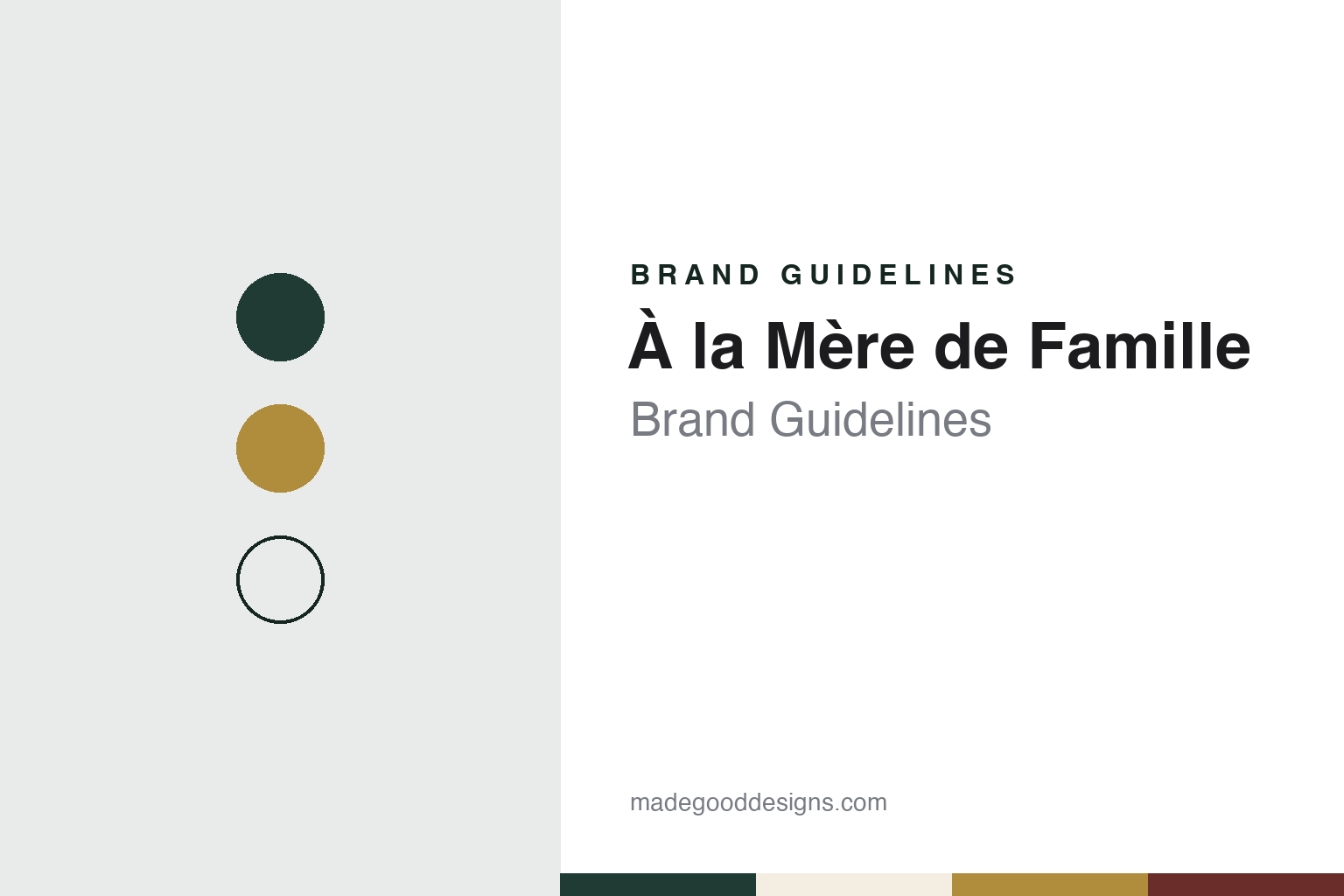
À la Mère de Famille Brand Guidelines
The Paris sweet shop that has kept one address since 1761.
Aa
Two constants: an À la Mère de Famille green, gold and cream palette and an old-style serif register. Abstract homage — not an À la Mère de Famille product or mark; no shopfront, box or logo is reproduced.
No. 35
One address, many families.
À la Mère de Famille is a shop before it is a brand. The company dates it to 1761, when, it says, a young grocer from Coulommiers opened on the rue du Faubourg-Montmartre in Paris, and it calls the shop at no. 35 the oldest chocolate maker in the city, one that has never changed its address or its trade. Those are the company’s own claims. The independent record is the building: French Wikipedia’s list of historic monuments in Paris’s 9th arrondissement records the “épicerie fine À la mère de famille” at 35 rue du Faubourg-Montmartre as inscribed as a historic monument in 1984.
The name, the company says, came from Marie-Adélaïde Bridault, who took over the business on her husband’s death in 1807 and ran it with four children — the “mother of a family” of the sign. It traces a chain of owners after her: the Bridault, Lecœur, Dreux and Legrand families; Suzanne and Albert Brethonneau, who took over after the Second World War; and the chocolatier Serge Neveu. Over that time, it says, the grocery turned gradually to chocolate and sweets, and the interior has stayed as it was since the end of the 19th century.
The company’s own history is told as a run of inheritances rather than sales. It says Georges Lecœur handed the shop to his apprentice Régis Dreux, who came back from the trenches of the First World War to run it; that after Dreux’s death in 1931 it passed to his daughter and her husband, the Legrands, who had no children and took in an orphaned young cousin, Suzanne; and that Suzanne, who married Albert Brethonneau, an apprentice who had arrived in 1946, stayed at the shop until 1985. The Brethonneaus then chose Serge Neveu as their successor, the company says, and he added his own chocolates to the old lines in the windows. It also says the shop was painted by the artist André Renoux.
Colour
Pralinés, squirrel’s follies and sweets from the regions.
The Dolfi family bought the shop in 2000. That date comes from the company, and also from La Dépêche du Midi, which reported in October 2017 that Jonathan Dolfi, his siblings and their father had bought “la Mère de Famille,” the oldest chocolaterie in Paris, in 2000. The company names the father, Étienne Dolfi, as head of the family, with his children Sophie, Steve, Jane and Jonathan; Steve and Jane are described on its website as co-owners.
The shop sells far more than chocolate bars. The company lists more than a hundred house recipes, among them praliné rochers, the nut clusters it calls Folies de l’Écureuil (“squirrel’s follies”), Florentins, Palets Montmartre, a spread, guimauves, fruit jellies and ice cream, and it says it makes almost all its own sweets, while calissons, candied chestnuts and jams are made for it by other artisans, and some traditional regional sweets are bought from their historic makers.
The family has also collected other old sweet shops. The company says that in 2000 it also took over the chocolaterie Buissière in Limoges and its Paladin, a dark ganache with roasted hazelnuts. It names, among others, Les Palets d’Or in Moulins, Au Négus in Nevers, La Chocolatière in Tours, Henriet on the Basque coast and Pillon in Toulouse, which it says keep their own names. La Dépêche du Midi reported in 2017 that Jonathan Dolfi had bought Pillon, founded in 1967. The best-known addition is Stohrer, the Paris pâtisserie that dates itself to 1730: English Wikipedia, citing La Dépêche, says the Dolfi family acquired it in 2017, and the company says ten of its seventeen Paris shops now sell both houses’ products.
Typography
Design and documentation.
The seven brands in this group all sell chocolate, and they come from three countries: Cémoi, Jeff de Bruges, Monbana and À la Mère de Famille from France, Summerbird and Peter Beier from Denmark, and Puccini Bomboni from the Netherlands. They sit at different points in the chocolate trade, from names found on supermarket shelves and in shopping-centre chains to single shops known mainly to the people who walk past their windows.
Some of these businesses are manufacturers, buying cocoa or chocolate in bulk and turning it into bars, drinks and seasonal shapes sold far from where they are made. Others are chocolatiers, who buy finished chocolate from a supplier and use it to make bonbons, truffles and filled pieces by hand, and whose identity rests on a shop, a recipe and a family name as much as on any wrapper. Many sit somewhere between the two, running workshops and shops at once.
Each guide separates what independent sources record from what the company says about itself — who founded it, who owns it now, where its cocoa comes from and where its chocolate is made — and marks plainly what rests only on the company’s own word.
Aa
An old-style serif for a shop that dates itself to 1761. (Specimen set in Cormorant Garamond, a serif STAND-IN; NOT the À la Mère de Famille logo.)
À la Mère de Famille
A fabrique near Tours.
The company says its chocolates are made not in Paris but at its own fabrique at Chambray-lès-Tours, near Tours, with three further workshops for pastry and confectionery, and the website’s legal notice names the publisher as J C Ménard Chocolaterie, a company based at Chambray-lès-Tours and represented by Étienne Dolfi. It says it turns cocoa beans into its own couvertures there, makes its pralinés from French hazelnuts and Sicilian almonds and pistachios ground in an old mill, and still does some work by hand, such as filling Easter moulds. All of that is the company’s own description.
It also describes its cocoa as bought directly from cooperatives, naming Haiti, Madagascar, São Tomé, Ecuador and Peru among its origins, and lists visits to plantations in São Tomé in 2017, Madagascar in 2018, Peru in 2019, Ecuador in 2022 and India in 2023. We have not found an independent account of those supply arrangements. The house has also been the subject of a recipe book by Julien Merceron, published in English by Chronicle Books in 2014.
For a design guide, À la Mère de Famille shows how a single listed shopfront can carry a brand across a chain of shops and a family of regional names. Compare Debauve & Gallais, another old Paris chocolate house, and La Maison du Chocolat, a Paris chocolatier now owned by a large group. For this guide we use bottle green, old gold and cream with a serif, an unofficial interpretation; no product or logo is reproduced.
Explore & save
Keep À la Mère de Famille’s identity on hand — save it to a board in the Made Good inspiration library.
À la Mère de Famille identity set
Pin the À la Mère de Famille green, gold and cream palette and the old-style serif register to your own board.