Yorkshire Tea Brand Guidelines
The 1977 Harrogate blend that became Britain’s best-seller.
Aa
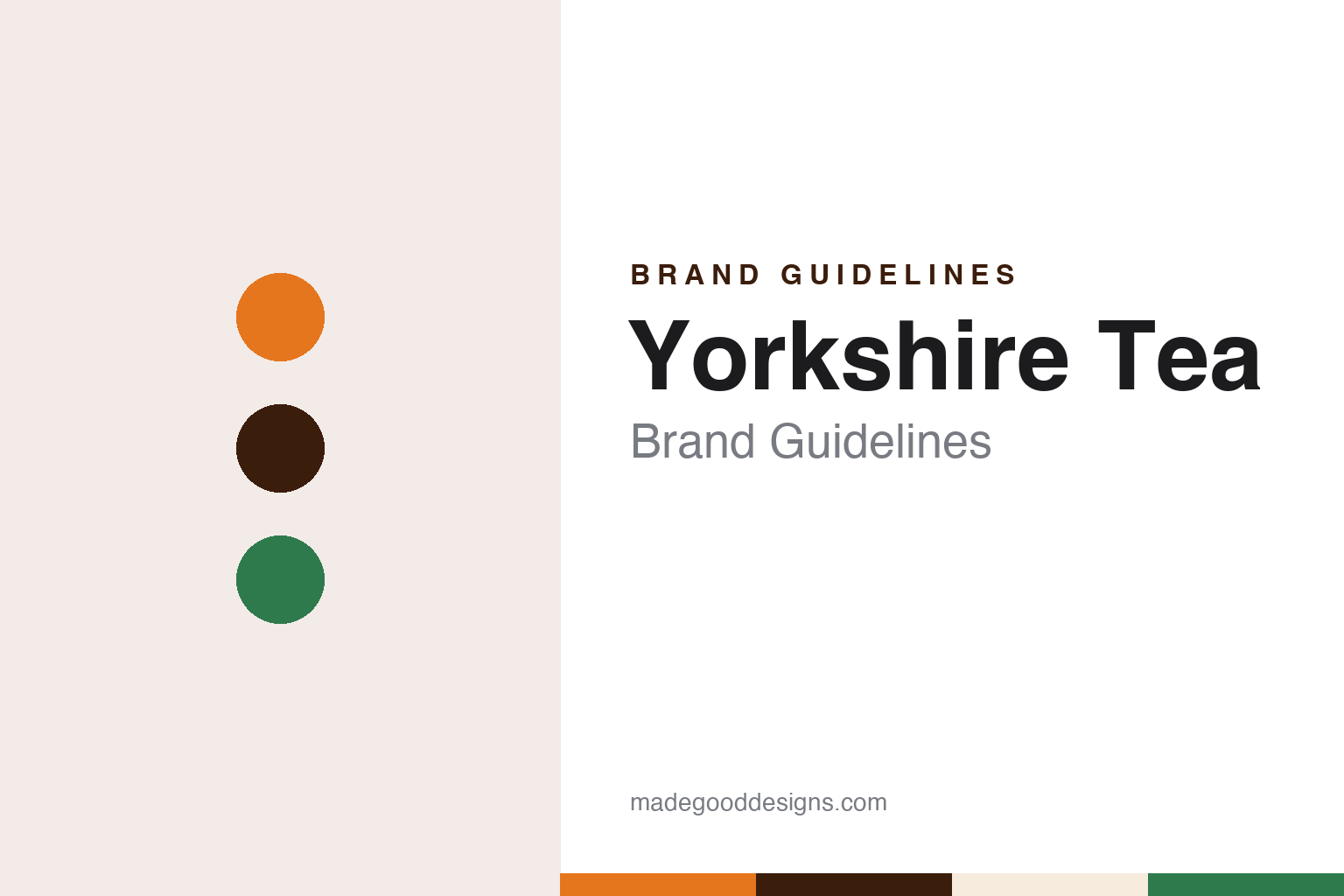
Two constants: a Yorkshire Tea orange, brown and green palette and a sturdy slab serif register. Abstract homage — not a Yorkshire Tea product or mark; no pack, logo or wordmark is reproduced.
A blend for Yorkshire water
A 1970s blend from an 1886 tea merchant.
Yorkshire Tea is a black tea blend made in Harrogate, North Yorkshire, by Taylors of Harrogate, part of the family-owned Bettys & Taylors Group. The group’s own timeline dates its launch to 1977: “Yorkshire Tea fills teapots for the very first time.” English Wikipedia, citing The Yorkshire Post in 2017, says it was first conceived as a “Yorkshire blend for Yorkshire people.”
The idea came from water. Yorkshire Tea’s website says tap water once varied so much that the company often made separate blends for individual customers, and that in the 1970s it set out to make “a black tea blend that’d taste lovely in water from any tap across Yorkshire.” English Wikipedia adds that in the early days different blends were sold in different parts of the county, matched to the hardness or softness of the local water, before the brand settled on a single blend in a standard orange pack — keeping a hard-water version in green.
The company behind it was already old. Taylors traces itself to 1886, when Charles Taylor set up C.E. Taylor & Co. in Yorkshire, and Bettys — the tea-room business opened in Harrogate in 1919 by the Swiss confectioner Frederick Belmont — bought it in 1962, according to the group. The Yorkshire Tea website puts it this way: “Yorkshire Tea was born in the 1970s, but it was 90 years earlier that the company was founded.” The trademarks YORKSHIRE TEA and YORKSHIRE GOLD are registered to Bettys & Taylors Group Ltd, the website’s footer says.
Colour
From county favourite to number one.
For years it was a regional favourite. Yorkshire Tea says that in its early years many people from the county took a supply with them when they moved away, and that this is one of the biggest reasons it came to be drunk across Britain. Supermarkets played their part too: when the West Yorkshire grocer Morrisons took over Safeway in 2004, The Times remarked on the shelf space suddenly given to Yorkshire Tea in a former Safeway store, according to English Wikipedia.
The climb is well documented. The York Press reported in August 2015 that Yorkshire Tea was Britain’s third-best-selling tea brand, behind Tetley and PG Tips; The Yorkshire Post reported in September 2017 that it had passed Tetley, and in November 2019 that it had become the best-selling brand, with 28% of the traditional black-tea market. The group marks 2019 as the year Yorkshire Tea became “the UK’s No. 1 brew.” In 2009 the then Prince of Wales granted it a Royal Warrant, The Yorkshire Post reported.
The range has widened around the core blend. The group lists Yorkshire Tea Decaf, Yorkshire Tea for Hard Water and Yorkshire Gold, which it calls its finest brew. Flavoured “brews” followed: Breakfast, Breaktime and Bedtime Brews in 2016, reported by FoodBev; a malty Biscuit Brew in 2018 and a Caramelised Biscuit Brew in 2024, reported by The Grocer; and a Toast and Jam Brew, launched in 2020 and discontinued in 2024, according to regional newspapers cited by English Wikipedia. The brand’s website now also sells green teas and fruit and herbal infusions under the Yorkshire Tea name.
The leaf itself comes from far away. “Tea doesn’t grow in Yorkshire (obviously),” the company says. It describes Yorkshire Tea as grown in more than 20 places across Africa and India — East Africa and Assam among them — shipped into Teesport and blended in Harrogate, where its tea buyers say they taste every batch before it leaves. All Yorkshire Tea bags and loose tea are Rainforest Alliance certified, the company says, and it buys under a programme it calls the Taylors Sourcing Approach, launched in 2013.
Typography
Tea and documentation.
The seven brands in this group all sell tea, and they come from three countries: Yorkshire Tea, Taylors of Harrogate, Ahmad Tea, Tetley and PG Tips from England, Teekanne from Germany, and Dammann Frères from France. Tea brands in general sit at many different points in the trade, from boxes of bags on a supermarket shelf to loose-leaf tins sold over the counter of a house’s own shop, and a single company can work at both ends at once.
A tea brand’s identity is usually carried less by a field than by a blend, a box and the cup it promises, because the leaf in the packet may have been grown a long way from where the name on the front was made. That makes the questions behind each name worth asking plainly: who started it, who owns it now, where its leaves are bought, and where its tea is actually blended and packed.
Each guide separates what independent sources record from what the company says about itself — its founding story, its owners over time, where its tea comes from and where it is packed — and marks plainly what rests only on the company’s own word.
Aa
A sturdy slab serif — a homely, everyday register. (Specimen set in Bitter, a slab-serif STAND-IN; NOT the Yorkshire Tea logo.)
Yorkshire Tea
One word, one colour: proper, and orange.
Yorkshire Tea’s voice rests on one word: “proper.” The group’s page for the brand is headed “A proper brew makes a proper difference,” and English Wikipedia lists “Let’s have a proper brew” and “Where everything’s done proper” among its taglines. Its advertising has leaned on its home county: from 2017 a television campaign cast well-known Yorkshire figures — Michael Parkinson, Sean Bean and the band Kaiser Chiefs among them — in a comic version of the company’s Harrogate base, according to English Wikipedia. The brand sponsored ITV’s Yorkshire-set drama Heartbeat from 1998 to 2001, The Grocer reported, and the England cricket team from 2013, The Yorkshire Post reported. For the 2014 Tour de France Grand Départ in Yorkshire it produced a sample pack renamed “Yorkshire Thé.”
The pack is the brand’s most visible asset, and colour does much of the work: orange for the standard blend and green for the hard-water version, as English Wikipedia describes. Recent changes have been practical rather than cosmetic. The company says it replaced the oil-based plastic in its tea bags with PLA, a plant-based material, so that all UK supermarket Yorkshire Tea boxes now hold plant-based bags. In 2024 it began removing the plastic overwrap from its boxes, adding an inner lid and keeping a tamper seal — a change it called “massive” for its Harrogate factory, and one it said it was rolling out “bit by bit.”
For a design guide, Yorkshire Tea shows how a regional name and a single strong colour can carry a national brand. Compare Taylors of Harrogate, the company that blends it, and Twinings, another long-established British tea name. For this guide we use a strong orange, a deep tea brown and a hard-water green with a slab serif, an unofficial interpretation; no product or logo is reproduced.
Explore & save
Keep Yorkshire Tea’s identity on hand — save it to a board in the Made Good inspiration library.
Yorkshire Tea identity set
Pin the Yorkshire Tea orange, brown and green palette and the sturdy slab serif register to your own board.