Taylors of Harrogate Brand Guidelines
The 1886 tea and coffee merchant behind Yorkshire Tea.
Aa
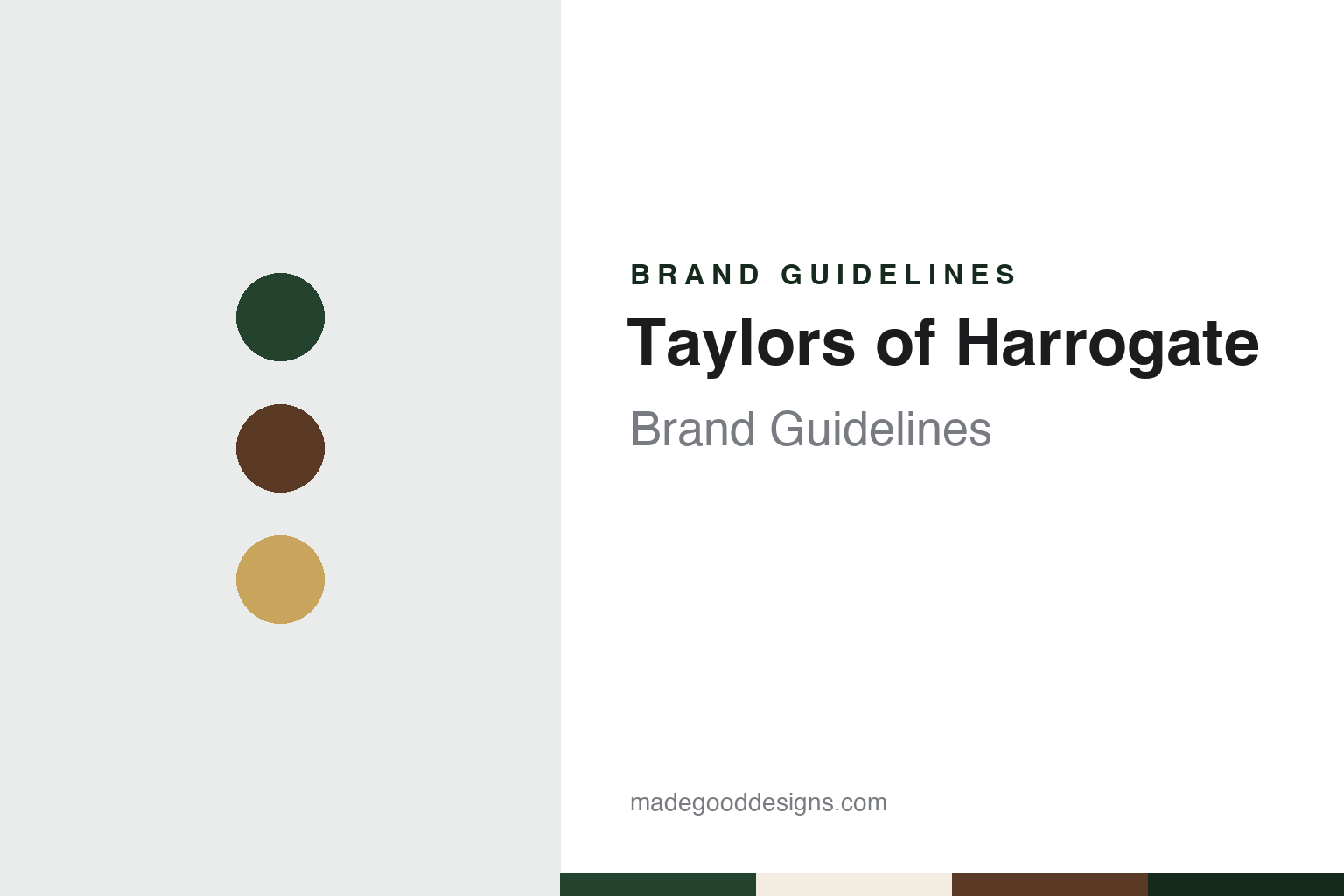
Two constants: a Taylors green, brown and brass palette and a merchant serif register. Abstract homage — not a Taylors of Harrogate product or mark; no pack, logo or wordmark is reproduced.
C.E. Taylor & Co.
A Victorian merchant blending for the local water.
Taylors of Harrogate is the tea and coffee business of the family-owned Bettys & Taylors Group in Harrogate, North Yorkshire. Its story starts in 1886, “when Charles Taylor and his brother set up a tea and coffee company,” the group says; English Wikipedia gives the founder’s name as Charles Edward Taylor, and the Yorkshire Tea website says the company was founded by Charles Taylor, his father and his brother. The business traded as C.E. Taylor & Co., a name later shortened to Taylors.
Taylors began as a merchant blending for local conditions. The Yorkshire Tea website says the company “bought the best teas and carefully created blends to suit the local water,” and that it won a gold medal at the London Grocery Exhibition in 1896. Charles Taylor set up tea and coffee kiosks in Yorkshire towns — English Wikipedia names Harrogate and Ilkley — and the company’s foodservice arm says these had tasting areas where guesthouse owners could sample blends suited to their own water. The flagship, the Café Imperial at 1 Parliament Street in Harrogate, “became famous across the region,” the group says.
That building links the company’s two halves. In 1962 Bettys — the tea-room business opened in Harrogate in 1919 by Frederick Belmont, a Swiss baker and confectioner who had left home as Fritz Bützer — bought C.E. Taylor & Co., which the group describes as “a Yorkshire-based café business and local tea and coffee merchant.” The purchase, it says, “established the foundations for the business we are today.” The former Taylors flagship is now home to Bettys, while Taylors works from its own headquarters across town, known as Pagoda House, according to the Yorkshire Tea website.
Colour
A family group, two names.
Bettys & Taylors describes itself as a “fourth-generation family business”; English Wikipedia says it is owned by the family of Frederick Belmont. Its timeline records a Family Constitution drawn up in 1994, when the business was in its third generation, setting out the aim of “working together to build a great Yorkshire Family Business.” The group lists six values it calls the Six Ps: prosperity, people, product, process, planet and passion.
Within the group, Bettys runs the Café Tea Rooms, and Taylors of Harrogate makes the teas, coffees and infusions. Its best-known product is Yorkshire Tea, launched in 1977, which The Yorkshire Post reported in 2019 had become Britain’s best-selling tea brand. The Yorkshire Tea website says plainly that “Yorkshire Tea is made by Taylors of Harrogate,” and that the same people create a wider range of speciality black teas, green teas and fruit and herbal infusions — which that website sells today under the Yorkshire Tea name.
Under its own name, Taylors now presents coffee to shoppers. Its consumer website offers coffee only — house blends including Rich Italian, Hot Lava Java and Lazy Sunday, along with coffee bags — whereas Wayback Machine captures of the same site from January 2019 and January 2021 show an “Our teas” section that is absent from the captures of January 2022 and January 2023. Taylors says its coffee is blended and roasted in Harrogate on a traditional drum roaster, and that its quality team includes “Q graders” certified by the Coffee Quality Institute, who assess up to 100 samples a day.
It also sells beyond the shop shelf. Through a foodservice business, Taylors Out of Home, it supplies cafés, restaurants, pubs and hotels, and says its customers include the restaurant chain LEON and the rail operator LNER.
Typography
Tea and documentation.
The seven brands in this group all sell tea, and they come from three countries: Yorkshire Tea, Taylors of Harrogate, Ahmad Tea, Tetley and PG Tips from England, Teekanne from Germany, and Dammann Frères from France. Tea brands in general sit at many different points in the trade, from boxes of bags on a supermarket shelf to loose-leaf tins sold over the counter of a house’s own shop, and a single company can work at both ends at once.
A tea brand’s identity is usually carried less by a field than by a blend, a box and the cup it promises, because the leaf in the packet may have been grown a long way from where the name on the front was made. That makes the questions behind each name worth asking plainly: who started it, who owns it now, where its leaves are bought, and where its tea is actually blended and packed.
Each guide separates what independent sources record from what the company says about itself — its founding story, its owners over time, where its tea comes from and where it is packed — and marks plainly what rests only on the company’s own word.
Aa
A merchant serif — the register of an old tea and coffee house. (Specimen set in Cormorant Garamond, a serif STAND-IN; NOT the Taylors of Harrogate logo.)
Taylors of Harrogate
Sourcing as the story.
Taylors’ public identity leans on sourcing as much as on flavour. The group’s page for the company carries the line “The home of extraordinary flavour,” and Taylors describes long-term relationships with growers under the Taylors Sourcing Approach, launched in 2013, which it says includes multi-year contracts and investment in the communities it buys from. Taylors says it received a Queen’s Award for Sustainable Development in 2017 for that supply-chain work. It also says it has switched its Harrogate manufacturing to renewable gas and electricity and put solar panels on its factory roof; we give these as the company’s own claims.
Packaging has been a recurring subject. Taylors says it was among the first signatories of WRAP’s UK Plastics Pact in 2018, and that in 2026 it joined the successor scheme, the UK Packaging Pact, as a founding member. In August 2023 it announced that its ground and bean coffee packs would be reduced to 200g and moved to a mono-polypropylene material that can be recycled at large supermarkets. On the tea side, it says it has moved Yorkshire Tea bags from oil-based plastic to plant-based material and removed the plastic overwrap from its tea boxes.
For a design guide, Taylors of Harrogate shows how a company can let its best-known brand carry the tea while its own name carries the coffee. Compare Yorkshire Tea, the blend it launched in 1977, and Dilmah, the family-owned Sri Lankan tea brand. For this guide we use a deep merchant green, a roasted brown and a brass gold with a serif, an unofficial interpretation; no product or logo is reproduced.
Explore & save
Keep Taylors of Harrogate’s identity on hand — save it to a board in the Made Good inspiration library.
Taylors of Harrogate identity set
Pin the Taylors green, brown and brass palette and the merchant serif register to your own board.