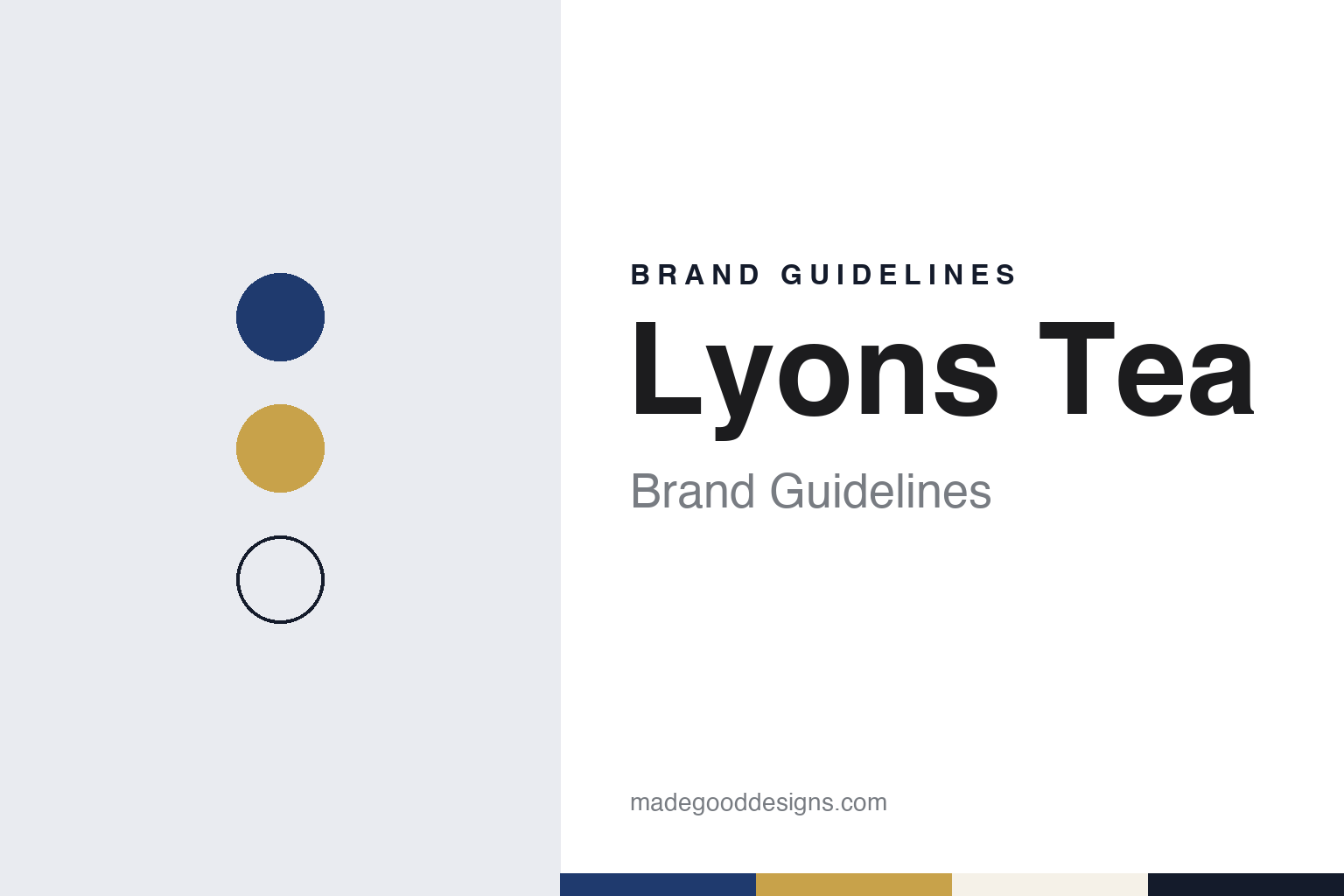
Lyons Tea Brand Guidelines
The London-born blend that became an Irish staple.
Aa
Two constants: a blue, gold and cup-white palette and a teashop serif register. Abstract homage — not a Lyons Tea product or mark; no pack, logo or label is reproduced.
From Piccadilly to Dublin
A London catering empire and its Irish tea.
Lyons Tea is an Irish best-seller with a London origin. It was first produced by J. Lyons & Co., the catering and food business that English Wikipedia dates to 1884 and credits to Joseph Lyons and his brothers-in-law Isidore and Montague Gluckstein, as an offshoot of the Salmon & Gluckstein tobacco firm. Lyons opened its first teashop in Piccadilly in 1894 and built a chain of about 200, along with the Corner Houses of London’s West End. The company also built the LEO business computers of the 1950s, and its last teashops closed in 1981, English Wikipedia says; the family’s story is told in Thomas Harding’s book Legacy: One Family, a Cup of Tea and the Company that Took On the World.
Tea followed the cafés. From 1904, English Wikipedia says, J. Lyons sold packaged tea through its teashops and then through shops in Britain, Ireland and beyond; in 1918 it bought the tea firm Horniman & Sons, and in 1921 it moved tea production to Greenford, west London, then the largest tea factory in Europe.
The brand tells its Irish story differently. A history on the Lyons website in 2007, when the site was run by Unilever, said that in 1902 “the J. Lyons family started business in Dublin from their premises in High Street, near Christchurch Cathedral,” moved in 1932 to Marlborough Street, behind the Gresham hotel, and in 1963 to “a tailor made factory in Goldenbridge, Dublin 8.” In 2020 the commentator Tom Clonan, writing in TheJournal.ie, argued that Lyons Tea was not founded in Dublin by a Lyons family, but by the Salmon and Gluckstein family in London. In 1962, according to English Wikipedia, citing The Times, J. Lyons and Company (Ireland) became Lyons Irish Holdings.
Colour
Minstrels, a jingle and a round bag.
Lyons built its Irish standing on advertising. English Wikipedia, citing Hugh Oram’s 1986 history of Irish advertising, says Lyons was a major advertiser in the early decades of RTÉ Television, with the “Lyons Minstrels” and coupon-based prize competitions. The brand’s 2007 website dated its first on-pack promotion to 1963, when buyers could find vouchers inside the packet, and said the Minstrels and a popular car giveaway became core parts of the brand over the next 25 years. The same site called its jingle — “Extra quality, Extra flavour, Lyons the Quality Tea” — one every Irish person knows, and still linked to a “classic TV advert featuring the generation spanning Minstrels.”
The brand also told its story through the tea bag and the box. By the late 1970s, the 2007 site said, a change to round bags helped Lyons take more than 65 per cent of the Irish tea market; it also claimed the country’s first pyramid-shaped tea bag, and described a “tea caddy style pack” as a later point of difference. In 1996 The Irish Times put Lyons’s share of the Irish tea market at 56 per cent.
Later campaigns kept the theme of conversation. TheJournal.ie noted a 2010 “Talk into Tea” campaign, and by 2022 the website carried the line “Now We’re Talking” and a partnership with the charity Pieta House. The range then included Lyons Original, Lyons Gold, a decaffeinated tea and an Earl Grey, as well as loose tea.
Typography
Ireland and its tea.
The seven brands in this group all sell tea, and they come from two countries on either side of the Irish Sea: Typhoo, Clipper, Whittard and Fortnum & Mason from England, and Barry’s Tea, Lyons and Bewley’s from Ireland. Tea brands in general sit at many different points in the trade, from boxes of bags on a supermarket shelf to caddies sold over the counter of a house’s own shop, and a single company can work at both ends at once.
A tea brand’s identity is usually carried less by a field than by a blend, a box and the cup it promises, because the leaf in the packet may have been grown a long way from where the name on the front was made. That makes the questions behind each name worth asking plainly: who started it, who owns it now, where its leaves are bought, and where its tea is actually blended and packed.
Each guide separates what independent sources record from what the company says about itself — its founding story, its owners over time, where its tea comes from and where it is packed — and marks plainly what rests only on the company’s own word.
Aa
A teashop serif for a brand born in London’s cafés. (Specimen set in DM Serif Display, a serif STAND-IN; NOT the Lyons Tea logo.)
Lyons Tea
From Allied Lyons to Lipton Teas and Infusions.
Ownership has changed several times. In 1978 J. Lyons merged with Allied Breweries to form Allied Lyons, later Allied Domecq, and Lyons Irish Holdings went with it. In July 1996 The Irish Times reported that Unilever had agreed to buy Allied Domecq’s 75 per cent of Lyons Irish Holdings, which it called “Ireland’s biggest tea distribution company,” and would bid for the remaining shares. In 2020 Unilever grouped its tea brands into a division called ekaterra; in November 2021 it agreed to sell most of that business to the private equity firm CVC Capital Partners, and after the sale was completed in July 2022 the company was renamed Lipton Teas and Infusions, based in Amsterdam, according to English Wikipedia. Lyons Tea for Ireland is listed among its brands, alongside PG Tips, and the lyonstea.ie address now redirects to the Lipton Teas and Infusions website.
Where the tea is made has been a point of debate. In November 2012 the Irish Independent reported a Love Irish Food survey in which 77 per cent of 1,000 householders believed Lyons Tea was produced in Ireland, “even though it’s actually packed in England for Dutch firm Unilever”; English Wikipedia also says the tea is produced in England. We could not confirm the current packing site in the sources we checked. In 2010 the brand’s website said its tea was grown in countries including Kenya and Indonesia; by 2022 it said its leaves were Rainforest Alliance Certified and that its boxes contained plant-based, biodegradable tea bags; in 2018 The Irish Times reported Unilever’s pledge to take plastic out of its tea bags.
For a design guide, Lyons Tea shows how a brand can become part of a country’s identity through decades of advertising. Compare Barry’s Tea, its Cork rival, and PG Tips, a sister brand under the same owner. For this guide we use blue, gold and cup white with a serif, an unofficial interpretation; no product or logo is reproduced.
Explore & save
Keep Lyons Tea’s identity on hand — save it to a board in the Made Good inspiration library.
Lyons Tea identity set
Pin the Lyons Tea blue, gold and cup-white palette and the teashop serif register to your own board.