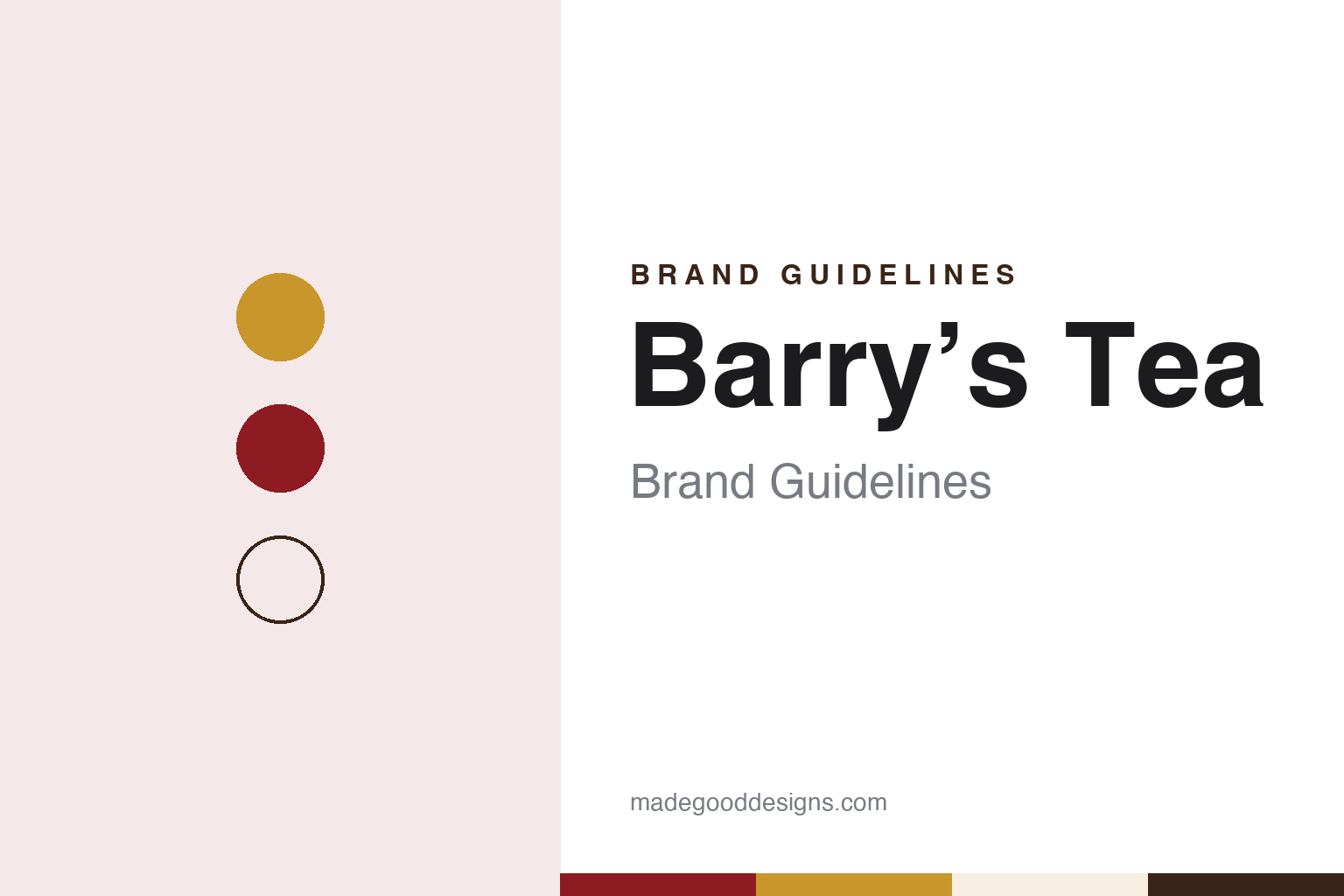
Barry’s Tea Brand Guidelines
The Cork family blender behind Gold Blend.
Aa
Two constants: a red, gold and milk palette and a shopfront serif register. Abstract homage — not a Barry’s Tea product or mark; no pack, logo or label is reproduced.
Prince’s Street
A Cork tea shop that became a national brand.
Barry’s Tea began in Cork in 1901, when James J. Barry started selling tea in the city. The company’s own history says that until the 1960s its teas came mostly from India and Sri Lanka and were sold mainly from its shop on Prince’s Street, in the centre of Cork; English Wikipedia gives the same founder, year and street.
The business passed down the family. The company says the founder’s son, Anthony Barry, was awarded the “Empire Cup” for tea blending in 1934, which it presents as proof of his standing in the trade; we could not find an independent record of the award, so we give it as the company’s claim. In 1960, it says, Anthony’s son Peter Barry “pioneered the concept of wholesaling tea” and began buying tea from East Africa. Those blends, the company says, became a house signature for their freshness, flavour and “distinctive golden colour.”
Wholesaling changed the scale of the business. Barry’s says it began selling its teas to other shops in Cork, then into the suburbs and then across the country, and that “through word of mouth alone” it had become a national brand by the mid-1980s. The family was also prominent in public life: English Wikipedia records that Anthony Barry and Peter Barry both sat in the Dáil for Fine Gael, and that Peter Barry’s daughter, Deirdre Clune, was later a TD and, from 2014 to 2024, a member of the European Parliament.
Colour
East African leaf, blended and packed in Cork.
The core of the range is black tea sold under blend names: Gold Blend, Master Blend, Original Blend and a decaffeinated blend, alongside fruit and herbal infusions and green teas that the company says it added as tastes changed. Its website, in figures it does not date, says Barry’s accounts for 38 per cent of tea value sales in an Irish market worth about €85 million at retail, and that Gold Blend leads the premium end of that market; English Wikipedia repeats the share as the company’s claim. We give these as Barry’s own numbers. English Wikipedia adds that the tea is sold in the United Kingdom and Spain, and in parts of Canada, Australia, France, Luxembourg and the United States with large Irish communities; the company says its online shop has sent tea to more than 60 countries in a year.
On sourcing, Barry’s says 95 per cent of its tea is bought “directly through government agencies in East Africa,” naming the Kenya Tea Development Authority and similar bodies in Uganda and Rwanda, which it says represent small farmers. It says its other main suppliers include estates in Assam, Kenya and elsewhere in India that its staff have visited, and that the tea in its black tea range comes from Rainforest Alliance Certified farms.
Where the tea is finished is stated plainly by the company: its sustainability page refers to “our black tea range, produced in Cork,” and the business gives its address as Kinsale Road, Cork. The Irish Times described Barry’s in 2018 as a Cork-based company making millions of tea bags a week. The company also says its master blender tastes its blends three times a day. It describes itself as “an independent, family-owned, Irish business”; we found no report of a sale to an outside owner in the sources we checked.
Typography
Ireland and its tea.
The seven brands in this group all sell tea, and they come from two countries on either side of the Irish Sea: Typhoo, Clipper, Whittard and Fortnum & Mason from England, and Barry’s Tea, Lyons and Bewley’s from Ireland. Tea brands in general sit at many different points in the trade, from boxes of bags on a supermarket shelf to caddies sold over the counter of a house’s own shop, and a single company can work at both ends at once.
A tea brand’s identity is usually carried less by a field than by a blend, a box and the cup it promises, because the leaf in the packet may have been grown a long way from where the name on the front was made. That makes the questions behind each name worth asking plainly: who started it, who owns it now, where its leaves are bought, and where its tea is actually blended and packed.
Each guide separates what independent sources record from what the company says about itself — its founding story, its owners over time, where its tea comes from and where it is packed — and marks plainly what rests only on the company’s own word.
Aa
A shopfront serif for a Cork tea merchant. (Specimen set in Libre Caslon Text, a serif STAND-IN; NOT the Barry’s Tea logo.)
Barry’s Tea
A family brand and its tea bag.
The brand’s recent history has been shaped by packaging. In May 2018 The Irish Times reported that Barry’s tea bags were sealed with polypropylene, a plastic, and that a spokeswoman said the company was “working hard towards a plastic-free tea bag solution” and had run trials with its filter-paper supplier; the same report noted that Unilever, then the owner of rival Lyons, had pledged to remove plastic from its bags. In August 2021, the Cork news site TheCork.ie reported, Barry’s said it had removed plastic from its tea bags. The company now says its black tea bags are biodegradable after “significant investment in the redesign and development of our machinery,” that its fruit, herbal and green teas followed at the end of September 2021, and that the bags are made of paper and wood cellulose with cotton string. Its boxes, it says, are recyclable and printed with vegetable-based inks.
Sponsorship has also drawn attention. Barry’s had backed greyhound races, including one in Cork, and in July 2019 The Irish Times reported that it was ending those sponsorships after an RTÉ Investigates programme raised concerns about the treatment of racing dogs.
Its rivalry with Lyons is a fixture of Irish tea talk, and the two are often compared on where they are made. In 2012 the Irish Independent reported that the marketing body Love Irish Food suggested “buying Barry’s Tea instead of Lyons” as an easy switch to an Irish-made product. Barry’s now signs off its website with the line “We Make the Tea. You Make the Moments.”
For a design guide, Barry’s Tea shows how a family name and a blend name can carry a brand for generations. Compare Lyons Tea, its long-time rival, and Bewley’s, another Irish tea and coffee name. For this guide we use red, gold and milk with a serif, an unofficial interpretation; no product or logo is reproduced.
Explore & save
Keep Barry’s Tea’s identity on hand — save it to a board in the Made Good inspiration library.
Barry’s Tea identity set
Pin the Barry’s Tea red, gold and milk palette and the shopfront serif register to your own board.