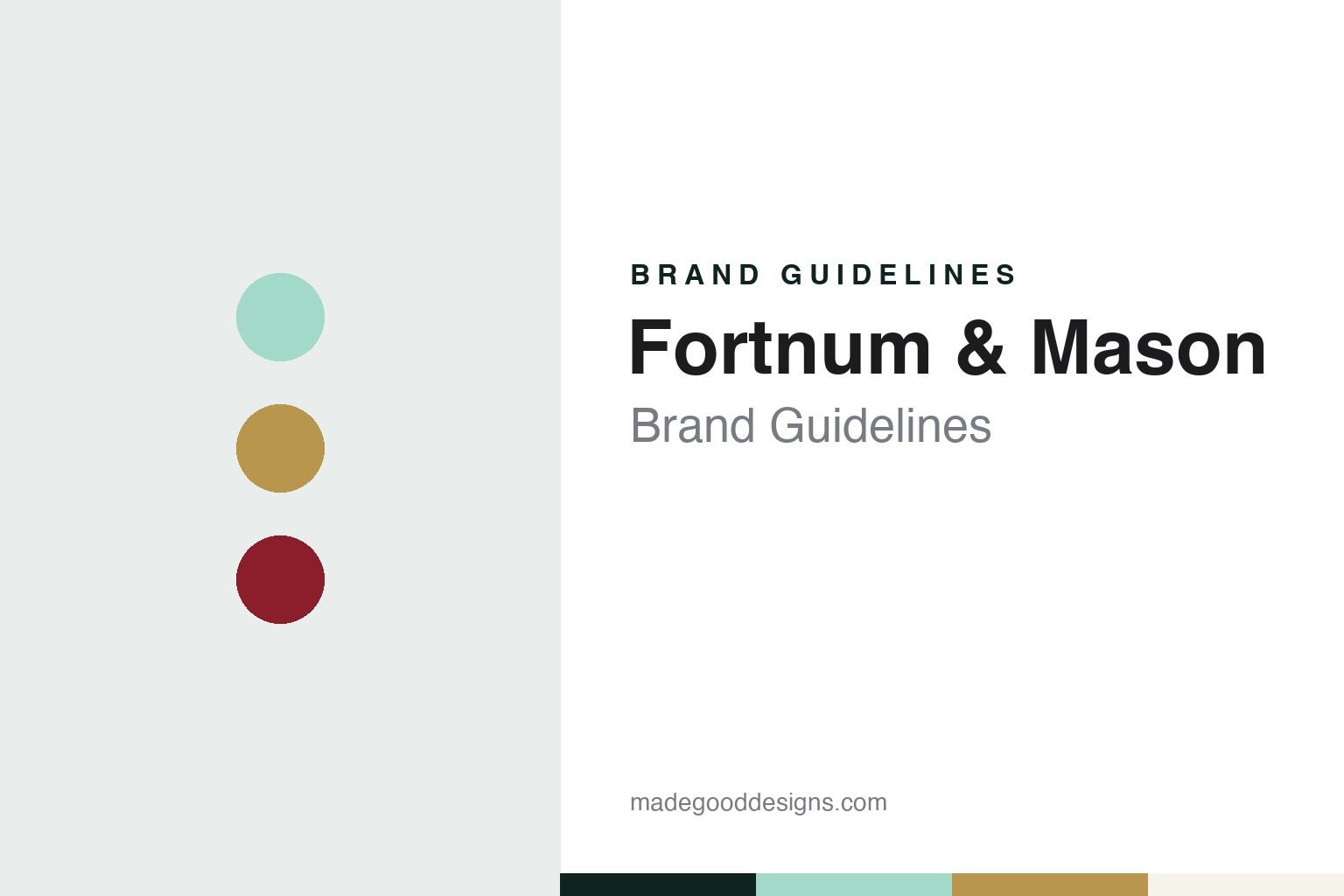
Fortnum & Mason Brand Guidelines
The Piccadilly grocer that dresses its tea in eau de nil.
Aa
Two constants: a Fortnum & Mason eau-de-nil, gilt and carpet-red palette and a Georgian grocer’s serif register. Abstract homage — not a Fortnum & Mason product or mark; no caddy, hamper, clock, logo or photograph is reproduced.
From palace wax to Piccadilly
A footman, a landlord and a grocery.
Fortnum & Mason is a London department store and grocer whose main shop stands at 181 Piccadilly, in St James’s, and whose name is now carried on tea caddies sold well beyond that building. English Wikipedia says the business was established in 1707 by William Fortnum and Hugh Mason. Fortnum was a footman in the household of Queen Anne, and the founding story the company tells begins with candles: the royal household insisted on new candles every night, and the half-used wax became, in the company’s words, “a legitimate perk for an enterprising footman” to sell on. Fortnum also had a side business as a grocer, Wikipedia says, and persuaded his landlord, Hugh Mason, to become his associate; the first shop was in Mason’s small premises at St James’s Market. The company’s own timeline adds that its legacy began in 1705 with Hugh Mason, “from a small store in St James Market and a spare room in his house,” and that the Fortnum family had come to London as builders after the Great Fire.
The royal connection continued. English Wikipedia says William Fortnum’s grandson Charles entered the service of Queen Charlotte in 1761, and that the link with the court brought more business. The shop moved into ready-to-eat luxuries such as poultry and game in aspic, supplied dried fruit and preserves to officers in the Napoleonic Wars, and was often called on for court functions in the Victorian era. The company says that during the Crimean War Queen Victoria asked it to send a consignment of concentrated beef tea “without delay” to Florence Nightingale’s hospitals. It also claims to have invented the Scotch egg in 1738, and Wikipedia records that in 1886, after buying the whole stock of five cases of a new product from H. J. Heinz, it became the first store in Britain to sell tinned baked beans. The present building at 181–184 Piccadilly was rebuilt in 1926–27 to a Neo-Georgian design by the architects Wimperis, Simpson and Guthrie.
Colour
A Weston family business since 1951.
The store has had one owner for three-quarters of a century. English Wikipedia says that in April 1951 the Canadian businessman W. Garfield Weston acquired Fortnum & Mason and became its chairman after a boardroom coup, and that it has been privately owned by Wittington Investments Limited since then. Wittington, a London holding company incorporated in 1941, is 79.2 per cent owned by the Garfield Weston Foundation, according to Wikipedia, and its other holdings include a majority stake in Associated British Foods and the homeware retailer Heal’s. Wikipedia says that since Garfield Weston’s death in 1978 the store has been run by two of his granddaughters, Jana Khayat and Kate Hobhouse, and that the chief executive, Tom Athron, joined in December 2020.
Under the Westons the shop gained its best-known fixture. In 1964 Garfield Weston commissioned a four-ton clock above the main entrance as a tribute to the founders; every hour, Wikipedia says, four-foot models of William Fortnum and Hugh Mason emerge and bow to each other. The company says the clock’s bells came from the same foundry as Big Ben’s. The store had a £24 million refurbishment for its tercentenary in 2007, which the company says the then Prince of Wales formally opened, and on 1 March 2012 Queen Elizabeth II opened the Diamond Jubilee Tea Salon on the fourth floor. Further shops followed: St Pancras International in 2013, Heathrow Terminal 5 in 2014, Dubai in 2014, The Royal Exchange in 2018 and Hong Kong in 2019, Wikipedia records, and in October 2025 a store at Bicester Village, its first in the UK outside London.
Royal warrants are part of the brand’s vocabulary. The company says that in 2024 King Charles III and Queen Camilla each granted it a warrant, for its services as Grocers and Tea Merchants, and that it was one of seven businesses to receive warrants from both. On its earlier history the sources differ: English Wikipedia says the first warrant came from Queen Alexandra in 1910, while the company’s own account dates its first warrant to 1898, from Queen Victoria, for services as “Oilmen.” Both agree that the warrant was briefly lost under King George VI in 1948, during post-war rationing, and restored in 1951.
Typography
Seven tea brands, two countries.
The seven brands in this group all sell tea, and they come from two countries on either side of the Irish Sea: Typhoo, Clipper, Whittard and Fortnum & Mason from England, and Barry’s Tea, Lyons and Bewley’s from Ireland. Tea brands in general sit at many different points in the trade, from boxes of bags on a supermarket shelf to caddies sold over the counter of a house’s own shop, and a single company can work at both ends at once.
A tea brand’s identity is usually carried less by a field than by a blend, a box and the cup it promises, because the leaf in the packet may have been grown a long way from where the name on the front was made. That makes the questions behind each name worth asking plainly: who started it, who owns it now, where its leaves are bought, and where its tea is actually blended and packed.
Each guide separates what independent sources record from what the company says about itself — its founding story, its owners over time, where its tea comes from and where it is packed — and marks plainly what rests only on the company’s own word.
Aa
A Georgian grocer’s serif — gilt lettering, a Piccadilly clock and a blue-green caddy. (Specimen set in Cormorant Garamond, a serif STAND-IN; NOT the Fortnum & Mason logo.)
Fortnum & Mason
A royal blend in a blue-green caddy.
The company calls tea “pivotal to our storied past, present and future” and says it has been selling it for more than three centuries, and its flagship blend comes with a royal story: when Edward VII came to the throne, it says, the king asked it to “bring me the finest tea in all of the land,” and in 1902 it answered with Royal Blend, a mix of Assam from India and Flowery Pekoe from Sri Lanka that it still sells, alongside a Sandringham Blend coffee from the same commission. Its range today runs from Breakfast and Afternoon blends to Earl Grey Classic and Queen Anne, sold as loose leaf in tins and caddies, as tea bags and in pouches and cartons. On sourcing the company speaks in general terms — on one tea page it says it focuses on estates that pay attention to “leaf appearance and liquor quality combined” — and the company pages we checked do not say where its blends are packed. In Piccadilly, St Pancras and The Royal Exchange it offers a bespoke blending service guided by staff it calls “tearistas.”
The colour is the other half of the identity. The company calls eau de nil “our unmistakeable signature colour for decades,” a bright blue-green that it says was inspired by the flowers and fabrics of India and recreated by eighteenth-century designers. In its account the colour became the house colour gradually: exterior paint in the 1840s, touches in its 1950s Christmas catalogues, the background to the Piccadilly clock and, finally, product packaging — “each famous caddy is perfectly packaged in Eau de Nil,” it says. Inside the store it pairs the green with a deep red velvet carpet and gilded chandeliers. The packaging is meant to outlast its contents: the company’s Long Love #Fortnums campaign showed customers’ reused hampers and caddies, the caddies turned into plant pots and paintbrush holders, under the line “our products are designed to live on.”
For a design guide, Fortnum & Mason shows how a grocer can turn a single colour, a royal origin story and a clock above its door into the dress of a tea brand. Compare Twinings, another London tea name dating from the reign of Queen Anne, and Taylors of Harrogate, an English tea blender from Yorkshire. For this guide we use Piccadilly green, eau de nil and gilt with a serif, an unofficial interpretation; no product or logo is reproduced.
Explore & save
Keep Fortnum & Mason’s identity on hand — save it to a board in the Made Good inspiration library.
Fortnum & Mason identity set
Pin the Fortnum & Mason eau-de-nil, gilt and carpet-red palette and the Georgian grocer’s serif register to your own board.