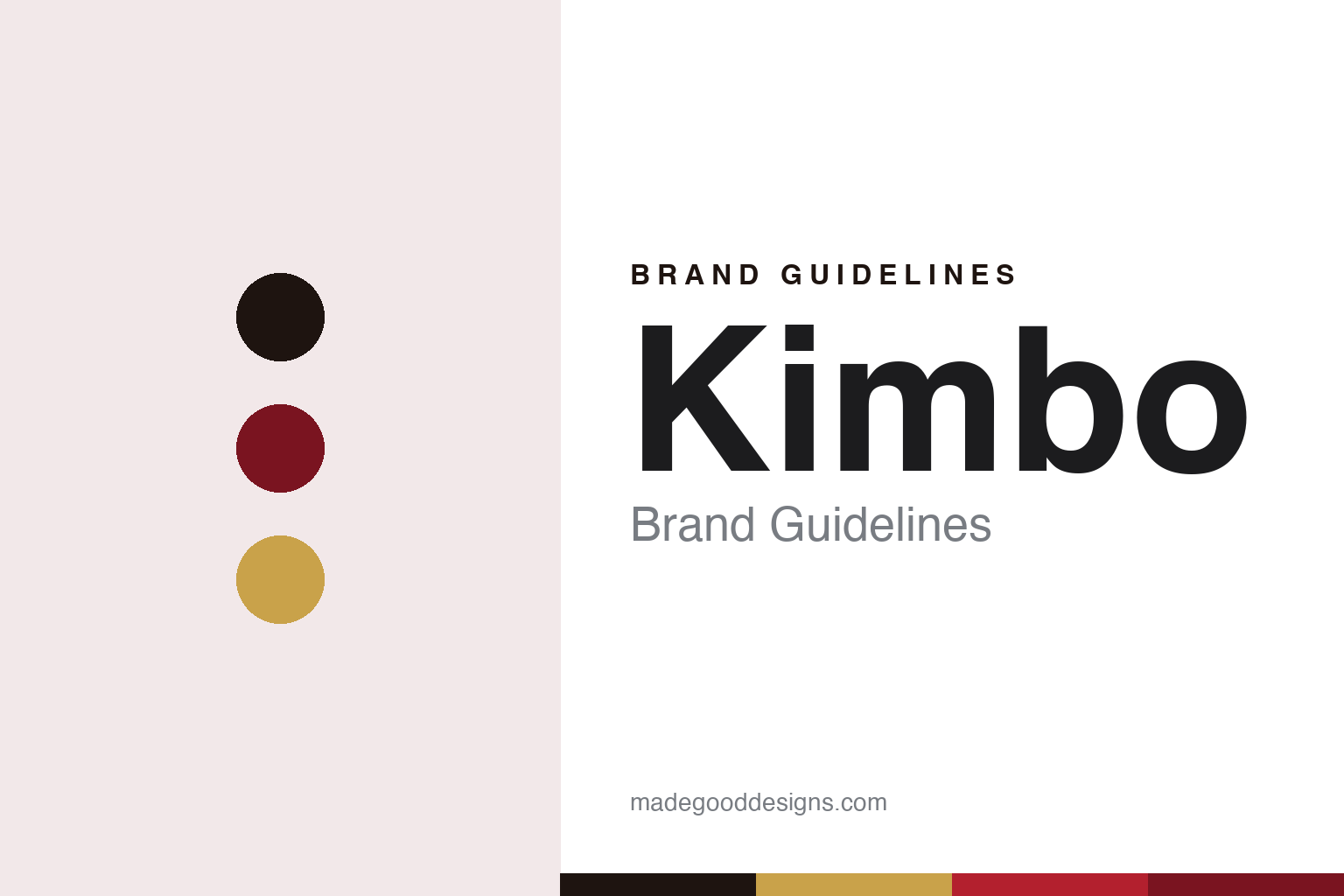
Kimbo Brand Guidelines
The Neapolitan espresso brand that renamed its own company.
Aa
Two constants: a Kimbo red, gold and roast palette and a warm serif register. Abstract homage — not a Kimbo product or mark; no tin, pack or logo is reproduced.
Café do Brasil
Three brothers and a vacuum tin.
Kimbo is a coffee roaster from Naples, founded by the Rubino brothers — Francesco, Gerardo and Elio, according to Italian Wikipedia. For most of its life the company was not called Kimbo at all. It traded as Café do Brasil, and Kimbo was the name of its best-known coffee; only in November 2013, for its fiftieth anniversary, did Café do Brasil take the name of its brand, the trade site Distribuzione Moderna reported, saying the change formalised a usage already established among consumers.
The company has dated its beginnings in two ways. Its website in 2011, archived by the Wayback Machine, said the story began in the 1950s with a small roastery in the historic centre of Naples, selling coffee to bars and grocers. Its website today says that in the 1960s the Rubino brothers seized the opportunity offered by new packaging methods — the “revolutionary” vacuum-packed tin — and that Cafè do Brasil S.p.A. was founded in 1963, with the Kimbo brand born from it. The tin, the company says, meant the real coffee of the Neapolitan tradition could be taken anywhere.
The company says the name Kimbo evokes the exotic lands where coffee beans come from. Its initial has become a motif of its own: on a page titled “K di Kimbo,” the company describes a one-metre aluminium sculpture in the shape of a K, made for it by the Neapolitan artist Lello Esposito and covered in reliefs of images from his work — among them San Gennaro, Pulcinella and the siren Parthenope — along with a moka pot and a coffee bean.
Colour
Second in Italy, the company says.
Kimbo grew into one of Italy’s best-known coffee brands. The company says it reached second place in Italian retail sales of packaged coffee in 1994 and still holds that position; Italian Wikipedia places it behind Lavazza. In the early 1990s the company added a lower-priced brand, Caffè Kosé, which in 2024 became Kosé by Kimbo, Italian Wikipedia says.
The company names one production site: a 40,000-square-metre plant at Melito di Napoli, in the Naples hinterland, as Italian Wikipedia puts it. There, the company says, it has automated processes once done by hand, such as roasting and blending, while people still control the roast and compose the blends. Since 2009 its logistics have run from an 18,000-square-metre hub at the Interporto di Nola, the company says.
The range now goes well beyond the tin. The company’s shop sells beans, ground coffee, compostable pods and capsules made to fit other companies’ machines, including Nespresso Original and Dolce Gusto, as well as a line called Antica Miscela dal 1963 and a specialty-coffee line, Sapiente, which it labels “Master Roasters from Napoli.” It also sells a cuccuma, the Neapolitan coffee pot.
Its advertising has long used familiar faces. Italian Wikipedia lists the television presenter Pippo Baudo in the 1980s and 1990s, the actor Massimo Dapporto in the 1990s, Gigi Proietti in the 2000s and, since 2018, the actress Serena Autieri, who has fronted a campaign under the line “Una tazza di Napoli” — a cup of Naples — according to the trade site Brand News, which Italian Wikipedia cites. In July 2016 SSC Napoli announced Kimbo as its third shirt sponsor, according to Italian Wikipedia, which cites the club.
Typography
Coffee and documentation.
The seven brands in this group all roast coffee, and they come from five European countries: Segafredo Zanetti and Kimbo from Italy, Julius Meinl from Austria, Tchibo and Dallmayr from Germany, Douwe Egberts from the Netherlands, and Paulig from Finland. Coffee brands in general sit at many different points in the trade, from vacuum packs on a supermarket shelf to espresso poured in a café under the roaster’s own sign, and a single company can work at both ends at once.
A coffee brand’s identity is usually carried less by a place of growth than by a blend, a pack and the cup it promises, because the beans inside will have been grown a long way from where the name on the front was roasted. That makes the questions behind each name worth asking plainly: who started it, who owns it now, where its coffee is bought, and where it is actually roasted and packed.
Each guide separates what independent sources record from what the company says about itself — its founding story, its owners over time, where its coffee comes from and where it is roasted — and marks plainly what rests only on the company’s own word.
Aa
A warm serif — a K that has become a motif. (Specimen set in Fraunces, a serif STAND-IN; NOT the Kimbo logo.)
Kimbo S.p.A.
Still a Rubino family company.
Kimbo remains owned by the Rubino family, according to Italian Wikipedia, which names Paola Rubino as president and Alessandra Rubino as chief executive; the two cousins were at the head of the company by the 2013 change of name, it says. The path there was not smooth. In 2010, after disagreements over strategy among the founders’ heirs, Michele Rubino, who had led the company since 1999, stepped down, the Corriere del Mezzogiorno reported, and the family brought in an outside chairman and chief executive, Raffaele Mazzuoccolo, formerly of Lavazza. In June 2011 the Corriere della Sera reported that a 31% stake held by Michele Rubino and his sister was for sale; Italian Wikipedia says it went to members of the other two branches of the family.
In June 2012, while still called Café do Brasil, the company bought La Tazza d’oro of Cagliari, founded in 1938 by Giuseppe and Carmela Murgia, La Nuova Sardegna reported, keeping its La Tazza d’oro and Caffè Karalis lines; the company says the purchase took it into the bars of Sardinia. Three months earlier it had become the coffee supplier to the motorway caterer Autogrill, according to Italian Wikipedia, citing Foodweb. At the time of the change of name, Distribuzione Moderna put its turnover at €170 million, with 150 employees, and said it was expanding abroad under the name “Kimbo Espresso Italiano.” Italian Wikipedia now lists four brands: Kimbo, Kosé, Caffè Karalis and La Tazza d’oro.
For a design guide, Kimbo shows how a product name can outgrow the company that made it, until the company takes the name itself. Compare Lavazza, which Italian Wikipedia places ahead of it in Italy’s packaged-coffee market, and Segafredo Zanetti of Bologna. For this guide we use a deep red, gold and roast brown with a serif, an unofficial interpretation; no product or logo is reproduced.
Explore & save
Keep Kimbo’s identity on hand — save it to a board in the Made Good inspiration library.
Kimbo identity set
Pin the Kimbo red, gold and roast palette and the warm serif register to your own board.