Segafredo Zanetti Brand Guidelines
The Bologna roaster behind Massimo Zanetti’s coffee group.
Aa
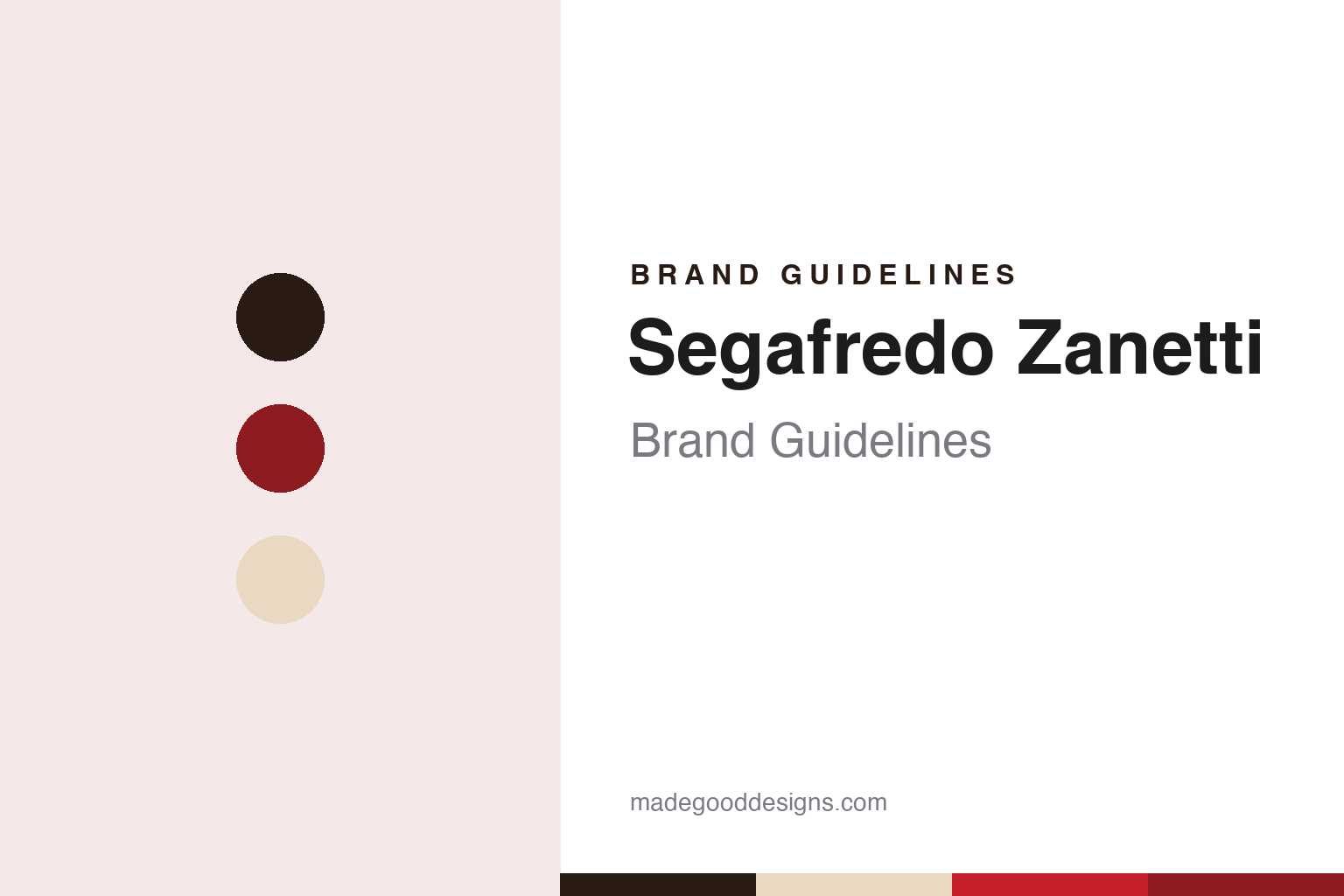
Two constants: a Segafredo espresso, crema and red palette and a condensed sans register. Abstract homage — not a Segafredo product or mark; no pack, cup or logo is reproduced.
A Bologna roaster
A family roastery and a new owner’s name.
Segafredo is a coffee roaster from Bologna. Its present form dates from the 1970s, when Massimo Zanetti, a businessman from Treviso who already owned a roastery, took over the city’s Segafredo roastery, according to Italian Wikipedia. Its article on Zanetti describes the business he bought as a historic coffee maker owned by the Segafredo family, with a reasonably well-known brand. The dates differ by source: Italian Wikipedia’s article on Zanetti’s group, citing L’Espresso in 2014, puts the takeover in 1974; its biography of Zanetti says the end of the 1970s; and the brand itself gives 1973, writing “Dal 1973” — since 1973 — on its website.
Zanetti added his own surname, and the mark became Segafredo Zanetti. In the group’s own account, archived in 2020, he came from “a family of coffee merchants,” and the Bologna purchase was the start of a longer expansion: abroad from the 1980s and 1990s, first in Portugal, France and Austria and then in South America; and, in the 2000s, into Finland, through the purchase of Meira, and into the United States.
The brand’s own history is brief. The company says Segafredo grew first in Italy, where it soon led the market for coffee served away from home, then moved into supermarkets and later into international markets. Its Italian website now describes Segafredo as a leader in espresso “in Italy and in the world” and says more than 50 million cups of its coffee are drunk each day; we give both as the company’s claims. It also says Segafredo is listed in Italy’s register of historic trademarks of national interest.
Colour
Cafés, capsules and a long run in sport.
Segafredo works on two fronts, Italian Wikipedia says: products for the home, such as blends and espresso systems, and products for use away from home, including professional blends, espresso systems and vending machines. Two group companies carry the name. Segafredo Zanetti Coffee System, which the group says was created in the 2000s, makes capsules, pods and coffee machines for homes and offices. Segafredo Zanetti Espresso Worldwide runs the franchised network of Segafredo Zanetti Espresso cafés, which Italian Wikipedia says share the same design. The company’s website now counts more than 400 Segafredo shops and says the brand serves more than 100 countries.
Its online shop sells the coffee as whole beans, ground coffee, capsules and paper pods, alongside machines and cups.
Outside Italy the name is perhaps most visible through sport. Italian Wikipedia, drawing on the company’s sponsorship pages, lists Segafredo on the shirts of Bologna from 1986 to 1989 and of Treviso in several seasons between 1986 and 2006; on Formula 1 cars, with Toleman in 1984, McLaren in 1986 and 2015 and Williams in 1994 and 1995; and as title sponsor of the Trek-Segafredo cycling team from 2016 to 2023. From 2017 to 2021 it was a title sponsor of the Giro d’Italia and sponsor of the race’s cyclamen jersey, the maglia ciclamino. In basketball it has been title sponsor of Virtus Bologna since the 2016–17 season, and in March 2017 Massimo Zanetti took a 47% stake in the club through a capital increase, becoming its owner, Italian Wikipedia says, citing the local site BolognaBasket.
Typography
Coffee and documentation.
The seven brands in this group all roast coffee, and they come from five European countries: Segafredo Zanetti and Kimbo from Italy, Julius Meinl from Austria, Tchibo and Dallmayr from Germany, Douwe Egberts from the Netherlands, and Paulig from Finland. Coffee brands in general sit at many different points in the trade, from vacuum packs on a supermarket shelf to espresso poured in a café under the roaster’s own sign, and a single company can work at both ends at once.
A coffee brand’s identity is usually carried less by a place of growth than by a blend, a pack and the cup it promises, because the beans inside will have been grown a long way from where the name on the front was roasted. That makes the questions behind each name worth asking plainly: who started it, who owns it now, where its coffee is bought, and where it is actually roasted and packed.
Each guide separates what independent sources record from what the company says about itself — its founding story, its owners over time, where its coffee comes from and where it is roasted — and marks plainly what rests only on the company’s own word.
Aa
A condensed sans — the name of a Bologna roastery. (Specimen set in Barlow Condensed, a sans STAND-IN; NOT the Segafredo Zanetti logo.)
Massimo Zanetti Beverage Group
One brand among about forty.
Segafredo belongs to Massimo Zanetti Beverage Group, the holding company Zanetti built around it. Italian Wikipedia counts about forty brands in the group, among them Chock full o’Nuts, Hills Bros. and MJB in the United States and Meira in Finland, and cites the group’s statement that Italy accounts for less than 10% of its turnover. English Wikipedia says the group runs 11 roasting plants worldwide and makes La San Marco espresso machines. Acquisitions continued through the 2010s: Boncafé, with plants in Thailand, Singapore and Malaysia, in May 2014, for $85.7 million, ANSA reported; The Bean Alliance in Australia and Cafés Nandi in Portugal in early 2019, Distribuzione Moderna reported; and the São Paulo brand Café Pacaembu in October 2019, Il Sole 24 Ore reported.
The group was a listed company for under six years. It joined the STAR segment of Borsa Italiana in June 2015, with the Zanetti family keeping 67% of the capital, according to Italian Wikipedia. In September 2020 MZB Holding, a company controlled by Massimo Zanetti, launched a voluntary takeover bid aimed at delisting it, and the shares left the market on 15 February 2021, according to Wikipedia, citing the group’s announcements. For 2019 the group reported consolidated revenue of €914.5 million, Beverfood reported.
As for where the coffee is roasted, Italian Wikipedia places the Segafredo plant at Rastignano, in the municipality of Pianoro, outside Bologna, and Segafredo Zanetti S.p.A. gives its seat at Sesto di Rastignano. The group also roasts abroad; in the United States, for example, Massimo Zanetti Beverage USA has roasting plants in Suffolk, Virginia and Moonachie, New Jersey, English Wikipedia says. The sources we checked do not say which plant supplies which market. The group’s Italian website says it has direct control of the chain from raw materials to finished product; we give that as its claim.
For a design guide, Segafredo shows how a family roastery’s name can be carried around the world by a group that added its owner’s name to it. Compare Lavazza, the Turin roaster, and illy of Trieste. For this guide we use espresso brown, crema and a red with a condensed sans, an unofficial interpretation; no product or logo is reproduced.
Explore & save
Keep Segafredo Zanetti’s identity on hand — save it to a board in the Made Good inspiration library.
Segafredo Zanetti identity set
Pin the Segafredo espresso, crema and red palette and the condensed sans register to your own board.