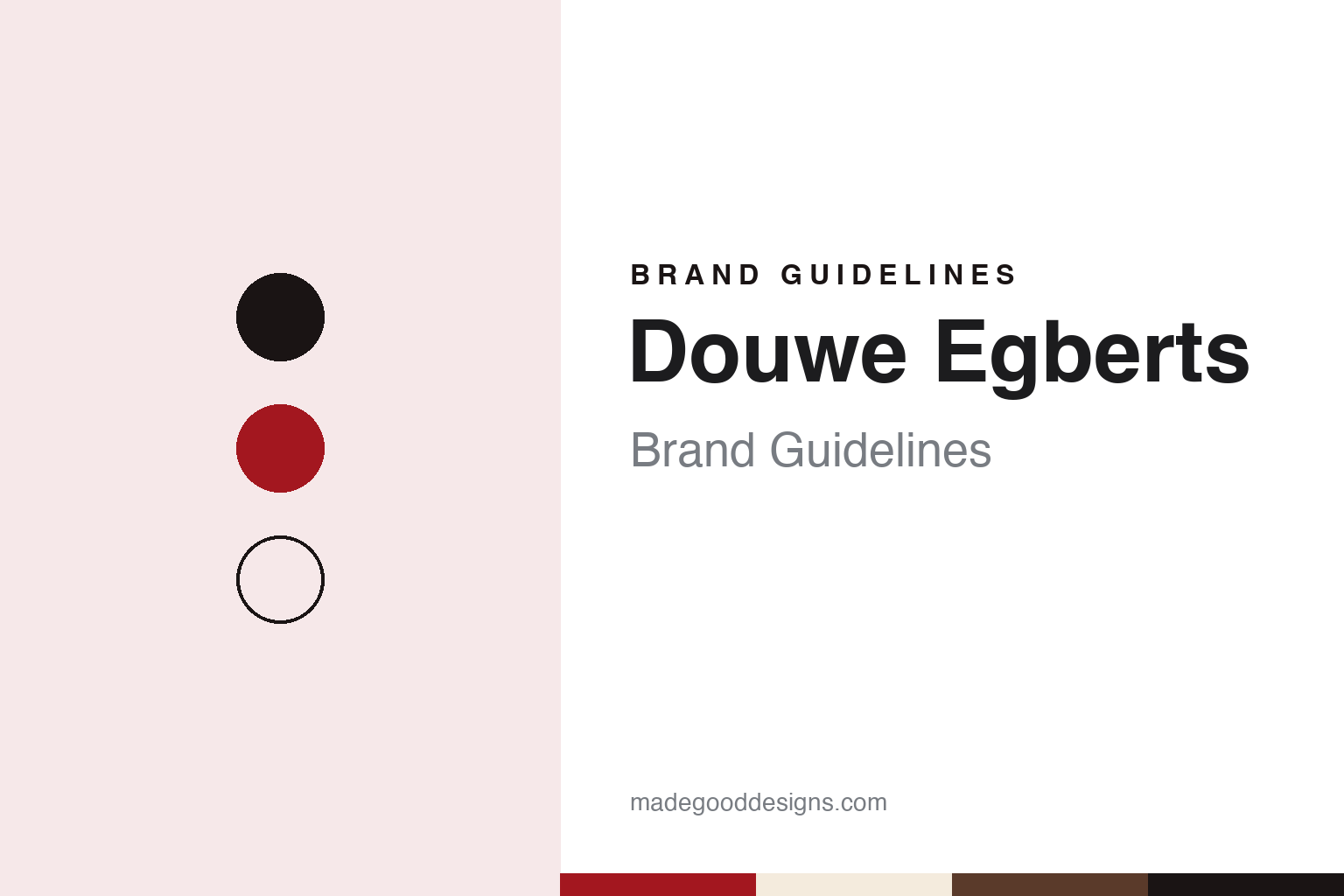
Douwe Egberts Brand Guidelines
The red DE seal from Joure, Friesland.
Aa
Two constants: a Douwe Egberts red, brown and cream palette and a Seal serif register. Abstract homage — not a Douwe Egberts product or mark; no seal, pack or logo is reproduced.
De Witte Os
A grocery in Joure, 1753.
Douwe Egberts traces itself to 1753, when Egbert Douwes and his wife Akke Thijsses opened a grocery called De Witte Os (“The White Ox”) on the Midstraat in Joure, Friesland. The company says coffee, tea and tobacco were its main products. Dutch Wikipedia gives the opening date as 11 March 1753 and says the couple had moved from the nearby village of Idskenhuizen; English Wikipedia gives 1752. The firm takes its name from their son, Douwe Egberts, who joined the business around 1780, according to the company, and to whom it was transferred that year, according to both Wikipedia editions. Dutch Wikipedia explains that both names are patronymics rather than surnames: Egbert was the son of a Douwe, and his own son Douwe was Egbert’s son.
After Douwe Egberts died in 1806, his widow Lysbeth Mintjes continued the firm as the “Firma van de Weduwe Douwe Egberts,” the company says; in 1812, under French rule, the family took the surname De Jong. Dutch Wikipedia credits the son with expanding the business beyond Joure. In 1919 the company opened a coffee roastery in Utrecht, on the Catharijnekade, chosen for its central location in the country; in 1929 it moved to the Merwedekade, now the Keulsekade, where Dutch Wikipedia says the company is still based in 2026.
The company’s own timeline marks the anniversaries: a 175th jubilee in Joure in 1928, and in 1953, at 200 years, the grant of the “Koninklijk” (Royal) predicate. It introduced Pickwick tea in 1937, named after Dickens’s The Pickwick Papers, and Moccona instant coffee in 50-gram jars in 1954. In 1976 its old warehouse in Joure became a museum; the company says Museum Joure now spans ten historic buildings and that De Witte Os is still open as a shop.
Colour
The red seal.
The best-documented element of the identity is the DE seal. The company says it first appeared in 1925 on tobacco packaging, has taken many forms since and now gives the brand quick recognition; English Wikipedia describes the 1925 logo as a red seal with a “D.E.” initialism. The sources we checked do not name a designer. The company’s timeline also records a figurative mark of a Friesian woman, which in 2002 made way for the “Aroma Lady.”
Tobacco was long part of the business. English Wikipedia says the tobacco brand White Ox took its name from the original shop, and that Douwe Egberts sold its tobacco interests, including Van Nelle and Drum rolling tobacco, to Imperial Tobacco in 1998. The company says it launched the Wigomat, an electric filter coffee maker, in 1963, and first advertised on Dutch television in 1967 with the line “Douwe Egberts koffie… lekkere koffie.” In 2001, working with Philips, it introduced the Senseo single-cup pad machine. Dutch Wikipedia notes the savings points printed on its packs, which customers can exchange for Douwe Egberts goods.
The original shop has an afterlife as an image: in 2018 De Witte Os was the model for KLM’s 99th Delft blue miniature house, Dutch Wikipedia says. The company’s historical archives up to 1978 are held at Tresoar, the Frisian historical and literary centre in Leeuwarden.
Typography
A seal older than the coffee brand.
The seven brands in this group all roast coffee, and they come from five European countries: Segafredo Zanetti and Kimbo from Italy, Julius Meinl from Austria, Tchibo and Dallmayr from Germany, Douwe Egberts from the Netherlands, and Paulig from Finland. Coffee brands in general sit at many different points in the trade, from vacuum packs on a supermarket shelf to espresso poured in a café under the roaster’s own sign, and a single company can work at both ends at once.
A coffee brand’s identity is usually carried less by a place of growth than by a blend, a pack and the cup it promises, because the beans inside will have been grown a long way from where the name on the front was roasted. That makes the questions behind each name worth asking plainly: who started it, who owns it now, where its coffee is bought, and where it is actually roasted and packed.
Each guide separates what independent sources record from what the company says about itself — its founding story, its owners over time, where its coffee comes from and where it is roasted — and marks plainly what rests only on the company’s own word.
Aa
A seal serif. (Specimen set in DM Serif Display, a serif STAND-IN; NOT the Douwe Egberts logo.)
Douwe Egberts
From Sara Lee to Keurig Dr Pepper.
Ownership changed several times after the Second World War. Douwe Egberts expanded into Belgium from 1948 and into France, Spain and Denmark, formed the holding company Koninklijke Douwe Egberts in 1968 and bought the Dutch roaster Kanis & Gunnink in 1969. In 1978 it came under the American Consolidated Foods, later the Sara Lee Corporation; Dutch Wikipedia says the company passed fully into Sara Lee’s hands that year after a number of steps, while the company’s timeline calls it a partnership. Under Sara Lee it took over Van Nelle in 1989.
In 2012 Sara Lee separated the coffee and tea business as D.E Master Blenders 1753, which began trading on Euronext Amsterdam on 12 June 2012. An investor group led by Joh. A. Benckiser (JAB) took it over in 2013 — The New York Times put the deal at $9.8 billion — and the shares left the exchange on 26 October 2013, Dutch Wikipedia says. In May 2015, after European Commission approval with conditions, it combined with Mondelēz International’s coffee business as Jacobs Douwe Egberts; in December 2019 that company merged with Peet’s Coffee as JDE Peet’s, which listed in Amsterdam in May 2020.
The latest owner is Keurig Dr Pepper. KDP announced its offer for JDE Peet’s on 25 August 2025; JDE Peet’s says the offer was declared unconditional on 27 March 2026, with settlement on 1 April 2026, and that on 29 September 2026 the Enterprise Chamber of the Amsterdam Court of Appeal ruled in squeeze-out proceedings for the remaining shares. KDP has said it plans to separate into two companies, one of them a global coffee business. JDE Peet’s calls Utrecht its global R&D centre, and in October 2025 it opened a revamped innovation laboratory there, alongside an innovation facility in Joure focused on extraction and freeze-drying; its research chief called Utrecht “the home of our oldest and most beloved brands – Douwe Egberts.”
For a design guide, Douwe Egberts shows a seal first printed on tobacco packs in 1925 that the company still uses to identify its coffee. Compare Peet’s Coffee, its sibling under JDE Peet’s, and Lavazza. For this guide we use a seal red, roast brown and cream with a serif, an unofficial interpretation; no product or logo is reproduced.
Explore & save
Keep Douwe Egberts’s identity on hand — save it to a board in the Made Good inspiration library.
Douwe Egberts identity set
Pin the Douwe Egberts red, brown and cream palette and the Seal serif register to your own board.