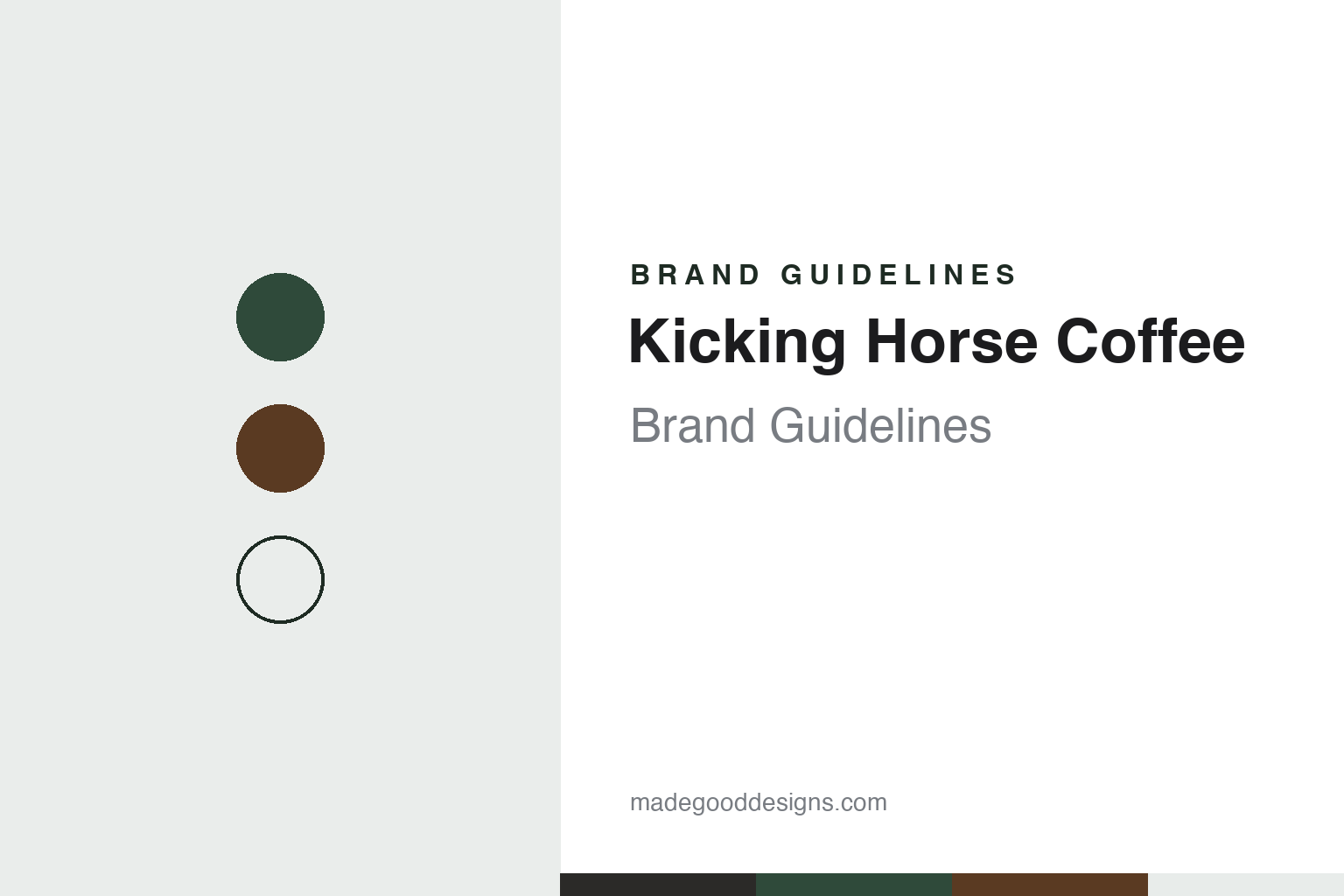
Kicking Horse Coffee Brand Guidelines
The Invermere garage roaster that grew into a Lavazza Group brand.
Aa
Two constants: a Kicking Horse charcoal, pine and dark-roast palette and a condensed sans register. Abstract homage — not a Kicking Horse Coffee product or mark; no bag, logo or label is reproduced.
A garage in the Rockies
Two founders, one roaster and a small town in British Columbia.
Kicking Horse Coffee began in 1996 in Invermere, British Columbia, in the Canadian Rockies. Its founders were Elana Rosenfeld and Leo Johnson, who, The Canadian Press reported in May 2017, “started Kicking Horse in 1996 with a coffee roaster in their garage.”
The company tells the same story in its own words. “Over 25 years ago we started roasting coffee,” its website says. “In a garage. Out in the Canadian Rocky Mountains, pretty much near the middle of nowhere.” It adds that “the garage is a little bigger now” and that the Rockies “are still right outside the front door.” The Lavazza Group, which now controls the business, describes the founders as having “dreamt of creating an innovative roasting facility” and says they began “an artisanal business, experimenting with the art of roasting and blending.”
The name is shared with the Kicking Horse Pass and the Kicking Horse River in the Rockies, which, according to English Wikipedia, were named after James Hector of the Palliser Expedition, who was kicked by his horse in 1858. The company’s website tells its own looser “legend” of a Rocky Mountain explorer kicked in the head by a horse, whose companions thought he was dead and began digging a grave, until, the site says, he “was woken up by a kick-ass cup of coffee.”
In 2008 the company opened a café in Invermere, The Canadian Press reported, and the café still appears on the brand’s website today.
Colour
Organic and Fairtrade, roasted in Invermere.
Kicking Horse built its identity around certified beans. “We only use certified Fairtrade and Organic coffee,” the company says on its sustainability page, explaining that it sees Fairtrade as a way to give farmers “better trading conditions” and to help supply grow with its own demand. It also says its organic coffee is tested by independent auditors, “randomly and without warning,” for pesticide and herbicide residues; we give that as the company’s claim.
The Lavazza Group tells a slightly longer story: the founders started with coffee “grown with strictly natural methods,” and over time “the brand intentionally focused on sourcing more organic and fair-trade coffee beans,” until its range became “certified all organic and fairtrade.” In 2017, reporting the Lavazza deal, The Canadian Press wrote that the company called itself a leader in the “fast-growing fair trade, organic segment.”
The roasts carry mountain and frontier names. In 2017 The Canadian Press listed Hoodoo Jo, Cliff Hanger and Grizzly Claw; the company’s website now leads with Grizzly Claw, Kick Ass, 454 Horse Power and Three Sisters, and is organised by light, medium and dark roast and by brewing method.
Where the coffee is roasted is stated plainly by the company. “Kicking Horse Coffee is roasted in Invermere, British Columbia,” its FAQ says — a point it makes while explaining that a United States tariff on Canadian goods sold online has affected its American e-commerce shop. The company’s website runs separate storefronts for the United States and for Canada in English and French, and it says it ships to both countries. In 2017 The Canadian Press reported that its beans were sold in cafés, grocery stores and online across Canada and the United States.
The Lavazza Group says Kicking Horse is “the market leader for organic coffee in North America” and that in Canada it was named “most trusted brand” in the Gustavson Brand Trust Index 2023; those are the parent company’s statements, which we have not checked independently.
Typography
Design and documentation.
The seven brands in this group all roast or sell coffee, and they come from four countries on two continents: Kicking Horse from Canada, Café du Monde from the United States, Löfbergs, Zoégas and Gevalia from Sweden, and Caffè Vergnano and Hausbrandt from Italy. Coffee brands in general sit at many different points in the trade, from vacuum packs on a supermarket shelf to espresso poured in a café under the roaster’s own sign, and a single company can work at both ends at once.
A coffee brand’s identity is usually carried less by a place of growth than by a blend, a pack and the cup it promises, because the beans inside will have been grown a long way from where the name on the front was roasted. That makes the questions behind each name worth asking plainly: who started it, who owns it now, where its coffee is bought, and where it is actually roasted and packed.
Each guide separates what independent sources record from what the company says about itself — its founding story, its owners over time, where its coffee comes from and where it is roasted — and marks plainly what rests only on the company’s own word.
Aa
A condensed sans for a mountain roaster’s loud, plain voice. (Specimen set in Oswald, a condensed sans STAND-IN; NOT the Kicking Horse Coffee logo.)
Kicking Horse Coffee
From private equity to the Lavazza Group.
Outside investors arrived first. In 2012, The Canadian Press reported, the private-equity fund Swander Pace Capital and partners bought a controlling stake in the company.
On 24 May 2017 Italy’s Lavazza Group announced that it was buying an 80 per cent stake in Kicking Horse from Swander Pace, in a deal that, according to The Canadian Press, valued the company at $215 million (Canadian). Elana Rosenfeld kept a 20 per cent stake and was to stay on as chief executive, while Lavazza’s chief executive, Antonio Baravalle, was to become chairman. Lavazza called Kicking Horse one of the “local jewels” it was looking for as it set out to acquire premium brands. English Wikipedia’s article on Lavazza records the same 80 per cent purchase in May 2017, citing that report.
The deal came shortly after Lavazza’s purchase of Carte Noire in France and Merrild in Denmark, which English Wikipedia dates to February 2016. Today the Lavazza Group lists four brands — Lavazza, Carte Noire, Kicking Horse and Merrild — and says Kicking Horse “joined our Group in 2017.” The coffee company’s own website carries the name Kicking Horse Coffee Co. Ltd. We found no later report of a change to the 80 per cent and 20 per cent holdings in the sources we checked, so we do not state the current split.
For a design guide, Kicking Horse Coffee shows how a small-town roaster can keep its mountain voice and its certified-bean promise after joining a large group. Compare Lavazza, its Italian parent, and Café du Monde, another North American coffee name tied to one place. For this guide we use charcoal, pine and a dark-roast brown with a sans, an unofficial interpretation; no product or logo is reproduced.
Explore & save
Keep Kicking Horse Coffee’s identity on hand — save it to a board in the Made Good inspiration library.
Kicking Horse Coffee identity set
Pin the Kicking Horse charcoal, pine and dark-roast palette and the condensed sans register to your own board.