Gevalia Brand Guidelines
The Gävle coffee named in Latin, split between two owners.
Aa
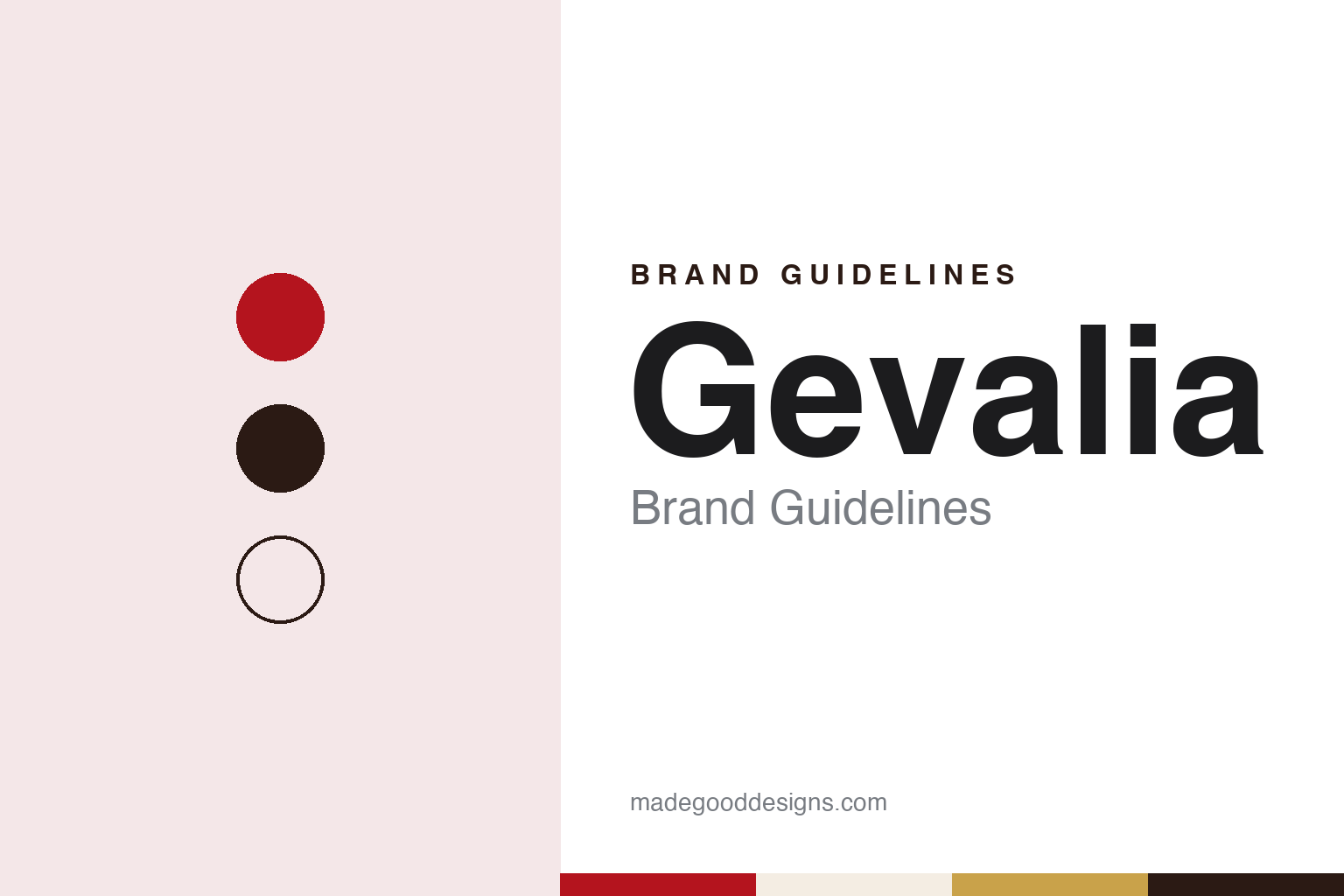
Two constants: a Gevalia red, brown and cream palette and a heritage serif register. Abstract homage — not a Gevalia product or mark; no packet, logo or label is reproduced.
Engwall’s trading house
A merchant in a port town, and a name in Latin.
Gevalia’s story begins with a general merchant. In 1853, the brand’s Swedish website says, a 26-year-old named Victor Theodor Engwall registered the firm “Victor Th Engwalls Handelshus i Gefle” in Gävle, a port town on Sweden’s east coast which, the company says, then had about 9,500 inhabitants and some 80 competing retailers. The trading house dealt in goods as varied as grain, spirits, snus, tobacco, glass and meat, and survived the great fire that destroyed much of the town in 1869. It became a limited company in 1905, and in 1908, the company says, Engwall’s son Ernst took over; English Wikipedia lists four further Engwall chief executives, the last of them, Jacob Engwall, in charge from 1963 to 1972.
Coffee came later. The company says Engwall bought its first roasting plant in 1913, to sell customers coffee of a more even quality than the beans roasted in shops or at home, and registered the name Gevalia in 1914. The name is the Latin form of Gävle; Swedish Wikipedia says it was devised by a few local residents with a knowledge of languages, and that the same Latin name has been used in the town for other businesses, including a cinema and a mineral-water maker.
According to the company, the name only really took hold in the 1920s, when it was printed on the red, pre-packed coffee packets the firm began to sell; on its Swedish website the brand marks 2020 as its hundredth year. Swedish Wikipedia gives 1920 as the launch of the Gevalia name, while the American website run by Kraft Heinz says Gevalia was “founded in 1853 in Gavle, Sweden, by Victor Theodor Engwall” — so the founding date depends on whether one counts the trading house or the coffee.
Colour
Vacuum packs, General Foods and an unexpected visitor.
The firm grew as a coffee business through the middle of the century. The company says it set up a research laboratory in 1948 and, five years later, opened one of Europe’s largest coffee roasteries in Gävle; it began vacuum-packing its coffee in 1957, so that ground coffee could be transported and stored without losing flavour, and says Gevalia became the most-drunk coffee in Sweden in 1966. Swedish Wikipedia adds that the company began grinding coffee at the factory and selling it in tins in 1947, and that in 1970 it bought the spice maker Kockens of Ystad.
In 1971, after about 120 years as a family business, the Engwalls sold the company — including Gevalia and Kockens — to the American food group General Foods, Swedish Wikipedia says; English Wikipedia and the company give the same year. General Foods had already bought another Swedish roaster, Coffea, maker of Premiär coffee, and moved its production from Gröndal to Gävle. It launched Gevalia in Denmark in 1973 and for a time ran a roastery at Glostrup, outside Copenhagen, which closed in 2004, when Danish production moved to Gävle. In the United States, Gevalia was sold from 1983 through a mail-order service, according to English Wikipedia; Swedish Wikipedia says it was positioned there as a gourmet coffee imported from Sweden.
Gevalia’s best-known advertising began in 1985. The company says the brand had come to seem old-fashioned by the early 1980s, and that the agency Young & Rubicam was asked to win younger city drinkers without losing existing ones. The result was a question: “Vilket kaffe skulle du bjuda på om du fick oväntat besök?” — “Which coffee would you serve if you had an unexpected visitor?” The first advertisement showed a large ship docking at a tiny skerry; the first television commercial, in 1991, showed a weightlifter falling through his floor into a neighbour’s coffee break. In December 1995, the company says, it set up three unannounced installations in central Stockholm: a light aircraft on the “Svampen” shelter at Stureplan, a metro carriage half-emerged from the ground at Norrmalmstorg and a hot-air balloon caught in the glass sculpture at Sergels Torg.
Typography
Design and documentation.
The seven brands in this group all roast or sell coffee, and they come from four countries on two continents: Kicking Horse from Canada, Café du Monde from the United States, Löfbergs, Zoégas and Gevalia from Sweden, and Caffè Vergnano and Hausbrandt from Italy. Coffee brands in general sit at many different points in the trade, from vacuum packs on a supermarket shelf to espresso poured in a café under the roaster’s own sign, and a single company can work at both ends at once.
A coffee brand’s identity is usually carried less by a place of growth than by a blend, a pack and the cup it promises, because the beans inside will have been grown a long way from where the name on the front was roasted. That makes the questions behind each name worth asking plainly: who started it, who owns it now, where its coffee is bought, and where it is actually roasted and packed.
Each guide separates what independent sources record from what the company says about itself — its founding story, its owners over time, where its coffee comes from and where it is roasted — and marks plainly what rests only on the company’s own word.
Aa
A heritage serif — in the spirit of a long-lived grocery brand. (Specimen set in Playfair Display, a serif STAND-IN; NOT the Gevalia logo.)
Gevalia
One name, two owners.
Swedish Wikipedia says Gevalia followed General Foods into its merger with Kraft and then, in 2012, into Mondelez International when Kraft Foods divided its business. English Wikipedia says the rights to the brand were divided at that split, and are now held by Kraft Heinz in North America and by JDE Peet’s in the rest of the world. Mondelez’s coffee business merged with Douwe Egberts in 2015 to form Jacobs Douwe Egberts, which became JDE Peet’s after a merger with Peet’s Coffee in December 2019, English Wikipedia says. Keurig Dr Pepper announced in August 2025 that it would buy JDE Peet’s, and a JDE Peet’s release of 5 October 2026 describes a court-ordered squeeze-out of its remaining shareholders by a KDP subsidiary.
The two halves now make the coffee in different places. The Swedish website, published by Jacobs Douwe Egberts S.E. AB, says all Gevalia filter coffees are roasted, blended and ground at its roastery in Gävle — at Alderholmen, according to Swedish Wikipedia — taking in 150 to 200 tonnes of beans a day. Swedish Wikipedia says production for the American market moved from Gävle to the United States in autumn 2014, and English Wikipedia says the North American coffee is roasted, ground and packaged there rather than imported. In the United States the gevalia.com address now leads to Kraft Heinz’s website, where the range includes K-Cup pods, and English Wikipedia notes the name is styled “gëvalia” there.
The company says Gevalia launched an organic coffee certified by the Swedish label KRAV in 1995 and began working with the Rainforest Alliance about a decade later, and that its Swedish range runs to around thirty coffees.
For a design guide, Gevalia shows how a town’s Latin name, a red packet and one long-running advertising question became a brand that two companies now share. Compare Zoégas and Löfbergs, two more Swedish roasters. For this guide we use a packet red, a roast brown and cream with a serif, an unofficial interpretation; no product or logo is reproduced.
Explore & save
Keep Gevalia’s identity on hand — save it to a board in the Made Good inspiration library.
Gevalia identity set
Pin the Gevalia red, brown and cream palette and the heritage serif register to your own board.