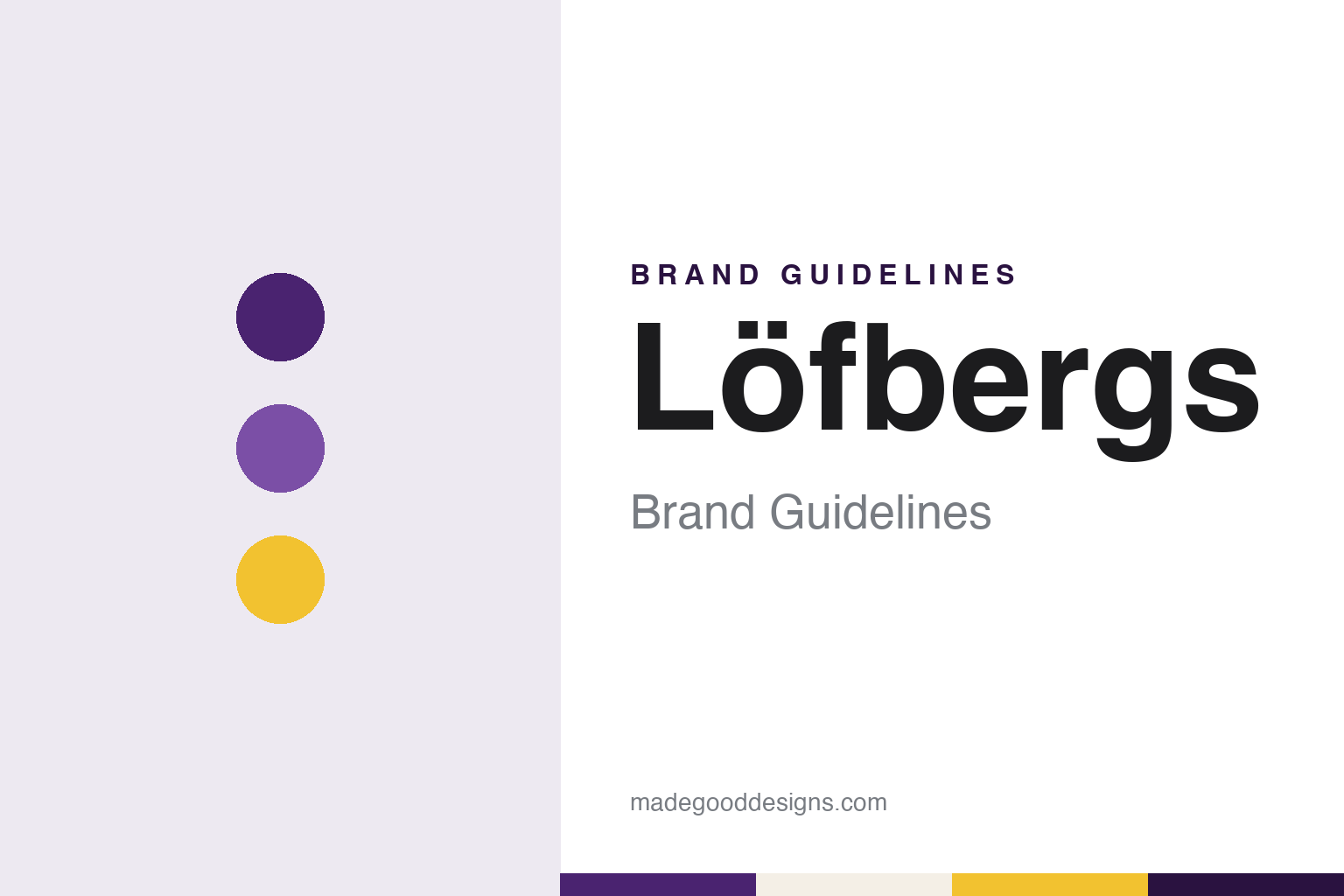
Löfbergs Brand Guidelines
The Karlstad roaster that registered a colour.
Aa
Two constants: a Löfbergs purple palette and a friendly geometric sans register. Abstract homage — not a Löfbergs product or mark; no pack, logo or colour registration is reproduced.
Three brothers
A coffee importer in Karlstad, 1906.
Löfbergs began in Karlstad, in the Swedish province of Värmland, in 1906. The company says the brothers Anders, John and Josef Löfberg started out importing and selling coffee in and around the town. Swedish Wikipedia describes the first business as a wholesale firm for coffee and colonial goods, and adds that the brothers also imported Citroën cars before starting a roastery. In 1927, Swedish Wikipedia says, the business was divided: Josef took the wholesale trade, John the car imports and Anders the coffee roastery.
The company dates its own roasting to 1911, noting that this was roughly when the Swedish word fika came into use. In 1960 it opened the “kaffeskrapan” — the coffee skyscraper — in Karlstad, where the company says it still roasts, tastes and packs much of its coffee; Swedish Wikipedia places the tower in the town’s Inre hamn, the inner harbour.
The company’s own timeline then moves outward. In the 1980s it says it made a push into hotels, restaurants and cafés, the “out of home” trade, where it now calls itself the market leader; English Wikipedia also describes it as Sweden’s major supplier of coffee to restaurants, cafés and companies. In the 1990s it began exporting, and today, the company says, half of its coffee is exported, with offices in Sweden, Norway, Finland, Denmark, Latvia and England.
On 1 July 2021, its 115th birthday, Löfbergs opened a new roastery for whole beans in Karlstad, which it calls the largest investment in the company’s history.
Colour
A blend in a purple bag.
The colour came before the name. In the 1920s Löfbergs began selling coffee to households in coloured packs, and by 1927, according to Swedish Wikipedia and the Swedish Intellectual Property Office (PRV), it offered eleven blends in packs of different colours. The luxury blend, Löfbergs Lyxblandning, came in purple, and customers began calling it Löfbergs Lila — “Löfbergs purple.” The company says the purple pack became the most popular and that people nicknamed the firm “de lila,” the purple ones. Swedish Wikipedia dates the formal adoption of the Löfbergs Lila name to 1955.
Löfbergs is also a trade-mark case study. PRV, which used Löfbergs Lila as a worked example on its website, says the company has both its logo and its purple colour registered as trade marks. The colour registration covers coffee products only, and was granted in 2005 after the company showed that the colour was associated with its brand, PRV says. Swedish Wikipedia calls Löfbergs one of few Swedish companies to have protected a colour this way. The company says the purple is protected in both Sweden and Estonia.
PRV adds that in 2007 the company received the Signumpriset, a prize given to Nordic companies for long-term care of a brand, in part for using the colour as its mark and getting it registered.
In August 2012 the company dropped “Lila” and went back to the name Löfbergs, Dagens Media reported at the time. The company says the purple stayed: on a page marking its 120th year it calls the colour “our signature.”
The purple also reached sport. Löfbergs sponsors the Karlstad ice-hockey club Färjestad BK and its home rink, Löfbergs Arena. For many years the club played in the same purple and yellow as Löfbergs, English Wikipedia says, until a change for the 2006–07 season that Expressen reported in May 2006.
On packaging, the company says it aims for all its packs to be fully recyclable and made of renewable or recycled material by 2030. It describes its ground-coffee pack as a plastic bag — about half from renewable feedstock — with a thin paper wrap, and says its iced coffee is packed in CartoCan cartons made in Värmland.
Typography
Design and documentation.
The seven brands in this group all roast or sell coffee, and they come from four countries on two continents: Kicking Horse from Canada, Café du Monde from the United States, Löfbergs, Zoégas and Gevalia from Sweden, and Caffè Vergnano and Hausbrandt from Italy. Coffee brands in general sit at many different points in the trade, from vacuum packs on a supermarket shelf to espresso poured in a café under the roaster’s own sign, and a single company can work at both ends at once.
A coffee brand’s identity is usually carried less by a place of growth than by a blend, a pack and the cup it promises, because the beans inside will have been grown a long way from where the name on the front was roasted. That makes the questions behind each name worth asking plainly: who started it, who owns it now, where its coffee is bought, and where it is actually roasted and packed.
Each guide separates what independent sources record from what the company says about itself — its founding story, its owners over time, where its coffee comes from and where it is roasted — and marks plainly what rests only on the company’s own word.
Aa
A friendly geometric sans for a purple brand. (Specimen set in Outfit, a sans STAND-IN; NOT the Löfbergs logo.)
Löfbergs
Still a family company.
Löfbergs has stayed in the family. On its 120th-anniversary page the company says it is still family-owned, now in the fourth generation, and active in about ten markets in northern Europe. English Wikipedia names Kathrine Löfberg as chair of the board. Swedish Wikipedia gives the group’s parent company as Bröderna Löfberg Aktiebolag, which also holds property and investment arms.
The roasting is not all in Karlstad. Swedish Wikipedia says the company roasts in Karlstad, in Denmark under the Peter Larsen Kaffe brand, and in Latvia; English Wikipedia says Löfbergs owns half of Peter Larsens Kaffe of Viborg, so the two sources describe that link differently. Both say it owns the tea brand Kobbs.
Much of what Löfbergs says about itself concerns sourcing. The company says it imported the first container of organic coffee into Sweden in 1995, and that it is now one of the world’s largest buyers and roasters of organic and Fairtrade-labelled coffee; Swedish Wikipedia says it buys from certified farms under the organic, Fairtrade and Rainforest Alliance schemes. In 2001, the company says, it co-founded International Coffee Partners with other family-owned coffee companies to work with smallholder farmers.
On market share, English Wikipedia, citing a marketing agency’s case study, calls Löfbergs the second-largest coffee brand in Sweden, with a 24.5 per cent share in 2023, and, citing a 1999 book on Karlstad’s buildings, gives a 20 per cent share in 1999.
The company runs a coffee bar, Löfbergs Rosteri och Kaffebar, in Karlstad, and offers guided tours and tastings there. A café it opened on Kungsgatan in central Stockholm in 2015 closed in January 2022, English Wikipedia says, citing Fastighetsvärlden.
For a design guide, Löfbergs shows how a single pack colour, picked up by customers as a nickname, can become a registered mark. Compare Zoégas, another Swedish roaster with a long history, and Paulig in Finland. For this guide we use purple, plum and a yellow with a geometric sans, an unofficial interpretation; no product or logo is reproduced.
Explore & save
Keep Löfbergs’s identity on hand — save it to a board in the Made Good inspiration library.
Löfbergs identity set
Pin the Löfbergs purple and yellow palette and the friendly geometric sans register to your own board.