Zoégas Brand Guidelines
The Helsingborg dark roast behind Skånerost.
Aa
Two constants: a Zoégas dark-roast palette and a heritage serif register. Abstract homage — not a Zoégas product or mark; no pack, logo or illustration is reproduced.
Carlos and Maria
A coffee shop on Kullagatan, 1886.
Zoégas traces its start to Helsingborg in 1886. The company says Carlos Zoéga was born in Sweden in 1850, emigrated to Brazil in 1871 and began trading coffee there. Back in Sweden, he opened a coffee shop in Landskrona in 1881, the company says, specialising in dark-roasted coffee; Swedish Wikipedia dates his return from Brazil to 1880.
In Landskrona he met Maria Tufvesdotter Thunéll, who, according to the company, had sold apples in the market at Ängelholm and ran her own photography studio by the age of 24. They married in 1885, and moved the business to Helsingborg. An advertisement in Helsingborgs Dagblad on 30 November 1886 announced a coffee, sugar and tea shop at Kullagatan 27; the company dates the opening to the next day, 1 December. Swedish Wikipedia says the couple lived and roasted on the premises, under the name Helsingborgs Patent-Kaffe-Ångbränneri.
The advertisement named Carlos alone. The company now says that is “only half the truth”: married women were legally minors at the time, it writes, and it has rewritten its history to give Maria her place as official co-founder. Swedish Wikipedia also lists both as founders.
Carlos died in 1888, two years after the opening. Maria kept the business going, selling from café to café across Helsingborg, the company says, and turned down offers to sell. She later married the confectioner Johan Svensson, who took the Zoéga name and joined the firm, and they had a son, Rudolf. In 1902, according to the company, the shop and the family home moved to Drottninggatan, where a shop and café still stand.
Colour
Blends named for hotels.
Two of the blends Zoégas still sells were first made for hotels. In 1903 the company created Mollbergs Blandning to order for the restaurateur of Hotell Mollberg in Helsingborg, which the company says is still open. In 1918 it created Horns blandning for the family behind Hotell Horn in Malmö, now the Hotel Savoy. That blend was later renamed Skånerost — “Scanian roast” — and the company calls it its best-selling coffee of all time; the company issued a press release for the blend’s 100th year.
Rudolf Zoéga joined the firm in 1913 and became its head in 1923, according to both Swedish Wikipedia and the company. Swedish Wikipedia credits him with turning the business into an industrial operation and quotes him comparing the blending of coffee to composing music: “There must be harmony for the composition to be good.” The company quotes the same comparison. The company says that in the late 1920s it bought an American roaster able to roast up to 240 kilos at a time, but chose to fill it with 180 kilos for the sake of quality.
During the Second World War, coffee was rationed in Sweden, and Swedish Wikipedia says the Zoégas factory, like those of the other large roasters, was made a temporarily protected site because coffee was considered a necessity.
In 1952 roasting moved to a new building on Ängelholmsvägen in Helsingborg, which the company calls one of Europe’s most modern roasteries at the time and says is the same site it works from today. Swedish Wikipedia puts the operation at about 70 staff producing more than 17,000 tonnes of coffee a year.
Dark roast is still the brand’s position. The company calls itself a leader and expert in dark roast, says its range runs from medium to extra-dark roast and espresso, and names beans from East Africa, especially Kenya, as a signature of its blends. It also sells capsules for Nespresso machines under the name Zoégas by Nespresso, including an Espresso Skånerost.
Typography
Design and documentation.
The seven brands in this group all roast or sell coffee, and they come from four countries on two continents: Kicking Horse from Canada, Café du Monde from the United States, Löfbergs, Zoégas and Gevalia from Sweden, and Caffè Vergnano and Hausbrandt from Italy. Coffee brands in general sit at many different points in the trade, from vacuum packs on a supermarket shelf to espresso poured in a café under the roaster’s own sign, and a single company can work at both ends at once.
A coffee brand’s identity is usually carried less by a place of growth than by a blend, a pack and the cup it promises, because the beans inside will have been grown a long way from where the name on the front was roasted. That makes the questions behind each name worth asking plainly: who started it, who owns it now, where its coffee is bought, and where it is actually roasted and packed.
Each guide separates what independent sources record from what the company says about itself — its founding story, its owners over time, where its coffee comes from and where it is roasted — and marks plainly what rests only on the company’s own word.
Aa
A heritage serif for a coffee house founded in 1886. (Specimen set in Playfair Display, a serif STAND-IN; NOT the Zoégas logo.)
Zoégas
A Nestlé brand roasted in Helsingborg.
Zoégas became a limited company in 1958, Swedish Wikipedia says, and its independence ended in 1986. That year — “exactly 100 years after the founding,” the company notes — AB Findus took a majority of the shares in Zoégas Kaffe AB. Findus was already part of Nestlé: according to Nestlé’s own Swedish history, Nestlé S.A. bought Findus from Marabou on 2 May 1962. Nestlé describes Zoégas at the time of the 1986 deal as the market leader in dark-roast coffee.
The brand was then folded into Nestlé’s Swedish company. Nestlé says its Swedish head office moved from Bjuv to Helsingborg’s Norra hamnen in 2000, and that in 2006 Zoégas Kaffe AB was merged into Nestlé Sverige AB. The company still describes production as taking place in Helsingborg.
The original shop has had its own history. Nestlé says a Zoégas café opened in the company’s first production premises in 1994. Swedish Wikipedia says the Drottninggatan shop, with fittings from 1931, was closed by Nestlé in 2022, as Helsingborgs Dagblad reported in March, and reopened under local owners in cooperation with Nestlé less than three months later, as the same paper reported in June; it now trades as Café 1886.
Packaging is where the brand talks most about design. The company says each of its coffees has its own story, illustrated on the pack. For 2026, its 140th year, it released Mon Amie, a dark roast made with the porcelain maker Rörstrand to mark Rörstrand’s 300th anniversary; the pack draws on the blue-flowered Mon Amie pattern that Marianne Westman designed in 1952, the company says. It also says it has replaced plastic with paper for the secondary packaging of its vacuum packs, and that all its coffee now comes in soft plastic designed for recycling.
On sourcing, the company says all its blends are certified, and Swedish Wikipedia says all varieties are Rainforest Alliance certified. Its Coffee by Women programme has helped train more than 50,000 coffee farmers, at least 30 per cent of them women, the company says. It also gives a Maria Zoéga scholarship, named for the co-founder, and its website announces the 2026 award.
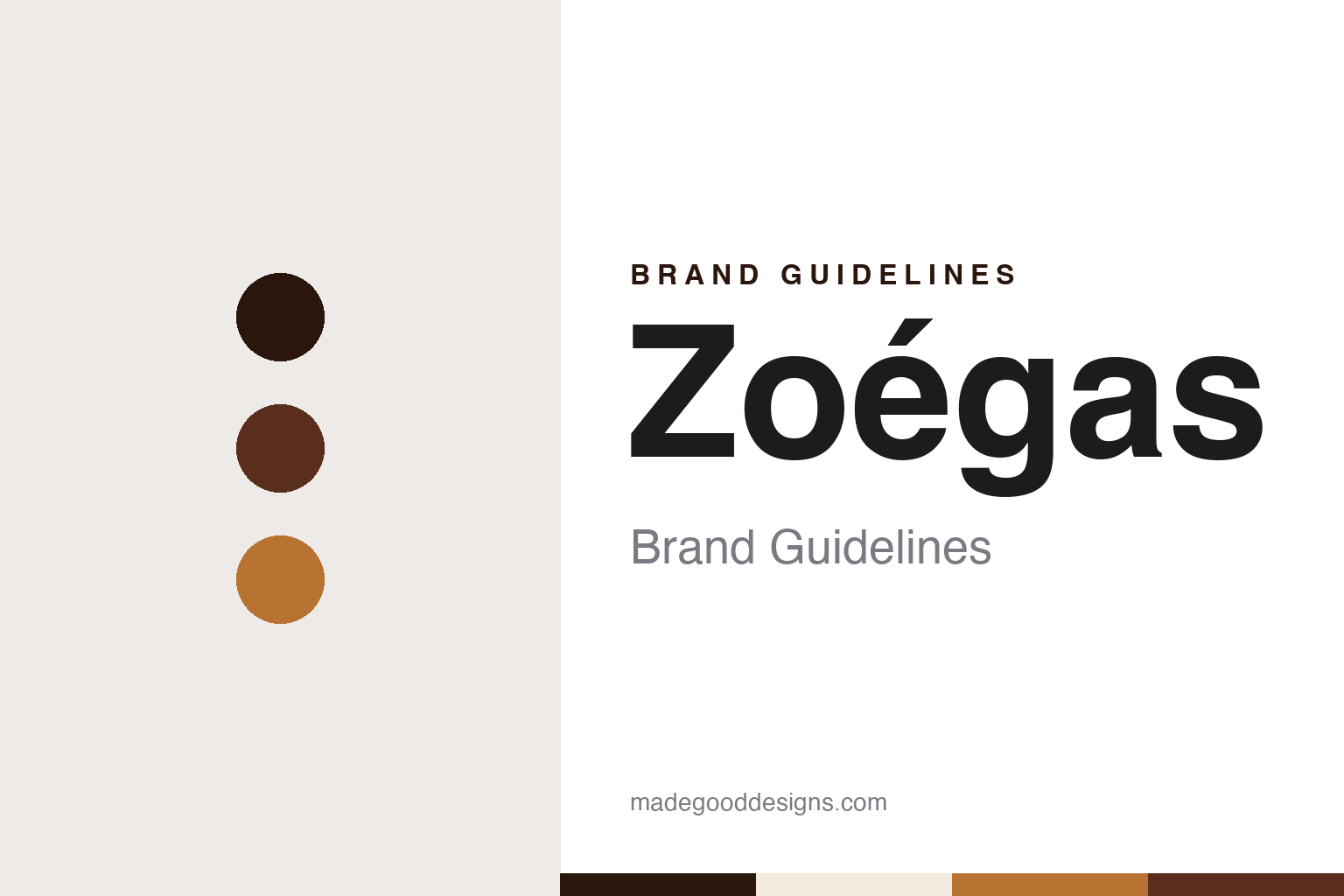
For a design guide, Zoégas shows how a brand can rewrite its own founding story and still keep one product, a dark roast, at its centre. Compare Löfbergs, its family-owned rival in Karlstad, and Gevalia. For this guide we use dark-roast brown, copper and cream with a serif, an unofficial interpretation; no product or logo is reproduced.
Explore & save
Keep Zoégas’s identity on hand — save it to a board in the Made Good inspiration library.
Zoégas identity set
Pin the Zoégas dark roast and copper palette and the heritage serif register to your own board.