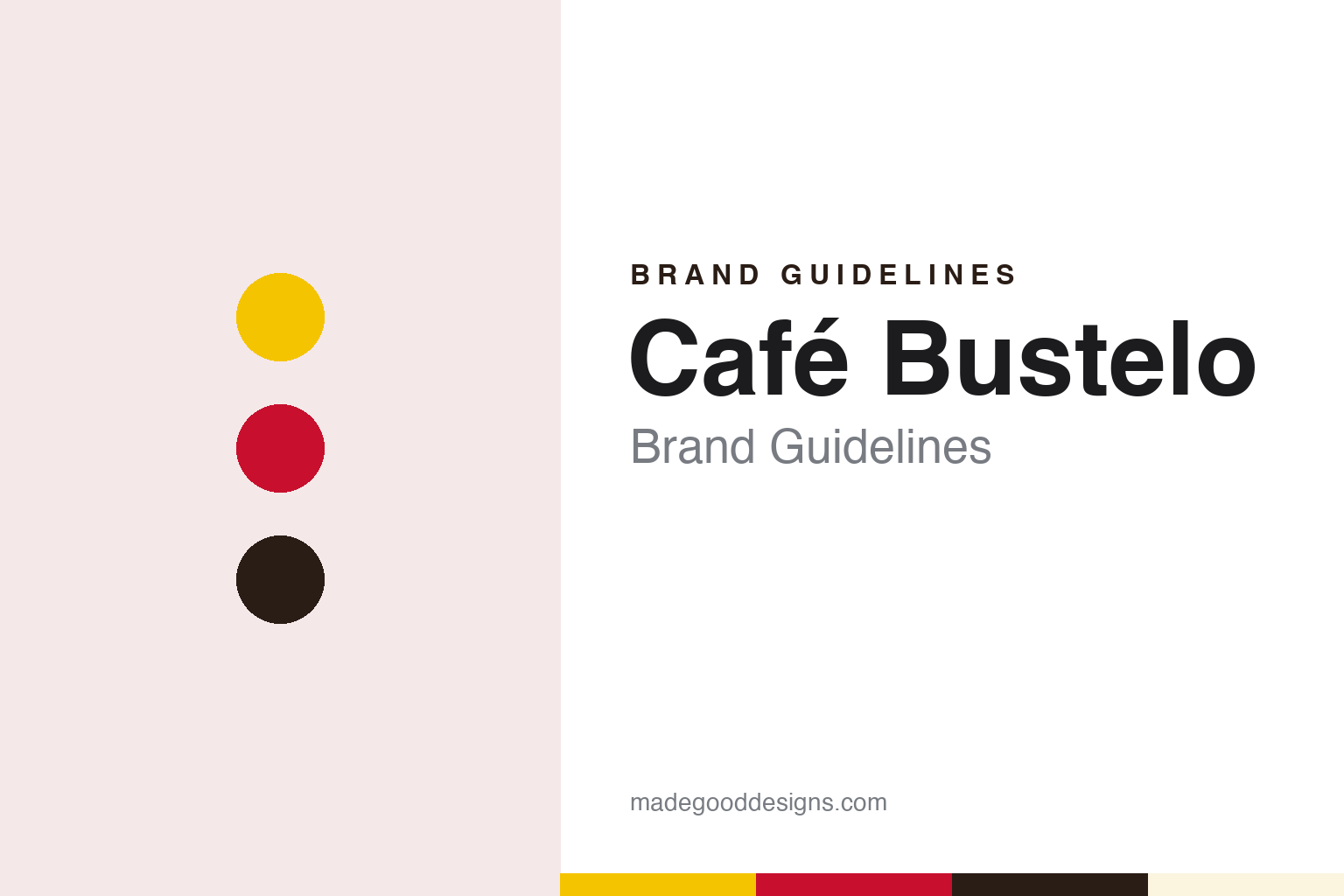
Café Bustelo Brand Guidelines
The East Harlem espresso-style coffee in the yellow-and-red can.
Aa
Two constants: a Café Bustelo yellow and red palette and a heavy sans register. Abstract homage — not a Café Bustelo product or mark; no can, brick, logo or label is reproduced.
El Barrio
A Spanish immigrant’s roaster on Fifth Avenue.
Café Bustelo began in East Harlem, New York, the neighbourhood also known as El Barrio. Its founder was Gregorio Menéndez Bustelo (1892–1965), an immigrant from Spain who, English Wikipedia says, spent time in Cuba as a young man and moved to the United States in 1917, citing the National Cyclopaedia of American Biography. His birthplace has been given two ways. The company’s own history, as archived in 2012, called him “a young man from Galicia, Spain”; in 2017 NBC News reported that the New York University historian James Fernandez had found immigration records placing his birth in Asturias, and English Wikipedia names the town as Luarca.
The founding date is also given two ways. The company’s website today says Gregorio first sold hand-ground coffee from his home and, “by 1928,” had saved enough to open a Bustelo Coffee Roasters storefront on Fifth Avenue. The earlier version of the same site said that “by 1931” the “Bustelo Coffee Roasters” sign hung over a storefront on Fifth Avenue between 113th and 114th Streets, and a 2015 blog post by New York’s Tenement Museum also gives 1931. English Wikipedia uses 1928.
The company says that in the 1930s Gregorio sold door to door to Latino-owned bodegas and independent supermarkets, and that in 1933 he married Angelina, who was born in Venezuela to Italian parents; together, it says, they grew the business. In the company’s words, Bustelo Coffee Roasters was “one of the first coffee roasters that catered to all Hispanic communities” — a claim we give as its own.
Colour
Espresso-style, in a brick and a can.
Bustelo’s product is a dark, finely ground coffee sold as espresso-style. English Wikipedia, citing the 2012 book Cubans, an Epic Journey, says it became popular with Cuban exiles, who brewed it in espresso coffeemakers rather than through the cloth filter, or coffee “sock,” then common. The company describes its coffee as “a shared tradition among people of Cuban, Puerto Rican, Spanish and other Latin origins.”
The packaging is the brand’s best-known feature. English Wikipedia says the company was known for its “distinctive yellow and red cans,” and the Tenement Museum’s 2015 post described “a brick of vacuum-sealed, brilliantly-colored Café Bustelo” in the corner stores of all five boroughs. Today the company sells, among other formats, a ground espresso coffee brick, single-serve pods and instant coffee. In 2020 its website described the brand’s colours as “bright sunshine yellows, cool ocean blues, fiery passionate reds.” No official colour values or typeface are published.
The can also appears in popular culture. Café Bustelo is named in “Today 4 U,” a song in the 1996 musical Rent. NBC News noted that reference in 2017, along with a Bustelo can on a kitchen counter in the CBS sitcom The Big Bang Theory and an empty one used as a swear jar in the Netflix series Luke Cage. English Wikipedia records artists using the Bustelo image and logo in paintings and prints.
Typography
Coffee brands of the Americas.
The seven brands in this group all sell coffee, and they come from four countries of the Americas: Café Bustelo, Community Coffee, Folgers and Maxwell House from the United States, Juan Valdez from Colombia, Café Britt from Costa Rica, and Pilão from Brazil. Each guide follows its own name back to where it started and forward to whoever owns it today, rather than treating the group as one story.
A coffee brand’s identity is usually carried by a name, a pack and a promise about the cup, and the beans behind it may have been grown far from where the name on the front was roasted. That makes the plain questions behind each name worth asking: who started it, who owns it now, where its coffee is bought, and where it is actually roasted and packed.
Each guide separates what independent sources record from what the company says about itself — its founding story, its owners over time, where its coffee comes from and where it is roasted — and marks plainly what rests only on the company’s own word.
Aa
A heavy sans for a loud pack. (Specimen set in Archivo Black, a sans STAND-IN; NOT the Café Bustelo logo.)
Café Bustelo
From a Miami family roaster to J.M. Smucker.
The brand passed out of the Bustelo family in 2000, when it was bought by Rowland Coffee Roasters of Miami, according to English Wikipedia and the Tenement Museum. The Tenement Museum described Rowland as a family-owned rival with Cuban roots, owned by the Souto family, who began the company after arriving in Florida in 1960, and said Bustelo’s marketing expanded under Rowland, including parties at music festivals such as Coachella in 2009. Rowland’s other leading brand was Café Pilón. The Café Bustelo website of that period, archived in 2012 with a Rowland copyright line, listed ground, decaffeinated and instant coffees alongside extensions such as Supreme by Bustelo, a cappuccino mix, an espresso beverage called Bustelo Cool and an iced tea mix, Té Bustelo.
On 16 May 2011 The J.M. Smucker Company of Orrville, Ohio, announced that it had completed the purchase of Rowland’s coffee brands and business operations for $360 million. Its release described Rowland as “a leading producer of espresso coffee in the U.S.,” with distribution concentrated in the northeastern United States and southern Florida, and said the deal included a manufacturing, distribution and office facility in Miami. Smucker said it expected to move manufacturing to its existing coffee facilities in New Orleans in about three years. NPR reported in June 2011 that Bustelo was the first major Hispanic brand Smucker had bought. Smucker’s release also said it intended to use its existing coffee infrastructure to expand distribution and marketing support for the acquired brands.
Smucker now says its New Orleans facilities produce Folgers, Dunkin’ and Café Bustelo, and that it has had coffee operations in the city since 1963. English Wikipedia, citing the same company page, says Café Bustelo is roasted in New Orleans. The copyright line on the Café Bustelo website names The J.M. Smucker Company.
For a design guide, Café Bustelo shows a coffee brand identified by the yellow and red of its can and brick. Compare Kimbo, another espresso brand, and Café du Monde, another coffee name tied to New Orleans. For this guide we use a yellow, a red and a dark roast brown with a heavy sans, an unofficial interpretation; no product or logo is reproduced.
Explore & save
Keep Café Bustelo’s identity on hand — save it to a board in the Made Good inspiration library.
Café Bustelo identity set
Pin the Café Bustelo yellow and red palette and the heavy sans register to your own board.


