Pilão Brand Guidelines
Brazil’s “strong coffee,” launched in 1978 by a São Paulo refiner.
Aa
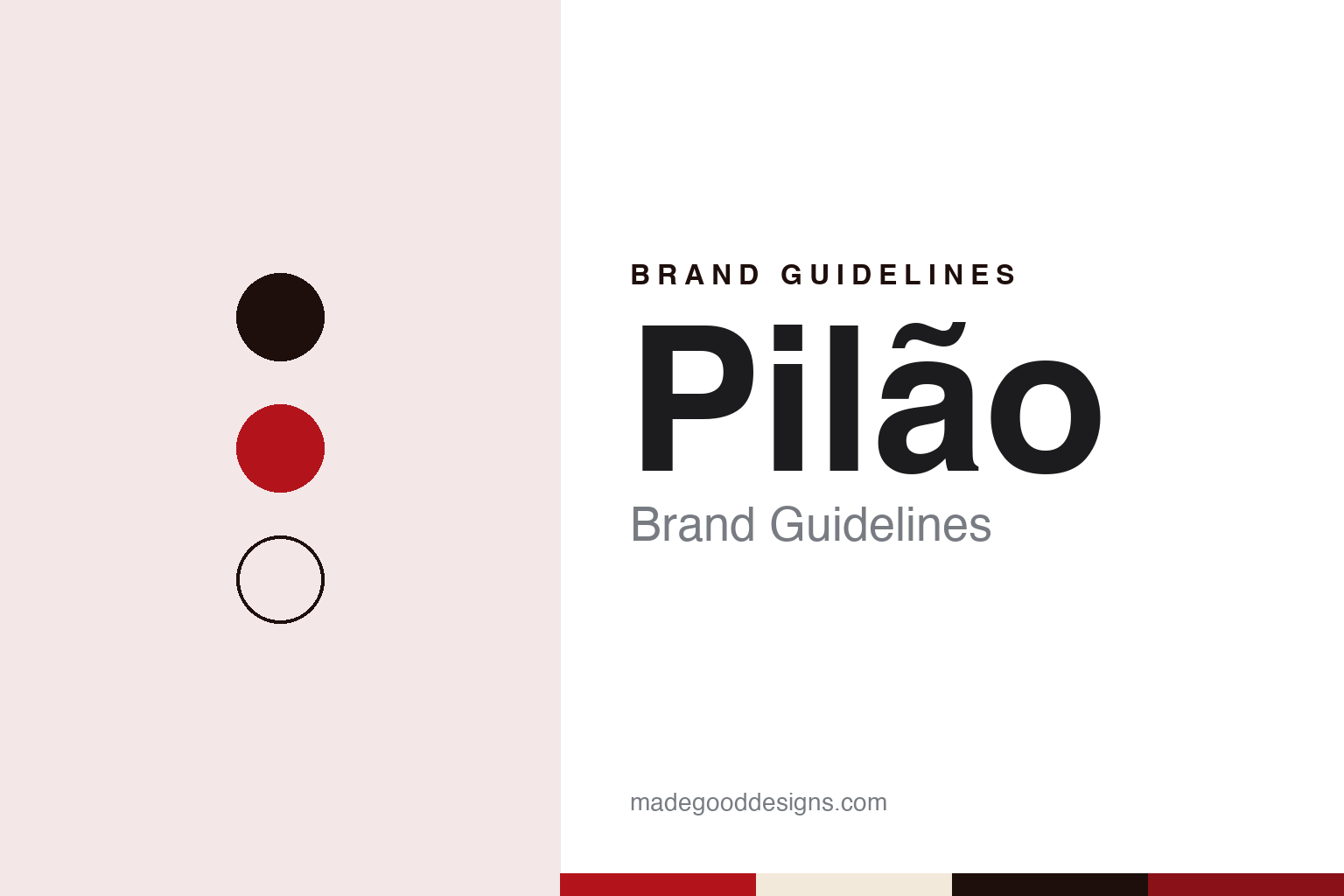
Two constants: a Pilão red, roast and crema palette and a Heavy sans register. Abstract homage — not a Pilão product or mark; no pack, logo or label is reproduced.
Cia. União
A coffee brand born inside a sugar company.
Pilão is a Brazilian coffee brand whose story begins inside a São Paulo sugar company. The brand was launched in 1978: the company says Pilão “was born in 1978” out of consumers’ wish for a stronger, fuller-bodied coffee, and Folha de S.Paulo reported in June 2000 that “the Pilão brand has been on the market since 1978.” Pilão is the Portuguese word for a mortar or pestle.
Pilão was created by the Companhia União dos Refinadores – Açúcar e Café, known as Cia. União. Portuguese Wikipedia says the company was founded in São Paulo in October 1910 by the Italian immigrant brothers Giuseppe and Nicola Puglisi Carbone, who persuaded the city’s small sugar refiners to join together, and that it later took up coffee and added the word to its name. Its best-known product was Açúcar União sugar. In 1973 control passed to Copersucar, the São Paulo cooperative of cane, sugar and alcohol producers, according to both Portuguese Wikipedia and Folha.
No individual founder of the Pilão brand itself is named in the sources we checked; it was launched by the company. By 2000, Folha reported, Cia. União ranked among the ten largest coffee roasters in the world and could process 100,000 tonnes of coffee a year at a unit in the Mooca district of São Paulo. Its other coffee brands included Café Caboclo, then about 70 years old and the oldest in the group, and Café União.
Colour
Sara Lee, D.E Master Blenders, JDE Peet’s.
The sale that set Pilão’s course came in 2000. On 6 June that year Folha de S.Paulo reported that Brazil’s competition authority, CADE, was reviewing the transfer of three traditional coffee brands created by Cia. União to the American Sara Lee group, a business the paper put at about R$450 million. Copersucar would keep the União sugar brand and concentrate on sugar and alcohol, and was licensing the Café União name to the buyer for ten years. Sara Lee had entered Brazilian coffee two years earlier: the same report says it bought Café do Ponto and Seleto in 1998. The paper quoted Maurílio Lobo Filho, president of Sara Lee’s subsidiary Café do Ponto: “We won’t change anything. First we will get to know the company.” He said the Mooca site was considered poorly placed for logistics but that there were no short-term plans to close it, and that its 325 jobs would be kept. Pilão’s own website dates the change to the same year, saying that in 2000 Pilão “became part of Jacobs Douwe Egberts” — the name its owner took much later.
Under Sara Lee, Pilão sat beside Café do Ponto and Caboclo. In November 2010 a Reuters report carried by Folha described Sara Lee as the owner of Café Pilão, Café do Ponto and Caboclo, leaders in retail in São Paulo and Rio de Janeiro, as it agreed to buy the coffee business of Café Damasco of Paraná; a list from the Brazilian coffee industry association ABIC printed with the report put Sara Lee Cafés do Brasil first among the country’s coffee processors. In April 2012 Reuters again described Sara Lee as “owner of the Pilão brand” when it bought the Brazilian espresso business Expresso.Coffee.
Then the owner itself changed shape. English Wikipedia records that Sara Lee announced in January 2011 that it would split, placing its international coffee and tea brands — Café Pilão among them — in a company named D.E Master Blenders 1753, which began trading in 2012. In 2013 Joh. A. Benckiser agreed to buy it, The New York Times reported; in 2015 it combined with the coffee business of Mondelēz International as Jacobs Douwe Egberts; and in December 2019 that company merged with Peet’s Coffee to form JDE Peet’s, which listed in Amsterdam in 2020. English Wikipedia lists Pilão among JDE Peet’s brands, and Portuguese Wikipedia names it first among the group’s Brazilian brands, alongside Café do Ponto, Damasco and Caboclo.
Typography
Coffee brands of the Americas.
The seven brands in this group all sell coffee, and they come from four countries of the Americas: Café Bustelo, Community Coffee, Folgers and Maxwell House from the United States, Juan Valdez from Colombia, Café Britt from Costa Rica, and Pilão from Brazil. Each guide follows its own name back to where it started and forward to whoever owns it today, rather than treating the group as one story.
A coffee brand’s identity is usually carried by a name, a pack and a promise about the cup, and the beans behind it may have been grown far from where the name on the front was roasted. That makes the plain questions behind each name worth asking: who started it, who owns it now, where its coffee is bought, and where it is actually roasted and packed.
Each guide separates what independent sources record from what the company says about itself — its founding story, its owners over time, where its coffee comes from and where it is roasted — and marks plainly what rests only on the company’s own word.
Aa
A heavy sans for a brand that sells strength. (Specimen set in Archivo, a sans STAND-IN; NOT the Pilão logo.)
Pilão
“Esse é o nosso forte.”
The newest owner is American. In August 2025 Keurig Dr Pepper announced that it would acquire JDE Peet’s for about €15.7 billion, and in January 2026 it launched an all-cash offer after obtaining competition clearances, with the JDE Peet’s board in support, according to English Wikipedia, which now lists JDE Peet’s as a KDP subsidiary. KDP has said it plans to separate into a coffee company and a beverage company, and in April 2026 it named JDE Peet’s chief executive Rafael Oliveira to lead the coffee business.
Today the brand’s website sells roast-and-ground coffee — its 500 g vacuum pack, “Tradicional,” is rated intensity 8 — as well as whole beans, soluble coffee and aluminium capsules, and promotes a Casa Pilão café franchise. Its line is “Pilão. Esse é o nosso forte”, a play on forte, which means both “strong” and “strong point”, and it calls Pilão “o café forte do Brasil”, Brazil’s strong coffee. The company says it selects its beans, roasts them slowly at high temperatures and grinds them cold, and that it uses 40 beans per cup; we give those as its own statements. It lists awards including Product of the Year in 2009 and 2010 and the Folha Top of Mind award in the coffee category in 2020 and 2021.
Pilão’s website does not say where the coffee is roasted today, and we did not find a documented plant in the sources we checked; the only production site on record in them is Cia. União’s Mooca unit, reported in 2000. No official logo, colour or typeface specification is published.
For a design guide, Pilão shows how a supermarket brand can hold one promise — strength — through a long line of owners. Compare Douwe Egberts, the Dutch house at the root of its present group, and Peet’s Coffee, its sister brand in JDE Peet’s. For this guide we use a deep red, roast brown and crema with a heavy sans, an unofficial interpretation; no product or logo is reproduced.
Explore & save
Keep Pilão’s identity on hand — save it to a board in the Made Good inspiration library.
Pilão identity set
Pin the Pilão red, roast and crema palette and the Heavy sans register to your own board.