St Michel Brand Guidelines
The village galette that became a French biscuit company.
Aa
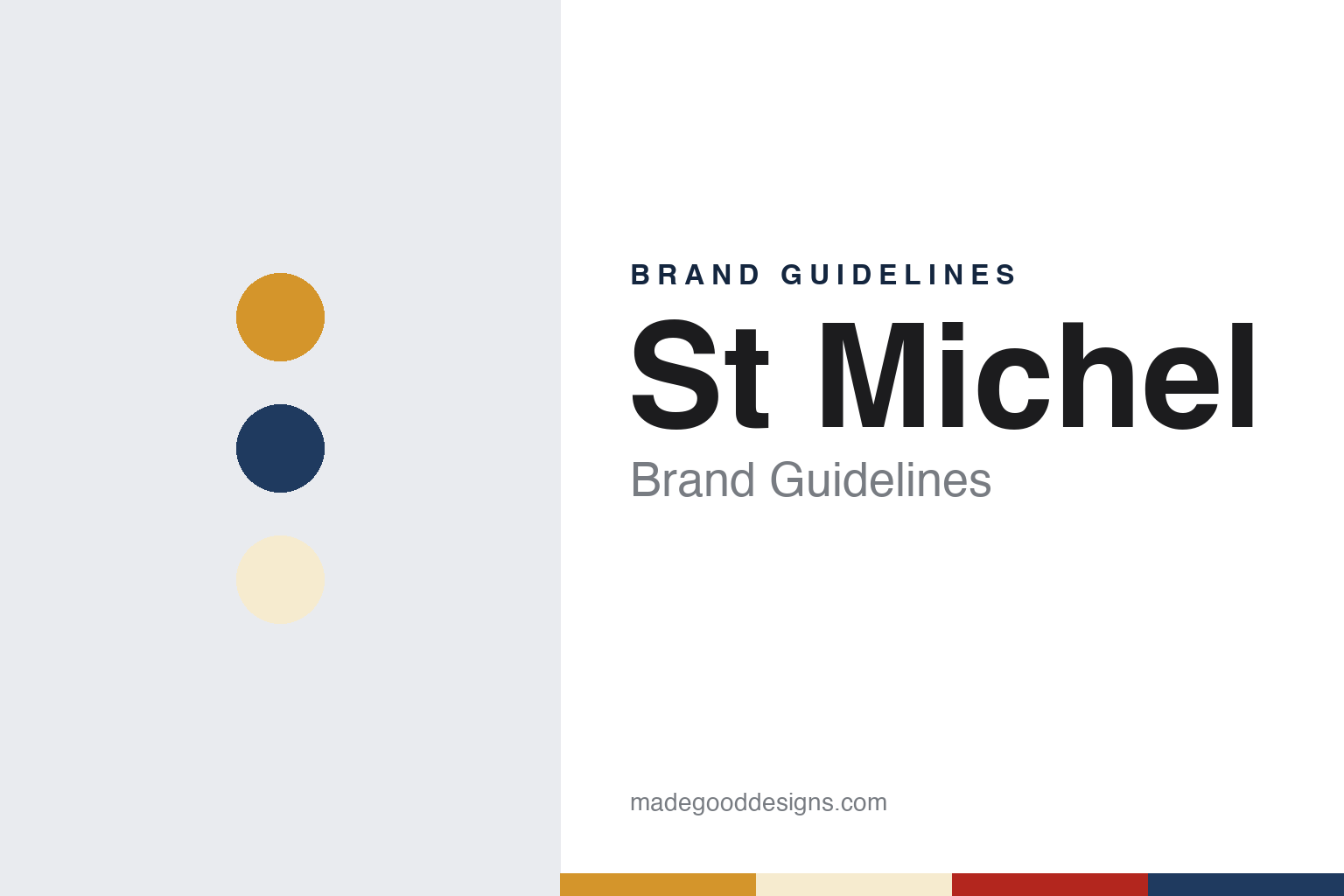
Two constants: a St Michel galette gold and Atlantic blue palette and a Classic serif register. Abstract homage — not a St Michel product or mark; no biscuit, pack or logo is reproduced.
The galette
A village bakery on the Atlantic coast.
St Michel began with a village bakery near the Atlantic coast. French Wikipedia says the pastry cook Joseph Grellier opened a bakery in Saint-Michel-Chef-Chef, in Loire-Atlantique, and in 1905, looking for a biscuit that would keep well and for a long time, created the Galettes Saint-Michel. The company tells the same story on its website: Grellier, it says, created the round, golden galettes to treat his village. It dates the brand to 1905 and marked 120 years in 2025.
His wife, Constance, found the first market. French Wikipedia says she sold the biscuits to well-off Parisian women who came for sea bathing at Tharon-Plage, the resort within the commune; the company credits her with the idea of selling the galettes to the ladies from the city who came to the beaches of the coast. In 1912, French Wikipedia says, Grellier built a production workshop opposite the bakery, a building that is still a company shop today.
Industrial production followed in 1919. French Wikipedia credits Félix Grellier, a nephew of the couple, with industrialising the biscuits from that year; the company says the biscuit factory was inaugurated in 1919 after the rapid success of the brand’s creator, and that he had chosen a hen as its emblem, as an image of rural France and of good produce.
Colour
From Bahlsen to Morina Baie.
The range grew out of the galette. The company says its Sablés de Retz were created by the biscuiterie in 1920 and its Roudor in 1979, and that the Madeleines de Commercy — a Lorraine speciality whose tradition it dates to 1748 — joined the business in 1986. Commercy, in the Meuse, remains one of its production sites. Since 2017, it says, it has also sold a chocolate-coated ring cake called Doonuts.
One product from this period was withdrawn amid controversy. In 1987, French Wikipedia records, Saint-Michel launched a chocolate biscuit called Bamboula, with a mascot of a small Black boy; the word is a racist slur in French, as the linguist Marie Treps has explained in the French press. On 13 April 1994 a “Village de Bamboula” opened at the Safari Africain animal park (now Planète Sauvage) at Port-Saint-Père, near Nantes, created in partnership with the biscuit maker to promote the biscuits, and Ivorian performers were brought in to live in the reconstructed village in front of visitors. A collective led by the CGT union protested, and the village closed in September 1994; French Wikipedia says the Bamboula biscuits and their character disappeared from the range at the same time. On 1 July 1997 the Nantes tribunal de grande instance ruled against the park for breaches of labour law and of the performers’ freedom of movement. The episode was the subject of a 2022 documentary, Le Village de Bamboula, and of reporting by France 3, France Bleu and Le Parisien.
Ownership left the founding family in the 1990s. In November 1994 the business daily Les Echos reported that the German biscuit maker Bahlsen was taking over the Saint-Michel galettes. Bahlsen merged its French subsidiaries from early 1996, and from 1999 the company traded as Bahlsen Saint-Michel, French Wikipedia says. Before 2006 it made biscuits at three plants: Saint-Michel-Chef-Chef, its historic site; Commercy, for madeleines; and Saint-Père-en-Retz.
In 2006 Bahlsen sold the business to Morina Baie Biscuits, a French group that already included Morina Pâtissier and the Biscuiterie de la Baie du Mont-Saint-Michel at Avranches, in the Manche; a Les Echos headline in September 2006 said the purchase would let the group double in size. In 2008 Morina Baie Biscuits took the name of its best-known brand and became St Michel Biscuits, with its head office at Contres, in Loir-et-Cher. In 2011, according to the regional daily Sud Ouest as cited by French Wikipedia, it bought the biscuit maker Champador in the Dordogne.
Typography
Design and documentation.
The seven brands in this group all make biscuits, and they come from four countries: LU and St Michel from France, Loacker, Balocco and Mulino Bianco from Italy, Arnott’s from Australia, and Pepperidge Farm from the United States. Biscuit brands in general sit at many different points in the trade, from family firms that still bake in the town where they started to names that have passed between food groups several times, and a single packet can carry the history of more than one owner.
A biscuit brand’s identity is usually carried less by a recipe than by a pack, a shape and a name, because the biscuit on the shelf may be baked a long way from the place the name recalls. That makes the questions behind each name worth asking plainly: who started it, who owns it now, how its packaging came to look the way it does, and where its biscuits are actually made.
Each guide separates what independent sources record from what the company says about itself — its founding story, its owners over time, its pack and where it bakes — and marks plainly what rests only on the company’s own word.
Aa
A classic serif — the village galette. (Specimen set in Fraunces, a serif STAND-IN; NOT the St Michel logo.)
St Michel
A hen for an emblem.
Today St Michel describes itself as “an independent French family company.” It says it makes biscuits and cakes “in our own factories in France and now in the United States,” and lists eight French production sites. They include Saint-Michel-Chef-Chef, where it says the galette was born and where it still makes galettes and Sablés de Retz alongside a second site at Saint-Père-en-Retz, as well as Avranches, Contres, Commercy, Guingamp, Saint-Péreuse and Champagnac-de-Belair. A ninth, the Donsuemor plant at Alameda, California, makes French-style cakes for the local market, the company says. Its brand website says its products are “always made in France.”
The company’s pages give about 2,000 staff in France, while its history page says more than 1,800; we give both. It also says it produces and sells biscuits for the Bonne Maman brand, exports to 100 countries, and sold 98 million packets of St Michel products in France in 2024. Its president, according to its website, is Bruno Rousseau.
The brand also sells directly. French Wikipedia lists St Michel shops in towns including Nantes, Tours, La Rochelle, Saint-Malo and Commercy, and the company says its home village has an Atelier St Michel shop and a Café St Michel. On its brand website it highlights French wheat flour, recipes without palm oil and manufacture in France, and it says it was an official Paris 2024 licensee.
Its visual identity is less documented than its history. The company says the founder chose a hen as its emblem; French Wikipedia shows an older logo and the current one without dating either, and we found no published brand guidelines or official colours. The company writes the brand name as “St Michel,” while the original business was the Biscuiterie Saint-Michel, named after its village.
For a design guide, St Michel shows how a single regional biscuit can carry a company, and its village’s name, across more than a century. Compare Verkade, the Dutch biscuit and chocolate maker from Zaandam, and Oreo, the American sandwich cookie now owned by Mondelez. For this guide we use a galette gold and an Atlantic blue with a serif, an unofficial interpretation; no product or logo is reproduced.
Explore & save
Keep St Michel’s identity on hand — save it to a board in the Made Good inspiration library.
St Michel identity set
Pin the St Michel galette gold and Atlantic blue palette and the Classic serif register to your own board.


