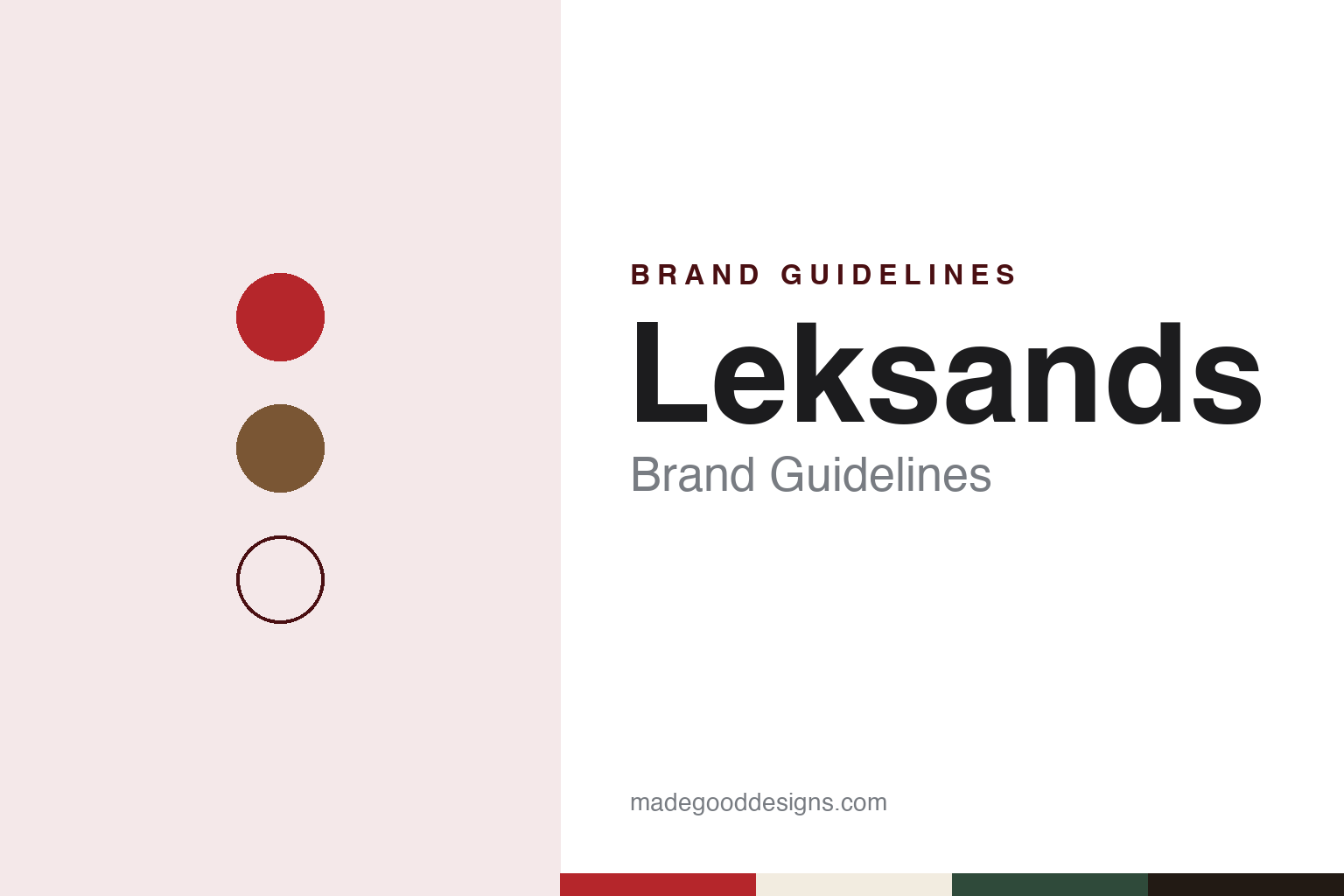
Leksands Brand Guidelines
The Dalarna family bakery that put a Dala horse on its crispbread.
Aa
Two constants: a Dala red, rye and birch palette and a slab serif register. Abstract homage — not a Leksands product or mark; no pack, horse or logo is reproduced.
A spisbröd bakery in an outbuilding
A family recipe, a wood-fired oven and a fire.
Leksands Knäckebröd is a family bakery in Häradsbygden, in Leksand municipality in the Swedish province of Dalarna, and Swedish Wikipedia calls it one of Sweden’s largest crispbread makers. The company describes itself as “family-baked since 1817.” In its telling, that year is the start of a recipe rather than a business: Jakobs Karin the elder taught the secret of crispbread to her daughter, Jakobs Karin the younger, who in turn taught her own daughter, Anna.
The bakery itself came later. In 1929 Anna Karlsdotter and her husband Jon Olof “Jon-Olle” Olsson started a spisbröd bakery — the company says its first bread was coarser than today’s crispbread — in a converted outbuilding on their farm, with a wood-fired oven. Anna had helped with the baking on the village farms and sold bread to the tourist hotel in Leksand, the company says, and all five of the couple’s children went to work in the bakery. Swedish Wikipedia gives the same 1929 start.
In 1942 a fire destroyed the bakery. Jon Olof handed the business to his son Martin, who built a new bakery on a plot near the railway with its own underground spring. That year the business was renamed from J.O. Olssons spisbrödsbageri to Leksands Knäckebröd. The company still says its bread is made from Swedish rye, water from that spring, yeast and salt. Martin’s younger brother Gunnar, bakery chief for thirty years, had the company build its own mill in 1946, and a second baking line followed in 1952.
Colour
A church, then a horse.
Leksands’ best-documented design decision came in 1964. That year, the company says, the Dala horse — the carved and painted wooden horse long associated with Dalarna — became its symbol on all packaging and in advertising, replacing an earlier silhouette of Leksand church. The same year Martin launched Brungräddat, a darker-baked bread that began, in the company’s account, as over-baked “failed” cakes that local customers bought at the bakery shop and liked.
The products changed with Swedish households. A third line arrived for the bakery’s fiftieth anniversary in 1979, when the company says it baked 2,700 tonnes and began selling beyond Dalarna, along the Norrland coast and in Stockholm. In 1987, with more Swedes living in small households, it sawed its large round cakes into triangular portions sold in smaller packs, and the triangle bread became a success. Rundrut, a round bread with a chequered pattern, followed in 1989 with a fourth line and a grain silo; the company calls it its biggest success, and says Anna and Karin had baked chequered bread in the 1920s.
More followed: a square portion bread, or bitbröd, and a fifth line in 1998, Fäbodknäcke the same year, inspired by a long-serving baker’s summer farm, and Mini-Rut in 2000. In 2009 three of the bakery’s bakers, Håkan, Jan Olof and Rolf, were each allowed to create a bread of their own, sold as Bagarns Bästa (“The Baker’s Best”), and the company says it sold more that year than ever before. In 2003, the company says, it tidied its range and its packaging got a new design. In 2013 it launched the thin Tre Kullor and promoted the knäckepizza, crispbread used as a pizza base; Swedish Wikipedia records both.
Typography
Design and documentation.
The seven brands in this group all make crispbreads, crackers or oatcakes — the dry, savoury side of the biscuit aisle — and they come from four countries: Ryvita, Peter’s Yard and Carr’s from England, Nairn’s from Scotland, Wasa and Leksands from Sweden, and Finn Crisp from Finland. Brands of this kind sit at many different points in the trade, from long-established supermarket staples to younger names sold through delicatessens, and a single maker can bake under its own name and for other people’s labels at the same time.
A cracker brand’s identity is usually carried less by the product itself, which can look much the same from one maker to the next, than by a grain, a pack and the story told about where it began. That makes the questions behind each name worth asking plainly: who started it, who owns it now, and where its crispbreads, crackers or oatcakes are actually baked today.
Each guide separates what independent sources record from what the company says about itself — its founding story, its owners over time and where it bakes — and marks plainly what rests only on the company’s own word.
Aa
A slab serif for a country bakery. (Specimen set in Zilla Slab, a serif STAND-IN; NOT the Leksands logo.)
Leksands
Six generations of one family.
Leksands has stayed in the family. In 1981 Martin Joon handed the leadership to his son Rune, the fifth generation, who built two more baking lines and doubled production, the company says. After 24 years as chief executive, Rune handed over to his son Peter Joon, the sixth generation, at the turn of 2005 and 2006; the company says Peter’s sister Annika Sund runs marketing and Rune sits on the board. Swedish Wikipedia also names Peter Joon as chief executive from 2005.
The bakery has grown on the same site. The company says it can now bake 8,000 tonnes of crispbread a year, makes eighteen kinds, and, citing a survey, that one in four Swedish crispbread buyers chooses Leksands. It says all its rye carries the Från Sverige (“From Sweden”) origin label and is grown as close to the bakery and its mill as possible. Its range is led by the traditional round Leksands Knäcke, in normal and Brungräddat bakes, with the triangles, Rundrut and Tre Kullor alongside. The surface is part of the product’s look. The company explains that the nagg, the spiked tool that pricks the dough, makes the pits or the chequered squares in its crispbread, and that the choice of nagg decides whether the surface comes out uneven and bumpy or smooth and even, which also changes how evenly it bakes. The company’s website sets its headings in Clarendon, a nineteenth-century slab serif.
For a design guide, Leksands shows how a regional symbol can carry a family business for six decades. Compare Marabou, a Swedish name with its own animal emblem, and Freia, the Norwegian company that founded Marabou. For this guide we use Dala red, rye and birch with a serif, an unofficial interpretation; no product or logo is reproduced.
Explore & save
Keep Leksands’s identity on hand — save it to a board in the Made Good inspiration library.
Leksands identity set
Pin the Leksands Dala red, rye and birch palette and the slab serif register to your own board.