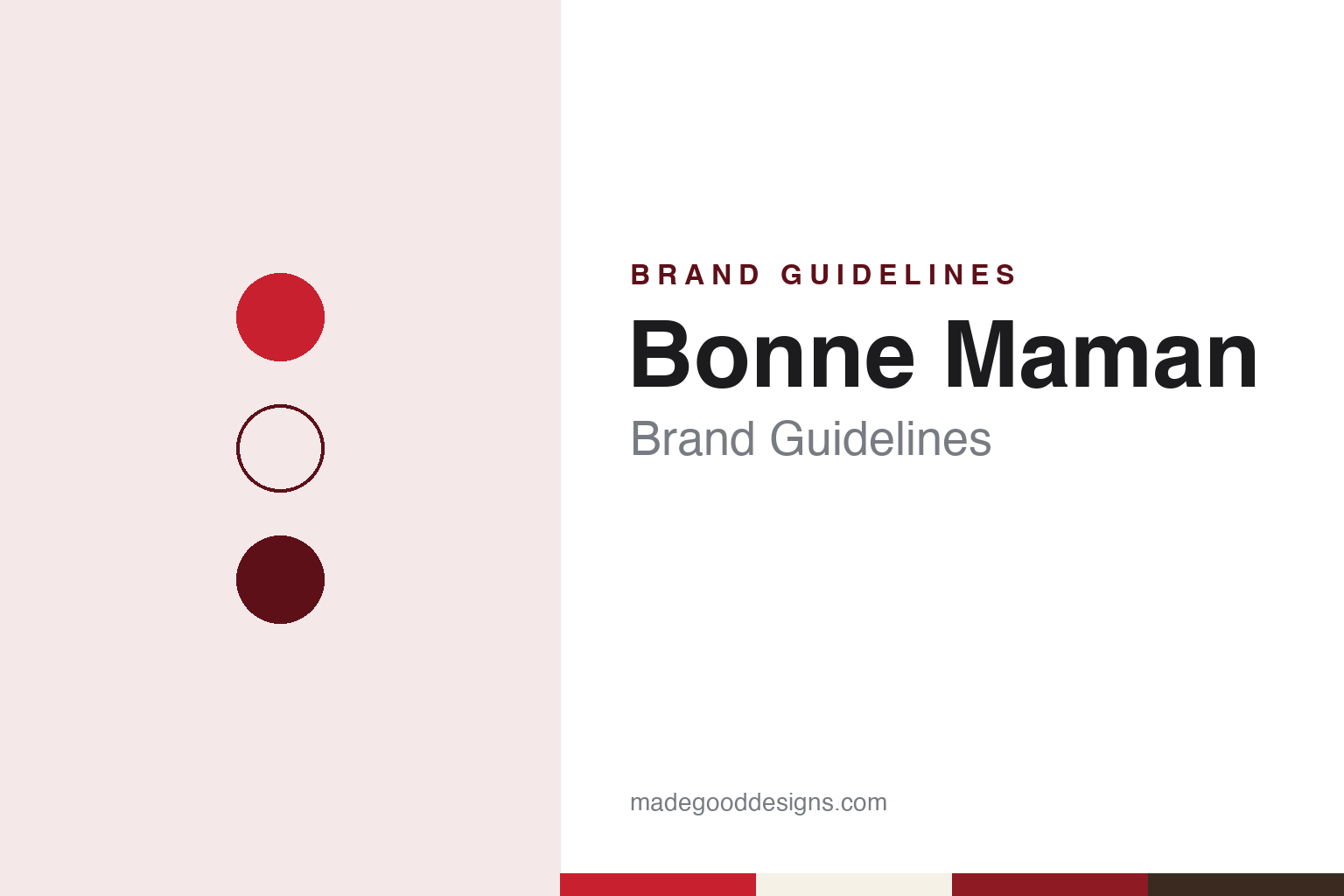
Bonne Maman Brand Guidelines
The Lot jam brand whose gingham lid has stayed the same since 1971.
Aa
Two constants: a gingham red and label cream palette and a pen-script serif register. Abstract homage — not a Bonne Maman product or mark; no jar, lid, label or logo is reproduced.
Andros
A family jam business in the Lot.
Bonne Maman is the leading brand of Andros, a family-owned French food group based at Biars-sur-Cère, in the Lot, near Brive-la-Gaillarde. French Wikipedia, citing the business magazine Capital in September 2009, says the group grew out of a jam business founded after the Second World War by Jean Gervoson and Pierre Chapoulart, who turned unsold plums from the trade run by Gervoson’s father-in-law into jam. The activity developed at Biars-sur-Cère at the end of the 1960s, and the group is still owned by the Gervoson family, French Wikipedia says.
The Bonne Maman brand was unveiled in 1971. French Wikipedia credits its creation to Jean Gervoson and his wife, Suzanne, and English Wikipedia says it was developed “as a mass-produced product with a home-made feel.” The name is an affectionate French term for a grandmother; the company says on its website that it was the nickname given to the grandmothers of the family, and that the story “begins at Biars-sur-Cère,” a village it places between the Cère and the Dordogne.
Andros has since become a group of many brands. French Wikipedia lists Mamie Nova, Pierrot Gourmand and the Andros fruit range among them, and cites Capital in October 2017 for estimates that its brands then accounted for 47 per cent of French jam sales and 62 per cent of refrigerated compotes. In 2000 Jean Gervoson left the management of the group and his two sons took over: Frédéric Gervoson for Andros and the Bonne Maman jams, and Xavier Gervoson for the Bonne Maman cakes, French Wikipedia says, citing Capital and La Voix du Nord.
Colour
A gingham lid and a pen-written label.
The pack is the brand’s best-known asset. French Wikipedia, citing Capital in 2009, describes it as unchanged since the launch: a patented jar shape, a lid printed with a gingham (“vichy”) pattern and a white label lettered in calligraphy as if written with a nib pen. Neither source gives a colour specification or names a typeface.
The design is credited to Pierre Roche-Bayard. In February 2017 the broadcaster RTL described him as a former managing director of the group rather than a member of the founding family, and said he had created the Bonne Maman packaging with its gingham lids — like the curtains of the family farm, as he put it — and was behind the cursive writing on the labels. RTL reported, citing his family, that he had kept the school pen-holder with which he wrote “Bonne Maman” on the first jars in 1971, and said Jean Gervoson launched the brand with him.
The company tells the story a little differently on its own website. It says that Suzanne Gervoson traced the name with a pen on the first jars, which were “coiffés de leur couvercle vichy” — topped with their gingham lids. We give both accounts as they were published.
English Wikipedia describes the jars as carrying “a handwritten-style label, along with a gingham-patterned (‘motif Vichy’) lid.” French Wikipedia adds that miniature 30-gram jars for hotels appeared from the brand’s creation, and cites Capital in 2017 for distribution in 125 countries, saying the miniature jars then led their market in the Netherlands and Greece and ranked second in the United Kingdom and the United States. A third of Bonne Maman jams were exported, according to Capital in 2009 and RTL in 2017.
Typography
Biscuits and the French pantry.
The seven brands in this group all sell biscuits, and they all come from one country, France: Bonne Maman, Gavottes, La Mère Poulard, Fossier, Traou Mad, La Trinitaine and Michel et Augustin. French biscuits in general sit at many different points in the trade, from the packet on a supermarket shelf to the tin sold in a regional shop or a town’s own bakery, and a single company can work at both ends at once.
A biscuit brand’s identity is usually carried by a recipe, a packet and a place, because the name on the front often points to a town, a region or a person even when the biscuit inside is made somewhere else, by someone else. That makes the questions behind each name worth asking plainly: who started it, who owns it now, and where its biscuits are actually baked and packed.
Each guide separates what independent sources record from what the company says about itself — its founding story, its owners over time, where its biscuits are made and how its packaging came about — and marks plainly what rests only on the company’s own word.
Aa
A pen-script serif — the register of a label written by hand. (Specimen set in Fraunces, a serif STAND-IN; NOT the Bonne Maman logo or label lettering.)
Bonne Maman
Biscuits baked under licence.
Bonne Maman moved beyond jam in 1997, when the brand extended into biscuits, and into desserts at the start of 2008, French Wikipedia says, citing Capital. The biscuits are not baked by Andros itself. French Wikipedia says they are made by St Michel Biscuits under a licence granted by Andros, and in May 2020 Capital described Xavier Gervoson as the owner of St Michel, reporting that the biscuit maker owed most of its success to two brands — St Michel and Bonne Maman, the second under a licence from the Andros group run by his brother Frédéric.
That arrangement has its own history. According to Capital, Jean Gervoson bought the Morina Baie biscuit business; Xavier took it over in the mid-1990s, relaunched it with new products and the Bonne Maman brand, and doubled its size by buying St Michel in 2006. Our St Michel guide covers that purchase from Bahlsen, and St Michel says it produces and sells biscuits for the Bonne Maman brand.
On where things are made, French Wikipedia, citing Capital in 2009, places Bonne Maman’s dessert units at Auneau and Biars-sur-Cère and its biscuit units at Avranches, in the Manche, and Contres, in Loir-et-Cher. RTL said in 2017 that although Andros has factories in China and the United States, Bonne Maman production stays in France: jams in the Lot, desserts in the Lot and Eure-et-Loir, and cakes in Loir-et-Cher and the Manche. The French website lists galettes, tartlets, financiers and butter madeleines; the British site lists ranges including madeleines and raspberry tartlets.
For a design guide, Bonne Maman shows a pack that sources describe as unchanged since 1971, carried from jam to biscuits and desserts. Compare St Michel, the company that bakes its biscuits, and LU, the Nantes biscuit maker. For this guide we use gingham red, label cream and a deep pen ink with a serif, an unofficial interpretation; no product or logo is reproduced.
Explore & save
Keep Bonne Maman’s identity on hand — save it to a board in the Made Good inspiration library.
Bonne Maman identity set
Pin the Bonne Maman gingham red and label cream palette and the pen-script serif register to your own board.