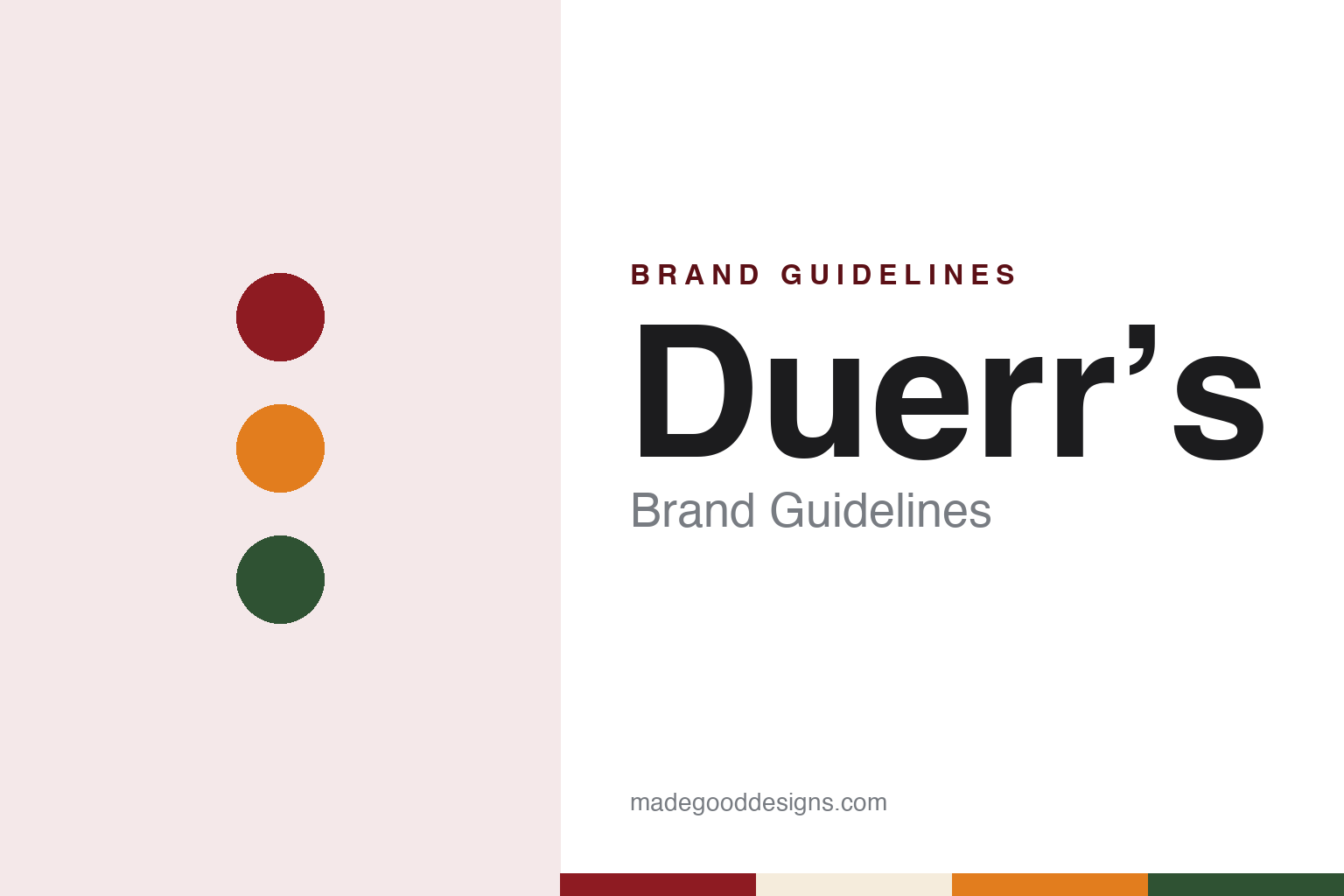
Duerr’s Brand Guidelines
The Manchester family jam maker founded on Mary Duerr’s kitchen in 1881.
Aa
Two constants: a Duerr’s red, orange and green palette and a Victorian display serif register. Abstract homage — not a Duerr’s product or mark; no jar, label, logo or fruit group is reproduced.
Mary’s jam
A Co-op buyer, a kitchen in Heywood and a handcart.
Duerr’s began in 1881 in Heywood, near Rochdale. English Wikipedia names the founder as Frederick Duerr; the company’s own history credits the start to two people. In its account, Fred and Mary Duerr had married in Leeds in 1872 and settled in Heywood, where Fred worked as a commercial traveller and then as a commission agent in the grocery trade. In 1881 the buyer of the Heywood Co-operative Society told Fred he could not find preserves of high enough quality and asked whether Mary, whose jam was well known locally, would supply the Co-op. “I will take all you can make,” he is quoted as saying. Mary cooked in her kitchen, and Fred took the jars to the shop by handcart.
The business soon needed space. In 1884 Fred built what the company history calls his first model factory, at Deanhead in Guide Bridge, Audenshaw, east of Manchester. In 1893 he commissioned a larger jam factory on Prestage Street, Old Trafford, the date given both by English Wikipedia and by the company booklet The History of F Duerr & Sons, written by the former chairman Tony Duerr and first published in 1993. The company says it stayed in Old Trafford for more than a century.
The booklet says Fred attributed his success to careful fruit buying and the application of scientific principles to jam making, and that in 1905 he pioneered the vacuum sealing of jars at a time when many makers still used card caps and paper — a claim the company repeats on its current timeline. Fred’s three sons, Oliver, Alfred and Edgar, joined him: Oliver ran the finances, Alfred sold to the co-operative societies of the north-west, and Edgar was the inventor.
It was Edgar, the company says, who designed and patented the “Lifeguard” collapsible pocket periscope that Duerr’s made for soldiers in the trenches during the First World War. English Wikipedia cites an example held by the Imperial War Museum. The firm became a limited company in 1924, and by 1935 Oliver’s sons Norman and Clive were running it, steering it through the Depression and the sugar rationing of the Second World War.
Colour
The fruit group, the labels and the lids.
Duerr’s visual identity has a documented origin. The company booklet says that one of its most successful promotions of the 1920s and 1930s was a colour print of a “fruit group”: customers who sent in twenty Duerr’s labels received a copy of the picture, and the booklet says it “still forms part of the Duerr’s logo.” The company’s timeline dates the offer to 1920. In 2002 the booklet also wrote that the founder would recognise “the familiar Victorian lettering on the jars and labels.” The firm says it relaunched its whole range with new labels in 1995.
Duerr’s own history dwells on packaging. The company says it pioneered Polytubs for catering customers in 1985, in place of large tins; introduced plastic squeezy jam bottles in 1988, which it calls the first in Europe, though the booklet admits the cost of the bottle made the price unattractive; and in 1991 introduced a tamper-evident button cap and shrink sleeve on its jams and marmalades, which it says was a first. In 2011 it launched easy-open lids using a two-piece design called Orbit; English Wikipedia, citing the company’s own announcement, describes Duerr’s as the first to introduce them.
The brand became national through supermarkets. The company says that in the early 1960s it sold half its output to wholesalers and half to co-operative societies and refused to supply the multiple grocers; when wholesalers formed buying groups it lost much of that trade, and the booklet says some shareholders favoured closing the business. A contract to pack preserves for the VG group followed in the late 1960s, and the company dates its listing with Kwik Save to 1973, which it says made Duerr’s a national brand. By 2001, the booklet says, nine-tenths of its trade was with the large multiples, under the Duerr’s label and under retailers’ own labels.
Duerr’s has also used marmalade for publicity. In 2006, its 125th year, it made what The Independent reported as the world’s most expensive marmalade, flavoured with a 62-year-old Dalmore whisky and vintage Pol Roger champagne and finished with edible gold. Today the company describes itself as famous for its Seville orange marmalade.
Typography
Design and documentation.
The seven brands in this group all make jam or marmalade, and all of them come from Britain: Tiptree, Mackays, Hartley’s, Robertson’s, Duerr’s, Frank Cooper’s and Chivers. British jam and marmalade brands in general sit at many different points in the trade, from family firms that still carry a founder’s surname to names that now belong to much larger food groups, and a single brand can be sold everywhere from a village shop to a supermarket shelf.
A preserves brand’s identity is usually carried less by a single product than by a jar, a label and the breakfast table it promises, because the company behind the name may have changed hands, moved its factory or grown far beyond the town where it started. That makes the questions behind each name worth asking plainly: who started it, who owns it now, and where its jam and marmalade are actually made and packed.
Each guide separates what independent sources record from what the company says about itself — its founding story, its owners over time, where its preserves are made and how its jars and labels have changed — and marks plainly what rests only on the company’s own word.
Aa
A Victorian display serif, after the lettering the company says its jars and labels kept. (Specimen set in DM Serif Display, a serif STAND-IN; NOT the Duerr’s logo.)
Duerr’s
Still family-owned, still in Manchester.
Duerr’s has stayed in family hands. English Wikipedia describes F. Duerr & Sons as an independent, family-run business in its fifth generation of family management, citing the Manchester Evening News; the company’s website says it is still family-owned, run by the fifth generation and “now welcoming the 6th,” with Richard Duerr, a descendant of Fred and Mary, “at the helm.” Its website sums up the company as “always Manchester and always family.”
The modern business was shaped by Tony Duerr, Norman’s son, who joined in 1960 after Cambridge and became managing director in 1965 at the age of 27, according to the company booklet. He later became chairman and was appointed OBE in 1995 for services to the food industry, the company says. In 2015 Place North West quoted Mark Duerr as managing director.
The manufacturing has moved across Greater Manchester rather than out of it. In 1995 the company opened a large warehouse on Floats Road, on the Roundthorn industrial estate in Wythenshawe; the Lord Mayor of Manchester opened the complex in 1996, and the company says all production except peanut butter moved there in 1997. Offices followed in 2001–02. Duerr’s began making peanut butter in 1989; its timeline says a new peanut-butter factory was built on Dallimore Road in 2010 — Place North West gave 2011 — and that the original Prestage Street site closed the same year. In 2015 the company bought a further 12,500 sq ft unit on the Roundthorn estate, and in 2019 it opened an expanded peanut-butter factory. The company now describes two factories, one dedicated to peanut butter, and says it has been making products for other brands for more than sixty years, alongside its own label. It has also bought smaller suppliers: Samuel Moore Foods in 1998, which took it into mincemeat, and, its timeline says, the fruit-filling maker Elgar Foods in 2005 and the bulk honey supplier Landauer Honey in 2008.
For a design guide, Duerr’s shows how a family maker kept one emblem — a fruit picture first offered as a label premium — at the centre of a brand that otherwise changed its jars, lids and labels many times. Compare Tiptree, another independent family jam maker, and Pip & Nut, a newer British nut-butter brand. For this guide we use a strawberry red, a Seville orange and a leaf green on cream with a serif, an unofficial interpretation; no product or logo is reproduced.
Explore & save
Keep Duerr’s’s identity on hand — save it to a board in the Made Good inspiration library.
Duerr’s identity set
Pin the Duerr’s red, orange and green palette and the Victorian display serif register to your own board.