Trolli Brand Guidelines
The Fürth gummy maker whose name has two owners.
Aa
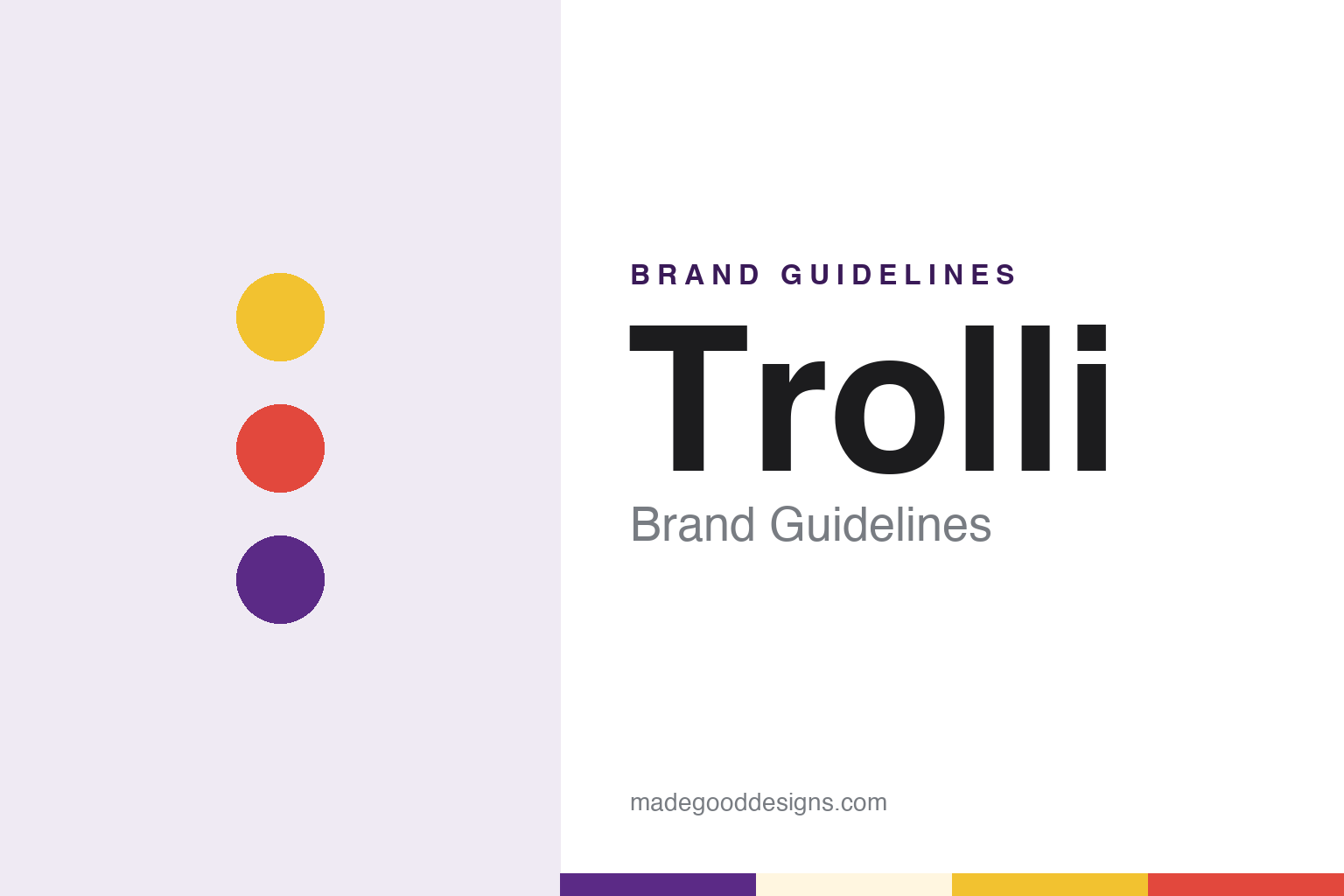
Two constants: a grape, sour yellow and ring red palette and a soft rounded display sans register. Abstract homage — not a Trolli product or mark; no pack, logo or sweet is reproduced.
From pasta to Wilmed
A post-war start in Fürth.
Trolli comes from Fürth, in Franconia, in northern Bavaria. The company says its story began in 1948, when Willy Mederer founded a sweets business. Its older history page, archived in 2013, adds that he first made pasta, because flour was easy to obtain after the war, and switched to sweets once sugar, previously rationed, could be traded freely again after the currency reform. The early range was simple sugar confectionery — peppermint fondant, cream cones and cream sticks — sold largely to wholesalers, markets and corner shops in southern Germany.
Through the 1950s and 1960s the range widened to coconut sweets, jelly bananas and jelly fruits, and the company sold it under the brand Wilmed, formed from WILly MEDerer. By then, the archived history says, about 150 people worked there. Willy’s son Herbert Mederer joined the family business at 17 and trained as a confectioner in Solingen before spending several years abroad, including in France and Austria, the same history says.
The move to fruit gums brought a new name. The archived company history says Trolli was coined in 1975, drawing on the trolls of Nordic legend — mischievous forest creatures, kind to children but fond of playing tricks on adults — and was chosen to sound fun to children. In 1979 the company registered the trademark “Trolli der Bär” (“Trolli the Bear”), the company and the trade journal Deutsche Lebensmittel-Rundschau say; English Wikipedia says the name was later shortened to Trolli. Herbert took over the business in 1984, the company says.
Colour
Rings, worms and a gummy burger — then a split.
Trolli built its name on shapes. The archived history calls the apple ring of 1982 the first Trolli original, followed two years later by a peach ring. It also describes the Wurrli, a gummy worm whose first form was cut in brass on a lathe, and which became a best-seller in America under the name “Squiggle.” The layered Trolli Burger followed in 1989, and in 1993 the sour “Saure Glühwürmchen,” or sour glow-worms, which the company says were already a hit in America before they were made in Germany. Herbert Mederer received the American confectionery trade’s Candy Kettle Award in 1993, the company says, and English Wikipedia, citing the Candy Hall of Fame, notes the same award.
Exports to North America grew to 40 tonnes a day, the company says, and in 1986 Mederer built a factory in Creston, Iowa. In 1997 it sold the American business together with the Trolli trademark rights there. English Wikipedia traces the American rights from Favorite Brands International through Nabisco, Kraft Foods and Wrigley, which agreed to sell its North American Trolli business to Farley’s & Sathers in 2005, as Convenience Store News reported that November. Farley’s & Sathers later merged with Ferrara Pan to form the Ferrara Candy Company of Chicago, which the Italian group Ferrero agreed to buy in 2017, the Chicago Tribune reported.
The result is one name with two owners. English Wikipedia says Ferrara holds the Trolli trademark in the United States, Canada and Mexico, while Trolli GmbH, part of the Mederer group, holds it in Europe, Asia, Africa and South America. The American Trolli runs its own promotions: in 2016, Forbes reported, it signed the basketball player James Harden and launched sweets modelled on his face and beard. Mederer returned to the American market with its own sales office in 2002, the company says.
Typography
Design and documentation.
The seven brands in this group all make sweets and gummies, and they come from Germany, Sweden, Britain and the United States: Katjes, Trolli, Werther’s Original, Cloetta, Maynards Bassetts, Swizzels and Jelly Belly. Sweet and gummy brands in general sit at many different points in the trade, from family firms that still carry a founder’s surname to names that now belong to much larger confectionery groups, and a single brand can be sold everywhere from a corner shop to a supermarket aisle.
A sweet brand’s identity is usually carried less by a single product than by a pack, a name and the treat it promises, because the company behind the name may have changed hands, moved its factory or grown far beyond the town where it started. That makes the questions behind each name worth asking plainly: who started it, who owns it now, and where its sweets are actually made and packed.
Each guide separates what independent sources record from what the company says about itself — its founding story, its owners over time, where its sweets are made and how its packaging has changed — and marks plainly what rests only on the company’s own word.
Aa
A soft rounded display sans for a brand named after mischievous trolls. (Specimen set in Fredoka, a sans STAND-IN; NOT the Trolli logo.)
Trolli
The Mederer group today.
Outside the Americas, Trolli remains a family business. The company describes the Mederer group as an independent family company with its head office in Fürth, whose owning family is now in its third generation, led by chief executive Robert Mähler and chief operating officer Heiner Opdenfeld, with about 2,300 employees worldwide. Its brands are Trolli, efrutti and Herbert’s Best.
The group grew by building and buying plants. It opened a site in Valencia, Spain, in 1994, and ran a packing plant in Plzeň, in the Czech Republic, from 1995 until Prag Aktuell reported its closure in 2013. In 1998 it bought the fruit-gum maker Efruti at Neunburg vorm Wald, in the Upper Palatinate, and in 2000 the Gummi Bear Factory, with plants at Boizenburg and Hagenow in Mecklenburg-Western Pomerania, from Barry Callebaut, Die Welt reported in 2003; the Boizenburg plant was sold in 2015 to The European Candy Group, Lebensmittel Zeitung reported. In 2001 it set up a joint venture in Guangzhou, China, taking full ownership in 2004, the company says.
At the start of 2012 the separate German companies at Fürth, Neunburg vorm Wald and Hagenow were merged as Trolli GmbH. The company had announced in October 2011 that it would close production in Fürth, nordbayern.de reported, and it now says Fürth production ended and moved entirely to Hagenow and Neunburg vorm Wald; Fürth remains the head office. From 2010 to 2014 the company’s name was on the Fürth football stadium, the Trolli Arena. The company says it supplies more than 100 countries from sites in Germany, Spain, France, China and the United States, and has used the claim “Let the fun win” since 2021. Trolli GmbH’s 2022 annual accounts, as summarised by German Wikipedia, show revenue of €174.7 million and 789 employees in Germany.
For a design guide, Trolli shows how one gummy brand can be split between two owners on either side of the Atlantic. Compare Katjes, the Emmerich liquorice and fruit-gum maker, and Jelly Belly, the American jelly-bean maker. For this guide we use a grape purple, a sour yellow and a ring red with a rounded sans, an unofficial interpretation; no product or logo is reproduced.
Explore & save
Keep Trolli’s identity on hand — save it to a board in the Made Good inspiration library.
Trolli identity set
Pin the Trolli grape, sour yellow and ring red palette and the soft rounded display sans register to your own board.