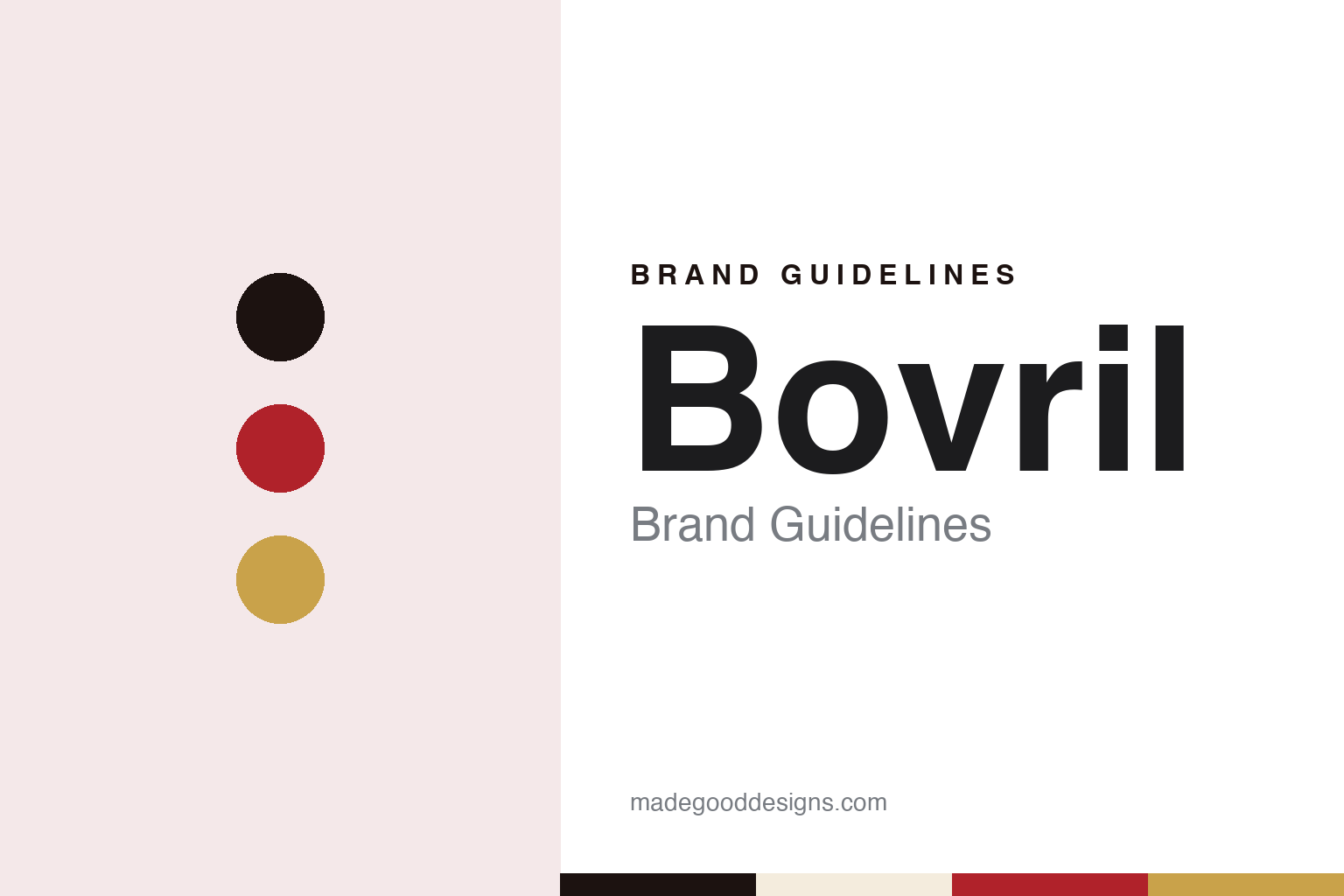
Bovril Brand Guidelines
The Victorian beef drink named after an ox and a novel.
Aa
Two constants: a beef black, Bovril red and poster gold palette and a Victorian display serif register. Abstract homage — not a Bovril product or mark; no jar, label or logo is reproduced.
Johnston’s Fluid Beef
An Edinburgh butcher, a French army order and Canada.
Bovril began as the idea of John Lawson Johnston, a Scot born in Roslin, Midlothian, in 1839. English Wikipedia says he trained as a butcher under his uncle in Edinburgh and later ran the shop himself. The origin story everyone tells involves France. Unilever, which owns Bovril today, says that in 1871 Napoleon ordered a million cans of beef for his army and that Johnston “rose to the challenge” with an invention called “Johnston’s Fluid Beef.” The dates vary between sources: English Wikipedia’s Bovril article puts the order in 1870, during the Franco-Prussian War, while its article on Johnston says he emigrated to Canada in 1871 and won a contract from the French army in 1874, and the Dulwich Society, the local history society of the London suburb where he later lived, says he went to Canada in 1874 as a dietetic expert for the French government.
It was in Canada that the product took shape. Wikipedia describes it as a variation on meat glaze in which the gelatine was broken down with alkali so that the paste stayed semi-liquid and was easier to pack and measure. A Quebec act incorporating Johnston’s Canadian Meat and Produce Company received assent in February 1875. He sold his Canadian business in 1880 and moved to England, where he lived at Kingswood House in West Dulwich.
The name came later. According to Unilever, Johnston’s Fluid Beef was renamed Bovril in 1886, and the brand still describes itself as “fuelling Brits since 1886.” Wikipedia explains the coinage: “Bo-” from the Latin bovinus, meaning “of an ox,” and “-vril” from “Vril,” the energy-giving substance in Edward Bulwer-Lytton’s 1871 novel The Coming Race. By 1888, Wikipedia says, more than 3,000 British pubs, grocers and chemists sold it, and in 1889 Bovril Ltd was formed and floated, The Times reported that March. In 1896 shareholders accepted a £2 million offer from the promoter Ernest Terah Hooley; Johnston stayed on the board of the new company until he died aboard his yacht at Cannes in November 1900, The New York Times reported. His son George Lawson Johnston, who had joined the board in 1896, became vice-chairman that year and was made Baron Luke in 1929.
Colour
A Pope, a Piccadilly sign and the football terraces.
Bovril was one of the great Victorian and Edwardian advertisers. Around 1900 a British campaign showed Pope Leo XIII on his throne holding a mug of Bovril under the line “The Two Infallible Powers — The Pope & Bovril,” English Wikipedia says. London’s Victoria and Albert Museum holds a Bovril poster from about the same date. By 1909, Unilever says, Bovril had an electric advertising sign in Piccadilly Circus. The company also built a headquarters and factory on Old Street in the City of London, designed by the architects H. V. Lanchester and E. A. Rickards; it was demolished in the 1970s.
The product kept company with explorers and soldiers. Bovril beef tea was the only hot drink that Ernest Shackleton’s men had while stranded on Elephant Island during the 1914–17 Endurance expedition, The New York Times reported in 1916. In the 1970s and 1980s the mountaineer Chris Bonington appeared in its television commercials, recalling melting snow for hot drinks on the first ascent of the Ogre in Pakistan.
Its most lasting association is with British football. Unilever says that by 1909 hundreds of thousands of supporters were drinking hot cups of Bovril, and English Wikipedia describes it as a winter staple on the terraces, drunk from flasks or, in Scotland, from disposable cups. The company says Bovril is also popular in Malaysia, Singapore and China, where generations have grown up with it, and that Britons buy about three and a half million jars a year.
Its supply chain once stretched to South America. By 1968, Unilever says, the Bovril business owned Argentine cattle ranches equivalent to about half the size of England. That same year production moved from London to Burton upon Trent, its home ever since. Bovril is sold in a distinctive bulbous jar and also as cubes and granules, and is made into a drink with hot water or spread on toast.
Typography
Design and documentation.
The seven brands in this group all make sauces, pickle, gravy or savoury spreads, and all of them come from Britain or Australia: HP Sauce, Lea & Perrins, Branston, Bisto, Marmite, Bovril and Vegemite. British and Australian pantry brands in general sit at many different points in the trade, from names that still carry a founder’s surname to names that now belong to much larger food groups, and a single brand can be sold everywhere from a corner shop to a supermarket shelf.
A sauce or spread brand’s identity is usually carried less by a single recipe than by a bottle, a jar, a name and the meal it promises, because the company behind the name may have changed hands, moved its factory or grown far beyond the town where it started. That makes the questions behind each name worth asking plainly: who started it, who owns it now, and where its jars and bottles are actually filled.
Each guide separates what independent sources record from what the company says about itself — its founding story, its owners over time, where its products are made and how its packaging has changed — and marks plainly what rests only on the company’s own word.
Aa
A high-contrast Victorian display serif for a brand of the poster age. (Specimen set in Playfair Display, a serif STAND-IN; NOT the Bovril logo.)
Bovril
Goldsmith, Beecham, CPC, Unilever — and two years without beef.
Bovril stayed independent until 1971, when James Goldsmith’s Cavenham Foods won control after a contested bid launched that June. English Wikipedia’s account, drawing on the Financial Times and other newspapers of the time, says Beechams and an Argentine consortium were also interested, that Goldsmith’s opening offer valued Bovril at £9.5 million and that the final price, in cash and shares, came to £15 million; Cavenham then sold off Bovril’s dairy business. In 1980, Grace’s Guide says, Bovril passed to Beecham, and in 1990 SmithKline Beecham sold Bovril, Marmite and the Ambrosia brand to CPC International. CPC renamed itself Best Foods in 1998 and merged with Unilever in 2000.
Unilever made the brand’s biggest recipe change. In 2004 it removed the beef from Bovril and turned it into a yeast-based, vegetarian product; English Wikipedia, citing The Guardian, links the move to falling sales, a ban on exports of British beef, the growth of vegetarianism and concern over BSE. In 2006 it reversed course and put beef back, The Guardian reported, once the export bans were lifted. Unilever has since sold a chicken version alongside the beef, and in November 2020 Forest Green Rovers, the Gloucestershire football club, announced a beet-based Bovril made with the brand for its meat-free stadium.
Bovril is still made in Burton. In April 2026 the news site Daily Focus reported that Unilever’s Burton factory produces Bovril alongside Marmite, Colman’s and Hellmann’s after a £40 million modernisation completed in November 2024. On 31 March 2026 Unilever agreed to combine its foods business with the American spice company McCormick, a deal City AM said includes Bovril; the companies expect it to close by mid-2027, and Britain’s Competition and Markets Authority opened a first-phase review in September 2026, FoodNavigator reported.
For a design guide, Bovril shows how a coined Victorian name, a poster habit and a cup on the terraces can keep a jar in the cupboard for 140 years. Compare Marmite, its stablemate in Burton, and Hellmann’s, the mayonnaise whose owner, CPC, bought Bovril in 1990. For this guide we use beef black, Bovril red and poster gold with a Victorian serif, an unofficial interpretation; no product or logo is reproduced.
Explore & save
Keep Bovril’s identity on hand — save it to a board in the Made Good inspiration library.
Bovril identity set
Pin the Bovril beef black, Bovril red and poster gold palette and the Victorian display serif register to your own board.