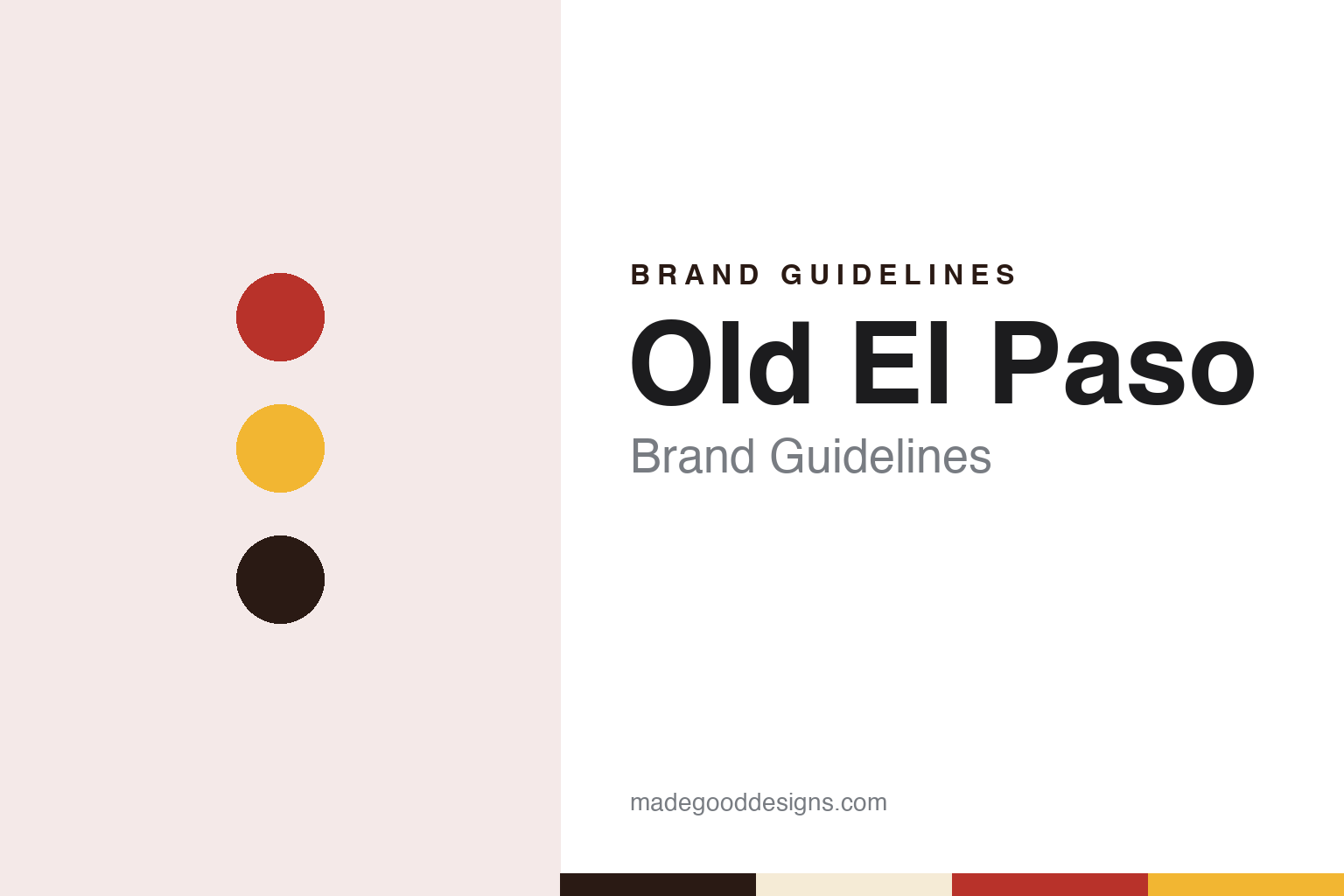
Old El Paso Brand Guidelines
The border cannery label that went global.
Aa
Two constants: a chile red, corn yellow and desert night palette and a sturdy slab serif register. Abstract homage — not an Old El Paso product or mark; no pack, logo or shell is reproduced.
A cannery near the border
Tomatoes, a farm in New Mexico and a label meant for outsiders.
Old El Paso is sold around the world, but its name points to one city on the Texas–Mexico border, and its roots lie in the canneries of the region around it. The fullest account of those roots is a 2018 history by the food historian Katherine Magruder, then a doctoral candidate in food studies at New York University, published by The Historical Cooking Project and footnoted to the El Paso Herald and El Paso Herald-Post. She writes that in 1912 A.C. Powell moved his family from Marfa, Texas, to Deming, New Mexico, where he started a tomato farm, and that in 1916 he founded the Mountain Pass Canning Company there to pack tomatoes. In 1925 he moved the cannery to Canutillo, Texas, just north-west of El Paso, and it went on to can green beans, pinto beans, green chiles and other produce of the Mesilla Valley.
The Old El Paso name itself, Magruder writes, began with a neighbour. The Valley Canning Company of Canutillo, run by Sam Gillett Jr., sold its goods across the Southwest under a “Valley” label, but Gillett felt that name was not evocative enough for customers further away, so products sold outside the region carried an “Old El Paso” label instead — a brand, as she puts it, meant from the start for people who were not from El Paso. The trademark record suggests the label was first used in commerce in 1938, she notes, although the name turns up in local newspapers only from the late 1940s.
The company tells a shorter version of the story. General Mills says the brand’s roots go back to 1917, when the Mountain Pass Canning Company began producing canned foods in the El Paso region, and that it adopted the Old El Paso name in 1938; its British site adds that the business began with canned tomatoes and pinto beans from a seven-acre farm. The company’s Australian site said in 2014 that around 1946 the brand launched a taco sauce, which it called the first of its kind outside Mexico.
Colour
Three labels, a move to Anthony and a national brand.
The business that became Old El Paso was built in the 1950s. In the early part of that decade, Magruder writes, Mountain Pass Canning was bought by Tom Barwise and James Dick Jr., who had sold his own grocery and canning business to Safeway in 1952, and the company added canned beef enchiladas, chili con queso and tamales to its range of Mexican foods. In 1955 Mountain Pass bought out Gillett and took over Valley Canning, which left it with three labels: “Old El Paso” for international sales, “Valley” for the local region and “Mountain Pass” for the rest of the United States, the El Paso Herald-Post reported that year. In 1958 the company moved to a larger site in Anthony, Texas, in El Paso County.
A national food company arrived a decade later. In 1968 Pet Inc. bought Mountain Pass Canning and with it the Old El Paso label, the Herald-Post reported that July. The company says that in 1969 Old El Paso became the first brand to advertise Mexican food across the United States and the first to offer a full line of Mexican meals, and that in 1970 American supermarkets created Mexican food sections for the first time. In the 1970s its taco shells and dinner kits went abroad; the company dates its arrival in Australia and in Britain to 1984. By the late 1980s, Magruder writes, Old El Paso held about a quarter of American salsa sales, and the “Mountain Pass” label was eventually dropped.
Abroad, the brand became known for one advertisement. A television spot made in Australia in the late 2000s, in which a young girl asks “¿Por qué no los dos?” — “Why not both?” — became an internet meme, the Australian trade title Marketing and the New Zealand Herald have reported, and the advertisement is held by Australia’s National Film and Sound Archive.
Typography
Design and documentation.
The seven brands in this group all make the seasonings, stocks, tomatoes and sauces that sit behind a meal, and they come from Switzerland, Germany, Italy, Britain, Hong Kong and the United States: Maggi, Knorr, Mutti, Cirio, Patak’s, Lee Kum Kee and Old El Paso. Brands in this part of the store cupboard in general sit at many different points in the trade, from family firms that still carry a founder’s surname to names that now belong to much larger food groups, and a single brand can be sold everywhere from a corner shop to a supermarket shelf on another continent.
A sauce or stock brand’s identity is usually carried less by a single product than by a jar, a cube, a tin, a name and the kitchen it promises, because the company behind the name may have changed hands, moved its factory or grown far beyond the town where it started. That makes the questions behind each name worth asking plainly: who started it, who owns it now, and where its products are actually made and packed.
Each guide separates what independent sources record from what the company says about itself — its founding story, its owners over time, where its products are made and how its packaging has changed — and marks plainly what rests only on the company’s own word.
Aa
A sturdy slab serif for a brand that began on a cannery label. (Specimen set in Bitter, a slab-serif STAND-IN; NOT the Old El Paso logo.)
Old El Paso
Pillsbury, General Mills and a factory in Navarra.
Two more owners followed Pet. The Pillsbury Company, part of Britain’s Grand Metropolitan since 1989, bought Pet in 1995, bringing in Old El Paso alongside brands such as Progresso, the General Mills history blog records. Pillsbury sold the Anthony cannery to a group of investors in 1997 and later bought it back, Magruder writes. General Mills of Minneapolis completed its takeover of Pillsbury in October 2001, and in 2002 it closed the Anthony plant, which had been the town’s largest private employer; more than 250 permanent jobs went, the Albuquerque Business First reported in April 2002. General Mills representatives suggested at the time that the plant made ingredients for cooking from scratch, while the brand now centred on taco kits and other ready-made items, Magruder writes.
For Europe, Old El Paso is made in Spain. The brand’s British site says its UK products come from a dedicated factory in Spain that also supplies Europe and other parts of the world, and General Mills’ Spanish arm says its single Spanish factory, at San Adrián in Navarra, exports Old El Paso and Nature Valley to more than 30 countries; it dates Old El Paso’s arrival in Spain to 1995. The regional daily Noticias de Navarra reported in May 2024 that General Mills was marking 20 years in San Adrián.
The range today runs from taco shells, tortillas and dinner kits to seasonings, sauces and refried beans. Its best-known shape is the Stand ’N Stuff shell, which the company says has a flat bottom so that it stands up on the plate while it is filled. In Britain a soft version was billed as the country’s first soft standing taco shell, eight years in development, and its launch was marked with a Guinness World Records attempt at the longest line of tacos, according to Guinness World Records. In September 2026 the brand went back to the city in its name: General Mills became title sponsor of El Paso’s college-football Sun Bowl, renamed the Old El Paso Sun Bowl, with the 93rd game set for 31 December 2026; the Sun Bowl Association’s executive director, Bernie Olivas, said it was fitting to have a sponsor whose origins were in El Paso.
For a design guide, Old El Paso shows how a cannery label written for distant customers can grow into an international brand that still carries the name of a border city. Compare Cheerios, another General Mills brand, and Tostitos, a rival in the American salsa aisle. For this guide we use chile red, corn yellow and a desert night brown with a slab serif, an unofficial interpretation; no product or logo is reproduced.
Explore & save
Keep Old El Paso’s identity on hand — save it to a board in the Made Good inspiration library.
Old El Paso identity set
Pin the Old El Paso chile red, corn yellow and desert night palette and the sturdy slab serif register to your own board.