UTMB Brand Guidelines
A loop of about 170 kilometres around Mont Blanc, started and finished in Chamonix.
Aa
Two constants: a night-ridge, glacier and headlamp palette and a grotesque sans register. Abstract homage — not a UTMB asset; no logo, bib or course map is reproduced.
A race around the massif
A Chamonix idea from 2003.
The Ultra-Trail du Mont-Blanc, shortened to UTMB, is a single-stage mountain race of about 170 kilometres and roughly 10,000 metres of climbing. It follows the Tour du Mont Blanc hiking route, a loop that walkers usually take seven to nine days to complete, through France, Italy and Switzerland, starting and finishing in Chamonix, English Wikipedia says. Aid bases along the loop include Les Contamines, Courmayeur in Italy and Champex in Switzerland, and the high points include the Col de la Seigne and the Grand Col Ferret.
The race was first held in 2003. French Wikipedia says that in October 2002 nine people, among them Michel and Catherine Poletti, decided to create an individual race to replace an earlier seven-person relay around the massif, which had stopped being held. The Polettis ran a record shop in Chamonix, and Catherine Poletti became the first race director while the other eight ran in the first edition.
In a June 2021 interview with the Belgian daily La DH, Catherine Poletti said the founders had hoped for 300 runners, 500 at most, and that 722 started. The first race, she said, carried the longer name “The North Face Ultra Trail International du Mont-Blanc.” French Wikipedia says the opening edition measured 155 kilometres, and that the distance grew over the following years as the organisers moved the finish, reaching 166 kilometres in 2008. Writing for the Chamonix guiding company Run the Alps in August 2021, Doug Mayer recorded the memories of Krissy Moehl, who won the women’s race at that first edition; she recalled a home-grown event, volunteers at the finish, and a course shortened by bad weather.
Colour
One race becomes a week.
Demand grew quickly. English Wikipedia says entrants doubled to about 1,400 in 2004, and French Wikipedia says that registration for the 2008 race closed in eight minutes. Catherine Poletti told La DH that 42,000 people asked for a bib for the 2019 edition. From 2009 the organisers used a lottery to decide who could start, after first requiring qualifying points from other races.
To give more runners a place, the organisers added races to the week. French Wikipedia lists the CCC (Courmayeur–Champex–Chamonix) in 2006, the team event PTL in 2008, the TDS (Sur les Traces des Ducs de Savoie) in 2009, the OCC (Orsières–Champex–Chamonix) in 2014, a youth race in 2016, the MCC in 2018 and a short trail at Courmayeur in 2022. Together they now make up a week of racing at the end of August, held across French, Italian and Swiss communes around the massif.
The race also has a fixed set of rituals and systems. French Wikipedia says Vangelis’s Conquest of Paradise is played before the main starts in Chamonix. Runners must carry a list of mandatory equipment, pacers are not allowed, and race numbers contain a magnetic badge read at about 50 checkpoints, with times published online as runners pass, English Wikipedia says. Food and drink points sit every 10 to 15 kilometres, and four larger aid stations, at Chamonix, Les Chapieux, Courmayeur and Champex, offer hot meals and beds; at Courmayeur runners can collect a drop bag left before the start. The event relies largely on volunteers to run aid stations and the course. French Wikipedia says that registrations for 2020 came from 111 nationalities, with large groups from Spain, Italy, the United Kingdom, China, the United States and Japan as well as France.
Sponsors have changed over the years. French Wikipedia lists The North Face as the main sponsor until 2016, Columbia Sportswear from 2017 to 2021, HOKA in 2022 and Dacia from 2023, with HOKA returning in 2024; since 2024 the week has carried the name HOKA UTMB Mont-Blanc under a naming agreement.
Typography
How races present themselves.
Running races and mass-participation events present themselves through a small, repeated set of things: a race name, a logo, a bib, a medal and a course map. Organisers publish these each year, and many of them change from edition to edition while the course and the landmark at the finish stay the same. Free weekly events work with a different kit: a printed personal barcode and a numbered finish token take the place of a bib, and shirts in set colours mark milestones instead of medals.
Title sponsors are a large part of that picture. A city marathon can carry a carmaker’s, a bank’s or an insurer’s name for a decade or more and then change it, so the race name on the bib, the medal ribbon and the finish banner shifts with each new contract. Start pens, finish arches, finisher shirts and medals are the places where the sponsor’s colours meet the event’s own marks.
Behind the events sit organisations of different kinds: sports clubs and the companies they set up to run their races, foundations, charities and commercial series owners. This guide describes each one plainly, by legal form and dated role, and names title sponsors as dated facts rather than as endorsements. Participant and finisher counts appear only as a dated source gives them.
Much of what these events publish about themselves is history: first editions, course changes, past names and lists of editions. Each guide below sets out what can be checked about one event, who organises it and how its name and visual language have changed, and keeps records to a single attributed fact.
Aa
A grotesque sans for race numbers and course signs. (Specimen set in Archivo, a sans STAND-IN; NOT the UTMB logo.)
From one race to a world series
UTMB Group and the series.
The event is run by UTMB Group. French Wikipedia says that in April 2020 Michel Poletti stepped down as chief executive after 17 years, and was succeeded by Frédéric Lénart, formerly an executive on the organising committee of the 24 Hours of Le Mans; Catherine Poletti remained president of UTMB Group. In her 2021 interview with La DH, she said the organisation had grown from two people to nine until 2018, and to 40 people working on the events all year.
In May 2021 UTMB Group and The IRONMAN Group announced a partnership to launch the UTMB World Series, a circuit of races leading to finals at UTMB Mont-Blanc, according to the joint announcement carried by Trail Run Magazine. English Wikipedia describes the series as operated by UTMB Group, a privately held company, in a commercial partnership with The IRONMAN Group, and says it began in 2022. Its finals are organised by distance: the OCC is the 50K final, the CCC the 100K final and the UTMB the 100-mile final.
Entry now runs through two systems, English Wikipedia says. The UTMB Index scores a runner’s performance in 20K, 50K, 100K and 100-mile categories, and Running Stones, earned by finishing World Series events, act as entries in the lottery for the Chamonix finals. Catherine Poletti told La DH that the series was a response to demand that had become too large for the races in Chamonix alone.
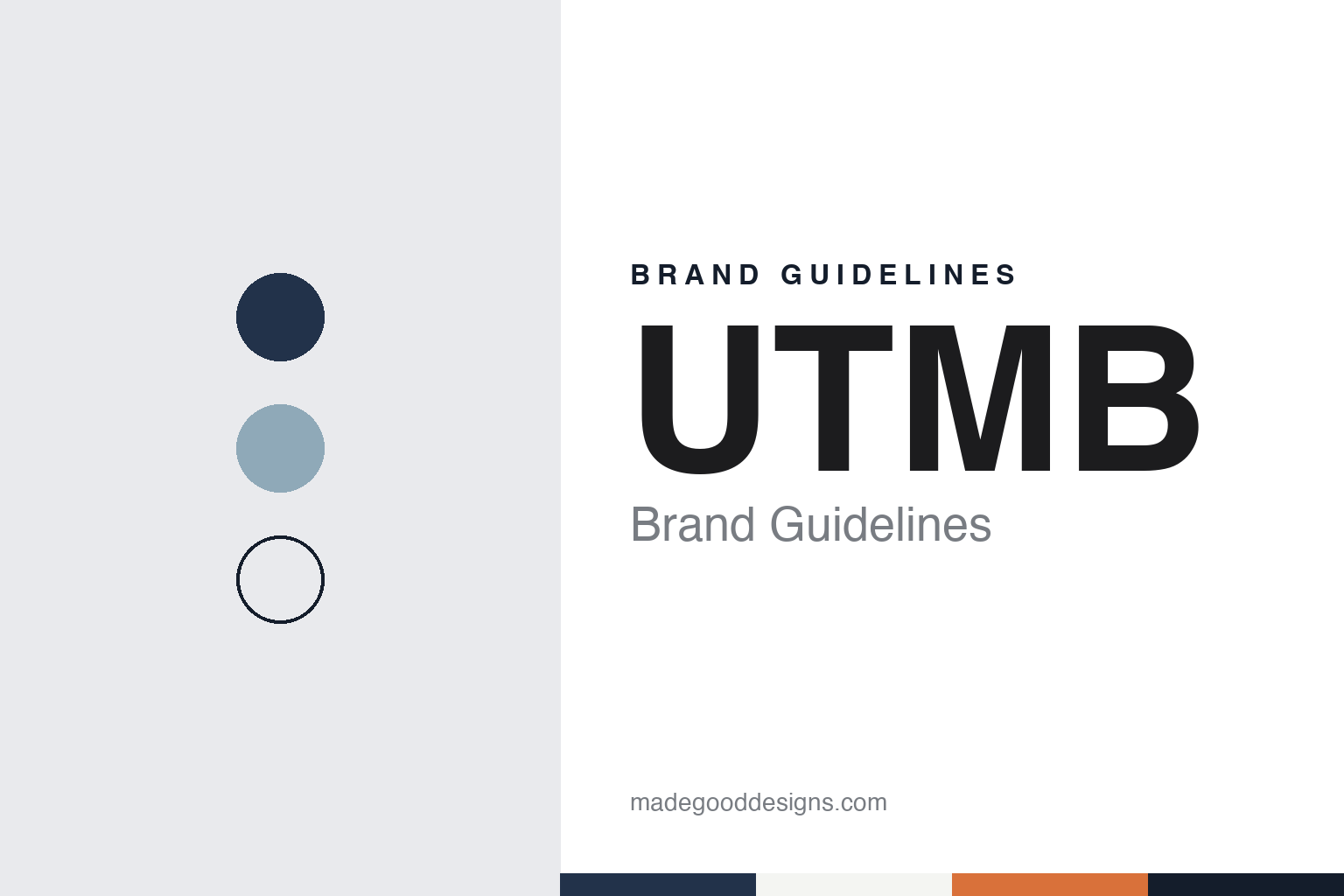
For a design guide, UTMB shows how a single mountain race can become a naming system: one place-name abbreviation lends its letters to a week of races, a sponsor title and a worldwide series. Compare HOKA, the event’s naming partner since 2024, and Comrades Marathon, a long-running road ultra. For this guide we use a night-ridge blue, a glacier blue, a headlamp orange and a snowfield white with a sans, an unofficial interpretation; no product or logo is reproduced.
Explore & save
Keep UTMB’s identity on hand — save it to a board in the Made Good inspiration library.
UTMB identity set
Pin the UTMB night-ridge, glacier and headlamp palette and the grotesque sans register to your own board.
Source & notes
Frequently Asked Questions
What font can I use to match the UTMB look?
This guide describes UTMB’s type as “A grotesque sans for race numbers and course signs”. Its type specimen is set in Archivo from Google Fonts as a stand-in; Archivo is not UTMB’s own lettering.
What colours are in the UTMB palette?
This guide’s UTMB palette is Night ridge #22324A, Summit ink #141D2B, Glacier blue #8FA9B8, Headlamp orange #D9713A and Snowfield #F4F5F2. The tones are the guide’s own unofficial interpretation, not official UTMB hex codes.
Who founded UTMB?
UTMB was founded by Catherine and Michel Poletti.