Comrades Marathon Brand Guidelines
The road between Durban and Pietermaritzburg, run in alternating directions since 1921.
Aa
Two constants: a green, gold and road-dust palette and a condensed sans register. Abstract homage — not a Comrades Marathon asset; no logo, medal or bib is reproduced.
A road race between two cities
An idea from 1921, run in two directions.
The Comrades Marathon is an ultramarathon of roughly 88 kilometres on the roads of KwaZulu-Natal, in South Africa, between Durban on the Indian Ocean coast and the inland city of Pietermaritzburg. Its direction changes every year: the “up” run starts in Durban and climbs inland, and the “down” run starts at Pietermaritzburg City Hall and descends towards the coast, English Wikipedia says.
The race was first run on 24 May 1921, Empire Day. It was the idea of Vic Clapham, a veteran of the First World War, who conceived it as a memorial to South African soldiers of that war; the name refers to those wartime comrades. The Sunday Tribune reported in May 2024 that Clapham had to keep asking officials before he got permission to stage the first race, which began with 34 runners. English Wikipedia says 48 entered, 34 started and 16 completed it within the 12-hour limit, and that Bill Rowan won in 8 hours 59 minutes.
The race has been held almost every year since. It stopped during the Second World War, from 1941 to 1945, and no race was held in 2020 or 2021; it returned in August 2022 under the slogan “The Return – Sishay’ Ibuya,” English Wikipedia says. The Comrades Marathon Association’s own record lists the 2022 race as the 95th Comrades and the 47th down run, from Pietermaritzburg City Hall to the Moses Mabhida Stadium in Durban, with 13,213 starters and 11,713 finishers.
Entry was restricted for its first five decades. English Wikipedia, describing the 1935 race, says government and race rules of the time required entrants to be white men, so Robert Mtshali, who ran that year, was not officially recorded. The Sunday Tribune reported in 2024 that, early in 1975, a Pietermaritzburg club, College Harriers, asked the Natal Athletics Association to open the race, and the South African Amateur Athletics Union confirmed that Black runners and women could compete that year, in a limited field with qualifying rules. The paper gives 1,501 entries, 1,352 starters and 1,237 finishers for 1975.
Colour
Hills, rituals and numbers.
Much of the race’s identity is built from its route. English Wikipedia describes five major climbs, known together as the “Big Five”: Cowies Hill, Fields Hill, Botha’s Hill, Inchanga and Polly Shortts. The highest point lies near Umlaas Road, and the halfway mark sits near Drummond. About 40 refreshment stations line the road.
The start follows a fixed sequence that English Wikipedia sets out: the national anthem, the song Shosholoza, Vangelis’s Chariots of Fire, and a recording of a rooster’s crow, first given in 1948 by the race official Max Trimborn in place of the starter’s gun, before the gun itself is fired. Near Drummond, runners pass “Arthur’s Seat,” a small recess in the roadside bank where some leave a flower. Near the end, the leading man and woman carry a scroll with a message from the mayor of the starting city to the mayor of the finishing city, and the top ten men and women each receive a red rose on the final straight.
The finish is just as ritualised. A gun is fired at the time limit, which English Wikipedia gives as 12 hours since 2003, after 11 hours from 1928; runners who have not crossed the line are not counted, and a bugler then plays the Last Post. Medals go to every runner who finishes within the limit. Alongside gold, silver and bronze, the association’s records list medals named after the founder and early runners, among them the Vic Clapham, Bill Rowan and Robert Mtshali medals; the Sunday Tribune reported that the Mtshali medal was introduced in 2019.
Race numbers carry their own code. English Wikipedia says a runner on a ninth finish wears a yellow number, and a runner with ten finishes receives a green number, kept permanently for all later races; 20th, 30th and 40th races are marked with green numbers in different formats. To enter, runners aged over 20 must first complete a recognised marathon in under five hours.
Typography
How races present themselves.
Running races and mass-participation events present themselves through a small, repeated set of things: a race name, a logo, a bib, a medal and a course map. Organisers publish these each year, and many of them change from edition to edition while the course and the landmark at the finish stay the same. Free weekly events work with a different kit: a printed personal barcode and a numbered finish token take the place of a bib, and shirts in set colours mark milestones instead of medals.
Title sponsors are a large part of that picture. A city marathon can carry a carmaker’s, a bank’s or an insurer’s name for a decade or more and then change it, so the race name on the bib, the medal ribbon and the finish banner shifts with each new contract. Start pens, finish arches, finisher shirts and medals are the places where the sponsor’s colours meet the event’s own marks.
Behind the events sit organisations of different kinds: sports clubs and the companies they set up to run their races, foundations, charities and commercial series owners. This guide describes each one plainly, by legal form and dated role, and names title sponsors as dated facts rather than as endorsements. Participant and finisher counts appear only as a dated source gives them.
Much of what these events publish about themselves is history: first editions, course changes, past names and lists of editions. Each guide below sets out what can be checked about one event, who organises it and how its name and visual language have changed, and keeps records to a single attributed fact.
Aa
A condensed sans for bib numbers and route signs. (Specimen set in Barlow Condensed, a sans STAND-IN; NOT the Comrades Marathon logo.)
The association and the calendar
A race run by its own association.
The race is organised by the Comrades Marathon Association, based in Pietermaritzburg, which runs the entries, results, a museum and the race archive on its website, comrades.com. The association presents the event as “The Ultimate Human Race,” and its website also uses the line “The Greatest Story Ever Run.” Its published history gives detailed figures for each edition: weather, start and finish venues, official distance, entries, starters, finishers and the number of each medal awarded.
The race calendar has moved over time. English Wikipedia says the race was held on Republic Day, 31 May, from 1962 to 1994; after that holiday ended in 1995 the race moved to Youth Day, 16 June, and the date has since varied, including May dates in 2009 and 2010 around football tournaments held in South Africa. The field has grown from 104 starters in 1960 to more than 1,000 in 1971 and more than 3,000 in 1979, according to English Wikipedia, which also says that in all but three editions since 1988 more than 10,000 runners have reached the finish.
Foreign runners first entered in 1962, when the Road Runners Club of England sent four runners. The race also has a place in street names: in May 2024 the Sunday Tribune quoted an association board member saying that Connaught Road in Scottsville, Pietermaritzburg, had been renamed Comrades Road.
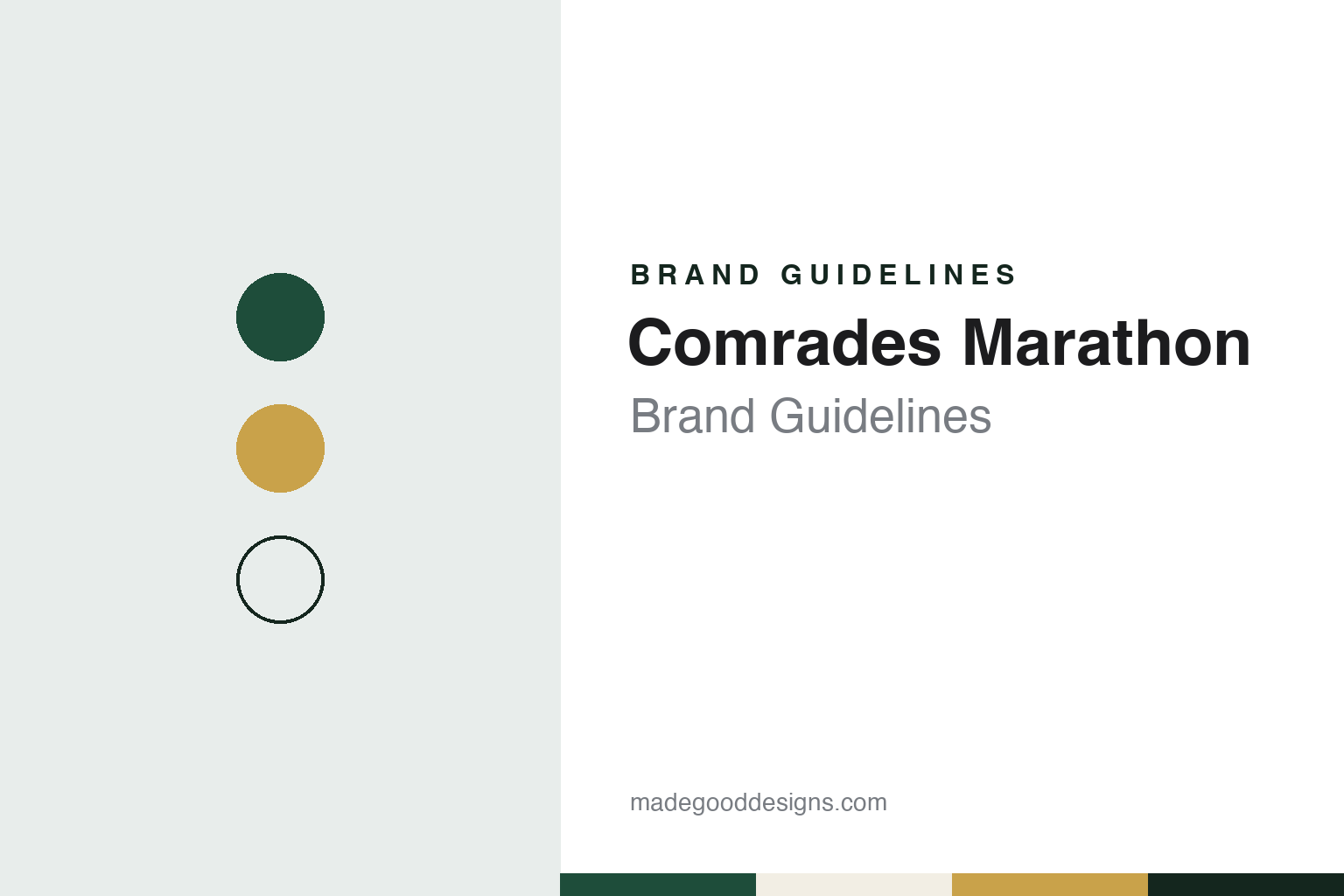
For a design guide, the Comrades Marathon shows how a race can build its identity from a route, a set of rituals and a numbering system rather than a single logo. Compare London Marathon, a big-city road race, and UTMB, a mountain ultra. For this guide we use a deep green, a medal gold, a rose red and a pale road-dust tone with a condensed sans, an unofficial interpretation; no product or logo is reproduced.
Explore & save
Keep Comrades Marathon’s identity on hand — save it to a board in the Made Good inspiration library.
Comrades Marathon identity set
Pin the Comrades Marathon green, gold and road-dust palette and the condensed sans register to your own board.
Source & notes
Frequently Asked Questions
What font can I use to match the Comrades Marathon look?
This guide describes Comrades Marathon’s type as “A condensed sans for bib numbers and route signs”. Its type specimen is set in Barlow Condensed from Google Fonts as a stand-in; Barlow Condensed is not Comrades Marathon’s own lettering.
What colours are in the Comrades Marathon palette?
This guide’s Comrades Marathon palette is Green number #1E4D3A, Night start #14261E, Medal gold #C9A24A, Finish rose #A8323A and Road dust #F2EEE4. The tones are the guide’s own unofficial interpretation, not official Comrades Marathon hex codes.
Who founded Comrades Marathon?
Comrades Marathon was founded by Vic Clapham.