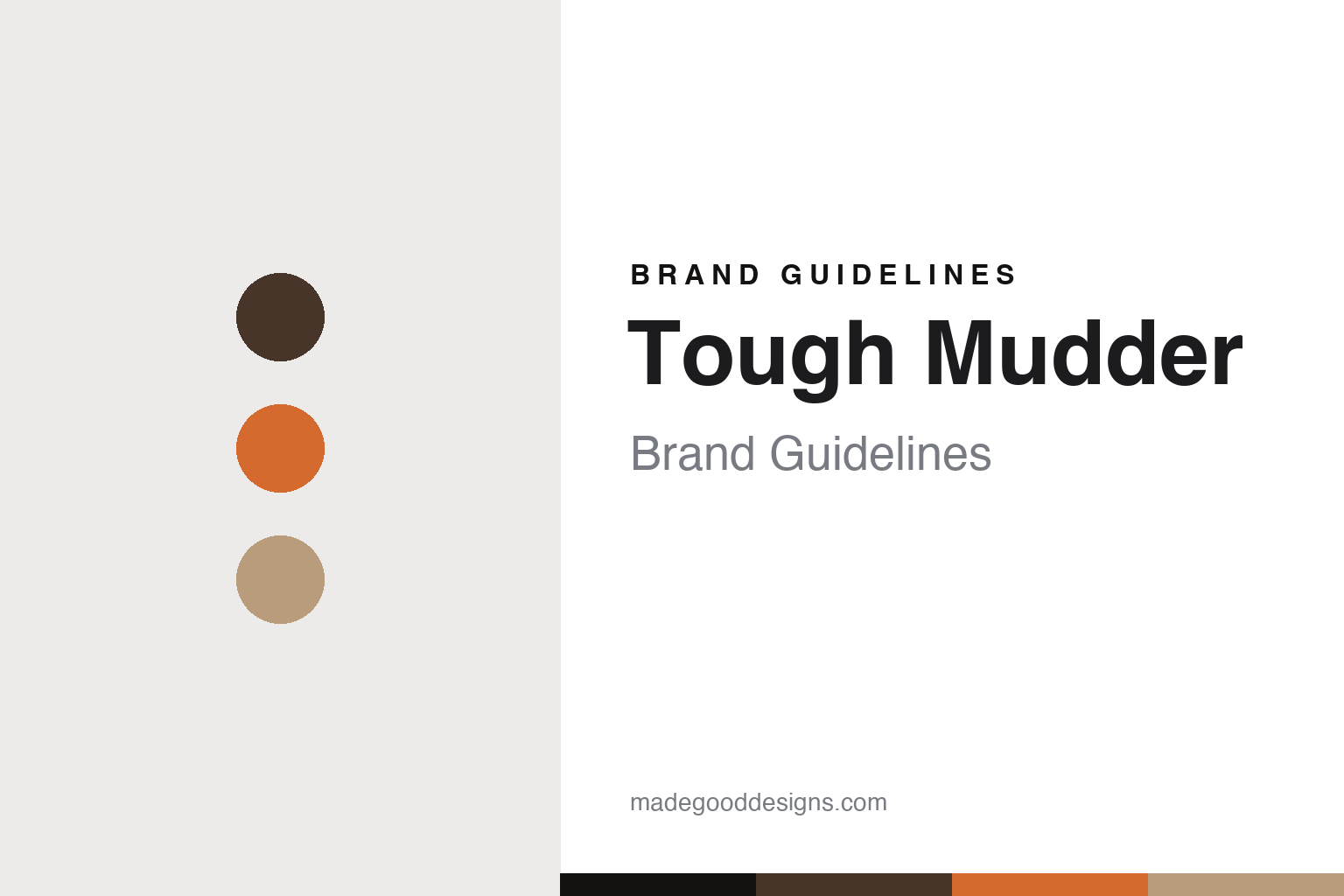
Tough Mudder Brand Guidelines
The Brooklyn mud run rebuilt under Spartan after 2020.
Aa
Two constants: a mud brown, ink and orange palette and a condensed sans register. Abstract homage — not a Tough Mudder asset; no logo, headband, obstacle or course graphic is reproduced.
Bear Creek
A business-school plan and a ski hill in Pennsylvania.
Tough Mudder started as a business plan. The New York Times reported on 28 April 2010 that a year earlier the idea had been a semifinalist in the Harvard Business School annual business plan contest, entered by a British student, Will Dean, who thought he could attract 500 people to a race through mud and man-made obstacles. When his contest teammates moved on, Dean brought in Guy Livingstone, a friend from boarding school and a former corporate lawyer in London, as chief operating officer.
The company was based in Brooklyn, subletting half an office in the Dumbo neighbourhood, and had six employees and two interns at the time, the Times reported. Its website went online in early February 2010, and it found its entrants almost entirely through Facebook advertising aimed at particular groups within reach of New York and Philadelphia.
The first event was held on Sunday 2 May 2010 at Bear Creek Mountain Resort, a ski resort near Allentown, Pennsylvania. The Times counted 4,500 prepaid participants from 37 states for a seven-mile course of muddy hills, cold water, walls, pipes and rope bridges, with the finish next to a beer tent and a live band. Dean and Livingstone had toured ski resorts and racetracks within two hours of New York the previous autumn before the resort’s general manager agreed to host them; his maintenance staff built the obstacles.
Dean later described those early weeks to the British magazine Coach, in an interview published on 16 September 2016: a month after the website opened, two tickets had been sold, and the team was just the two founders and two interns. By then, Coach reported, the company had 150 staff and 120 events in 11 countries on its calendar for that year, and more than 2.5 million people had taken part since 2010, according to the company’s figures.
The events spread beyond the United States. Dean told Coach in 2016 that the company had added events in Asia, a shorter Tough Mudder Half and the 24-hour Toughest Mudder, alongside a training partnership with the gym chain Virgin Active in Britain.
Colour
Untimed, muddy and done as a team.
The idea set Tough Mudder apart from road races. The Times reported in 2010 that there was no prize money and contestants were not timed: the point was to finish, and to have a story to tell. Dean said he had disliked how time was the only measure in marathons and triathlons. Before the start, participants recited a pledge to help others and not to whine, and the paper said the idea drew on similar events in Britain and Germany.
Much of the brand’s visual language grew out of that first race. Finishers received an orange headband, which the Times likened to something worn by a 1970s basketball player, and on-site artists offered free Tough Mudder tattoos. Dean told Coach in 2016 that thousands of participants had Tough Mudder tattoos, and that event T-shirts mattered so much to entrants that a shortage at one event in 2014 caused uproar.
Obstacles became named fixtures. Dean described the Funky Monkey, a set of monkey bars over water, and his own favourite, the King of the Swingers, in which entrants catch a trapeze bar and swing out to hit a bell before dropping into water.
The formats have multiplied. In November 2026 the company’s US website lists 5K, 15K and Infinity events for its 2027 season, in cities including Austin, Los Angeles, Atlanta, Philadelphia, Chicago, Toronto and Nashville, as well as a kids’ programme, season passes, group packages and an endurance series. The site also has regional editions for the United Kingdom, Germany and France.
For designers the useful point is that the identity rests on shared experience rather than on results: the pledge, the headband and the team photograph do the work that a finishing time does at a road race.
Typography
Races and mass-participation events.
Running races and mass-participation events present themselves through a small, repeated set of things: a race name, a logo, a bib, a medal and a course map. Organisers publish these each year, and many of them change from edition to edition while the course and the landmark at the finish stay the same. Free weekly events work with a different kit: a printed personal barcode and a numbered finish token take the place of a bib, and shirts in set colours mark milestones instead of medals.
Title sponsors are a large part of that picture. A city marathon can carry a carmaker’s, a bank’s or an insurer’s name for a decade or more and then change it, so the race name on the bib, the medal ribbon and the finish banner shifts with each new contract. Start pens, finish arches, finisher shirts and medals are the places where the sponsor’s colours meet the event’s own marks.
Behind the events sit organisations of different kinds: sports clubs and the companies they set up to run their races, foundations, charities and commercial series owners. This guide describes each one plainly, by legal form and dated role, and names title sponsors as dated facts rather than as endorsements. Participant and finisher counts appear only as a dated source gives them.
Much of what these events publish about themselves is history: first editions, course changes, past names and lists of editions. Each guide below sets out what can be checked about one event, who organises it and how its name and visual language have changed, and keeps records to a single attributed fact.
Aa
A condensed sans for course maps and obstacle boards. (Specimen set in Oswald, a sans STAND-IN; NOT the Tough Mudder logo.)
Tough Mudder
From bankruptcy proceedings to Spartan.
The original company did not survive in its first form. In January 2020, English Wikipedia records, creditors petitioned for Tough Mudder to be placed into involuntary Chapter 11 bankruptcy. In February 2020 the US Bankruptcy Court in Delaware approved the sale of Tough Mudder’s assets to Spartan Race, the obstacle-race company, the specialist site Mud Run Guide reported, with the sale due to close by 28 February. The endurance-events platform RunSignup reported the acquisition on 27 February 2020.
Spartan’s own announcement, dated 26 February 2020, said it had acquired the US business and assets of Tough Mudder under an agreement with the trustee managing the involuntary Chapter 11 proceeding, approved by the judge in the case, and that it had bought Tough Mudder’s UK business earlier that month. Spartan said the US business would operate as OCR U.S. Holdings, LLC, a wholly owned Spartan subsidiary, that existing licences for the brand in more than 20 countries would be honoured, and that former Tough Mudder chief executive Kyle McLaughlin would oversee the new company’s global business.
Since then Tough Mudder has run as one of Spartan’s brands. In November 2026 the Tough Mudder website lists Spartan, Spartan Trail, Deka and other Spartan event names in its brand bar, and its events, shop and season passes sit inside the same group.
The palette in this guide is our own reading of mud and the finishers’ orange headband, not a brand specification.
For a design guide, Tough Mudder shows how a brand can be carried by rituals, a pledge, a headband and a team photograph, and can outlast the company that created it. Compare HYROX, a fitness race built on a fixed indoor format, and New York City Marathon, another mass-participation event from the city where Tough Mudder began. For this guide we use mud brown, ink and an orange with a condensed sans, an unofficial interpretation; no product or logo is reproduced.
Explore & save
Keep Tough Mudder’s identity on hand — save it to a board in the Made Good inspiration library.
Tough Mudder identity set
Pin the Tough Mudder mud brown, ink and orange palette and the condensed sans register to your own board.
Source & notes
Frequently Asked Questions
What font can I use to match the Tough Mudder look?
This guide describes Tough Mudder’s type as “A condensed sans for course maps and obstacle boards”. Its type specimen is set in Oswald from Google Fonts as a stand-in; Oswald is not Tough Mudder’s own lettering.
What colours are in the Tough Mudder palette?
This guide’s Tough Mudder palette is Mud brown #47352A, Ink #141210, Headband orange #D46A2E, Clay #B99C7C and Paper #F6F2EC. The tones are the guide’s own unofficial interpretation, not official Tough Mudder hex codes.
When was Tough Mudder founded?
Tough Mudder was founded in 2010, in Brooklyn, New York.
Who founded Tough Mudder?
Tough Mudder was founded by Will Dean and Guy Livingstone in 2010.