Cloetta Brand Guidelines
Three Swiss brothers in Copenhagen and a chocolate village in Sweden.
Aa
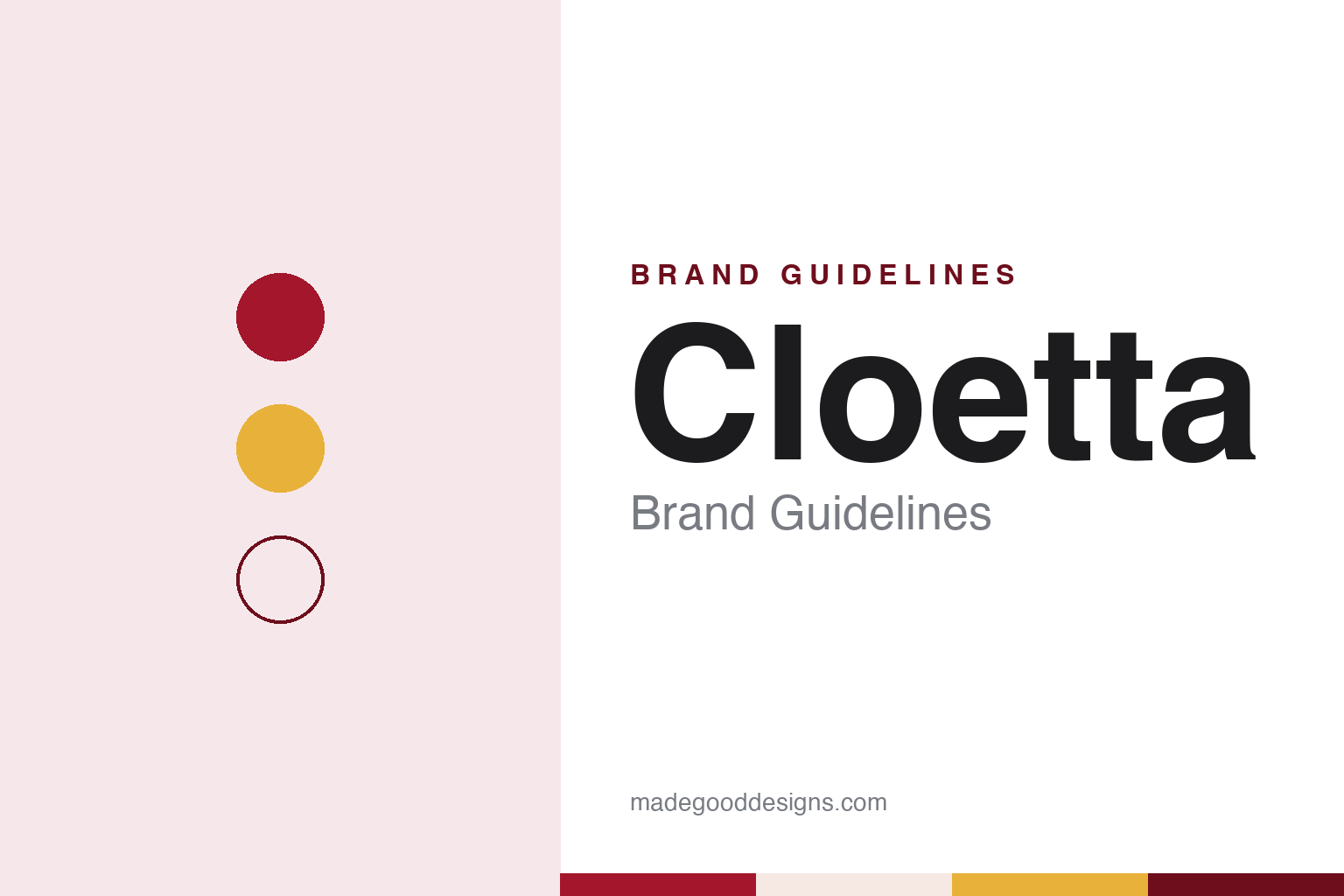
Two constants: a red, gold and blush palette and a rounded sans register. Abstract homage — not a Cloetta product or mark; no pack, logo or sweet is reproduced.
Brødrene Cloëtta
A steam chocolate factory in Copenhagen, then a move to Sweden.
Cloetta began in Denmark, not Sweden. In 1862 three Swiss brothers, Bernhard, Christoph and Nutin Cloëtta, founded a firm in Copenhagen to make chocolate and confectionery, Cloetta’s own history says. Swedish Wikipedia gives its name as Brødrene Cloëttas Damp-Chokolade-Fabrik — the Cloëtta Brothers’ steam chocolate factory — and calls it one of Denmark’s first chocolate factories. Bernhard had arrived in Copenhagen in 1848 and his brothers two years later, it says; the factory started at Sortedams Mølle, moved to Niels Hemmingsens Gade in 1865 and in 1901 gained a new building on Hørsholmsgade by the architect Ludvig Knudsen, which Swedish Wikipedia says made it the largest chocolate factory in the Nordic countries.
The brothers soon looked across the water. A factory in Malmö followed in 1872, according to the Swedish encyclopaedia Nationalencyklopedin, or 1873, according to Cloetta; another opened in Kristiania, now Oslo, in 1896. In 1900, Swedish Wikipedia says, citing the Swedish biographical dictionary, Cloetta bought a chocolate company at Råby, outside Motala, and in 1901 moved that business to Ljungsbro, near Linköping. By 1902 it had decided to close its plants in Malmö and in Norrköping, and some thirty families moved north from Malmö with the work.
Ljungsbro became a company village. Swedish Wikipedia, citing the business-history archive Företagskällan, says Cloetta planned the small town using Cadbury’s Bournville in England as its model, kept in touch with Cadbury and shared its social ambitions; it planted 500 apple trees and made apple purée during the First World War, when the war cut off imported raw materials. Later the company architect Henry Fraenkel designed houses in the town, including the 1948 town hall.
The family did not keep the business. In 1917, Cloetta says, the Svenfelt family took over the majority of the company through a newly formed company, Svenska Chokladfabriks AB, and the family still holds a major stake today.
Colour
A slogan, a biscuit bar and a century of brands.
Cloetta’s advertising has a long memory. In 1921 it created the slogan “Tag det rätta – tag Cloetta” — “choose right, choose Cloetta” — the company says, and Swedish Wikipedia, citing Företagskällan, says it made a big impact. The same year a biscuit-filled chocolate bar went on sale under the name Five o’clock; Swedish Wikipedia, citing Cloetta, says it was renamed Kexchoklad in 1938, the year Cloetta’s own timeline gives for the brand’s introduction.
Cloetta’s history lists a run of Swedish favourites from the following decades: Guldnougat in 1913, Tarragona in 1928, Sportlunch, first called Mellanmål, in 1937, Center in 1941 and Plopp in 1949. In 1971, Swedish Wikipedia says, it bought the Stockholm chocolate maker Choklad AB Thule, owner of Mums-mums and Plopp. The company was listed on the Stockholm Stock Exchange in 1994, and in 1998 it bought its rival Candelia, maker of Polly and Bridgeblandning, which Swedish Wikipedia says created Sweden’s largest chocolate and confectionery group.
Many of the brands Cloetta sells today came from elsewhere, and its own history tells their stories alongside its own. Läkerol was launched in Sweden in 1909. The chewing gum Jenkki — Finnish for “Yankee” — appeared in Finland in 1951, and Ahlgrens bilar, the car-shaped sweets, followed in 1953; Cloetta says they took the Italian Bugatti as their inspiration and calls them “the world’s best-selling car.” The Dutch brands go further back still: Cloetta dates Venco liquorice to 1878 in Amsterdam and Red Band to 1928.
Those brands reached Cloetta by a separate path. The Dutch sugar and food company CSM bought Red Band in 1986, Cloetta’s history says; Leaf bought Ahlgrens, with Läkerol and Ahlgrens bilar, in 1993; CSM bought Malaco in 1997 and Leaf itself in 1999. In 2005 the private-equity firms CVC and Nordic Capital bought CSM’s confectionery division and renamed it Leaf.
Typography
Design and documentation.
The seven brands in this group all make sweets and gummies, and they come from Germany, Sweden, Britain and the United States: Katjes, Trolli, Werther’s Original, Cloetta, Maynards Bassetts, Swizzels and Jelly Belly. Sweet and gummy brands in general sit at many different points in the trade, from family firms that still carry a founder’s surname to names that now belong to much larger confectionery groups, and a single brand can be sold everywhere from a corner shop to a supermarket aisle.
A sweet brand’s identity is usually carried less by a single product than by a pack, a name and the treat it promises, because the company behind the name may have changed hands, moved its factory or grown far beyond the town where it started. That makes the questions behind each name worth asking plainly: who started it, who owns it now, and where its sweets are actually made and packed.
Each guide separates what independent sources record from what the company says about itself — its founding story, its owners over time, where its sweets are made and how its packaging has changed — and marks plainly what rests only on the company’s own word.
Aa
A rounded sans for a company built on a family of friendly sweets brands. (Specimen set in Nunito, a sans STAND-IN; NOT the Cloetta logo.)
Cloetta
Fazer, Leaf and a listed company.
Cloetta’s modern shape came from two mergers. In 2000 it combined with the confectionery business of Finland’s Fazer to form Cloetta Fazer. The partnership ended after years of disputes between its two main owners, the Svenfelt-Trotzig family company Malfors Promotor and the Fazer family; shareholders approved the split on 25 July 2008, Just Food reported, and Swedish Wikipedia says the independent Cloetta was listed on the Stockholm exchange on 8 December 2008.
In December 2011 Cloetta announced that it would merge with Leaf. The deal was completed on 16 February 2012: Leaf’s owners, CVC and Nordic Capital, took 57.6% of the combined company and Cloetta’s existing shareholders 42.4%, Just Food reported, and Leaf’s chief executive, Bengt Baron, became chief executive of the new Cloetta. The merged group kept the Cloetta name. In December 2013 the two private-equity firms sold their remaining 16.1% stake, ConfectioneryNews reported. Cloetta then bought The Jelly Bean Factory in Ireland in 2014, the Dutch fudge maker Lonka in 2015 and the pick-and-mix company Candyking in 2017, the company says, when it also divested its Italian operations.
Today Cloetta AB is based in Sundbyberg, near Stockholm, and its B-shares trade on Nasdaq Stockholm; Malfors Promotor was still its largest owner in 2023, Swedish Wikipedia says, citing Cloetta. The company says it has six factories in five countries. The largest, at Levice in Slovakia, makes Malaco, Red Band and Läkerol among others; Ljungsbro still makes Kexchoklad, Ahlgrens bilar, Center and Plopp; the others are at Roosendaal and Sneek in the Netherlands, Turnhout in Belgium and Dublin, Cloetta says.
For a design guide, Cloetta shows how a company name can sit above dozens of local brands, each with its own pack and character. Compare Fazer, its former partner, and Marabou, another Swedish chocolate name. For this guide we use a deep red, a wafer gold and a soft blush with a sans, an unofficial interpretation; no product or logo is reproduced.
Explore & save
Keep Cloetta’s identity on hand — save it to a board in the Made Good inspiration library.
Cloetta identity set
Pin the Cloetta red, gold and blush palette and the rounded sans register to your own board.