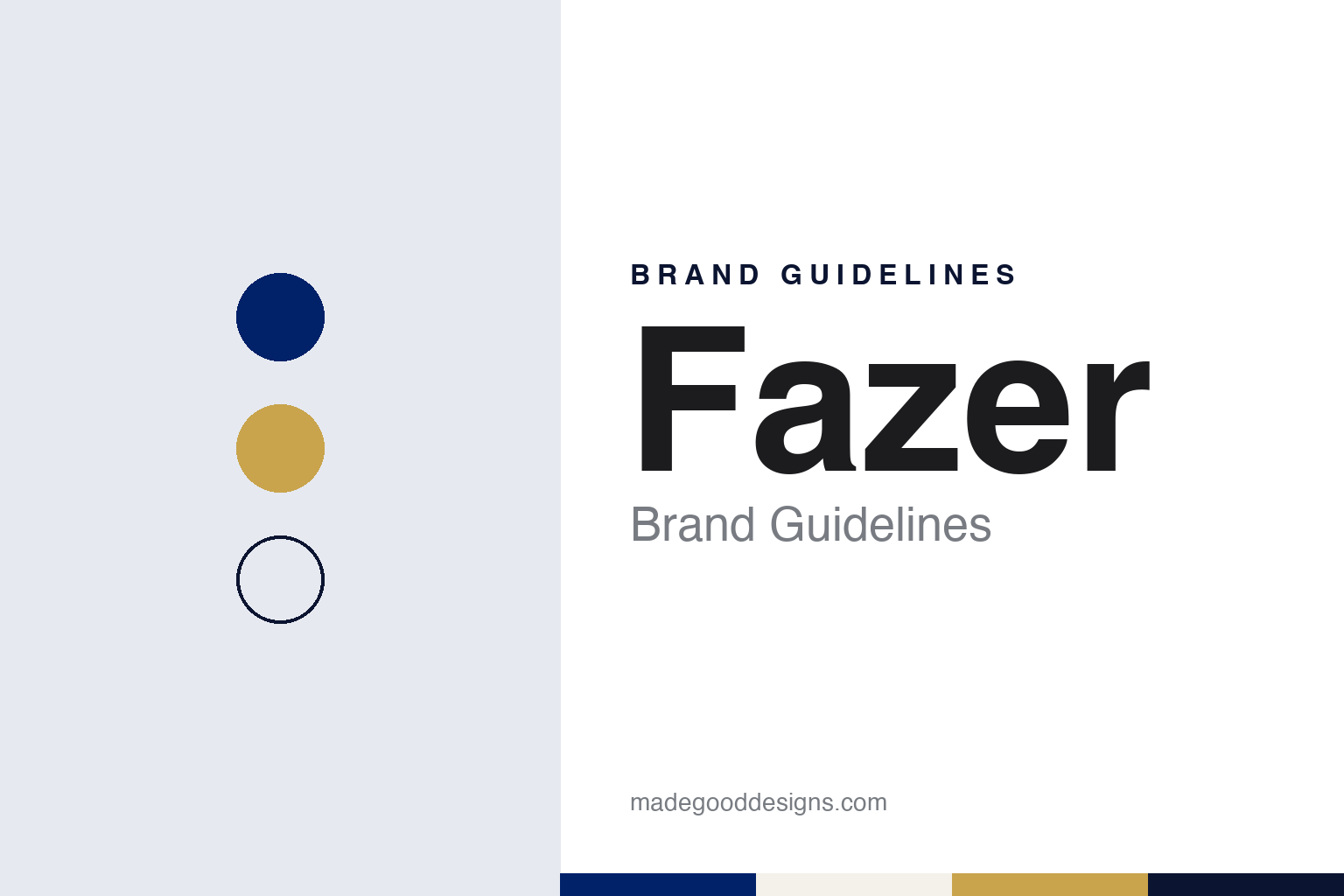
Fazer Brand Guidelines
The Helsinki café whose blue became Finland’s first colour trademark.
Aa
Two constants: a Fazer blue and gold palette and a Classic serif register. Abstract homage — not a Fazer product or mark; no wrapper, logo or signature is reproduced.
Kluuvikatu 3
A confectioner’s café in Helsinki, 1891.
Fazer began as a café. In the autumn of 1891 Karl Fazer opened a “French-Russian” confectionery and café at Kluuvikatu 3 in central Helsinki, in a building owned by his father, the Swiss-born furrier Eduard Fazer; English Wikipedia dates the opening to 17 September 1891. The company’s own portrait of its founder says he trained as a confectioner in Saint Petersburg, at the G. Berrin patisserie, and worked in Berlin and Paris before returning home at 25. Berta Fazer, whom he married in 1894, kept the books, the company says,, dressed the shop windows and helped name new sweets.
The café soon became a factory. Finnish Wikipedia says Fazer began industrial confectionery production in 1897, after a change in customs duties made it worthwhile to compete with cheap Russian imports, in a factory in Helsinki’s Punavuori district; exports followed from 1898, and the Fazer trademark was registered in 1908. Several products from those years are still sold, among them the Pihlaja rowanberry jellies of 1895, which the company lists alongside Mignon (1896) and Kiss-Kiss (1897). Karl Fazer was also an Olympic trap shooter in 1912. He died in 1932; his son Sven Fazer became managing director in 1939, the company says, and Finnish Wikipedia says Sven’s son Peter Fazer led the business from 1965 to 1987.
The Kluuvikatu site is still Fazer’s flagship café. Finnish Wikipedia says the original building was replaced in 1930 by a functionalist one designed by Gösta Juslén, and the company says the café “remains in its original location.” Production moved in stages out of central Helsinki to Vaarala, in what is now Vantaa: building began there in 1955, the city-centre factory moved in 1963 and the head office followed in 1966, according to Finnish Wikipedia.
Colour
Fazer Blue, and Pantone 280 C.
Fazer’s best-known product is Karl Fazer Milk Chocolate, universally called Fazer Blue (Fazerin Sininen in Finnish, Fazers blå in Swedish). It went on sale in 1922. The company says the Swiss recipe was a gift to the Fazer family from an Englishman, and English Wikipedia says the chocolate is made with fresh milk rather than milk powder. Fazer says the bar is made today at its Vantaa factory, at more than 13 million tablets a year.
The wrapper is the brand. Finnish Wikipedia says Karl Fazer’s gold signature has been on the blue wrapper from the start, and that on 30 April 2001 the blue — Pantone 280 C, English Wikipedia says — was entered in the register of the Finnish Patent and Registration Office as the first colour trademark accepted in Finland. The wrappers of the Fazer Blue range were redesigned at the start of 2021. The bar also tops Finnish brand polls: Finnish Wikipedia says it was voted Finland’s most respected brand for the ninth year running in 2017, in the annual survey by Markkinointi & Mainonta magazine and Taloustutkimus, and that it was the country’s best-selling confectionery product in 2016.
Around it sits a large confectionery portfolio. Fazer bought the Swedish confectioner Mazetti in 1975, bringing Dumle toffees and Tutti Frutti, English Wikipedia says; the company names Dumle, Geisha, Fazermint and Tyrkisk Peber as its international confectionery brands. Its sugar confectionery is made in Lappeenranta in eastern Finland. In 2025, Fazer says, the confectionery business had net sales of EUR 581 million and about 2,000 employees.
Typography
A Nordic national bar.
The seven brands in this group all make chocolate, and they come from six countries across the Nordic region and Central Europe: Anthon Berg from Denmark, Marabou from Sweden, Fazer from Finland, Freia from Norway, Kalev from Estonia, and Wawel and E. Wedel from Poland. Most are the kind of name a shopper in their home country grows up with: the everyday milk-chocolate bar, the boxed assortment brought out for guests, the sweet that friends abroad ask to have sent home.
Many of these national brands no longer belong to the families or towns that started them. Over the past century, and especially since the 1990s, chocolate makers across Northern and Central Europe have been bought, merged and sold again, and several of the names in this group now sit inside multinational food companies or regional confectionery groups, while others have stayed closer to home. A brand can outlive several owners while keeping its wrapper, its lettering and its place on the shelf, and that continuity is often the most valuable thing a buyer acquires.
Each guide separates what independent sources record from what the company says about itself — who founded it, who owns it now, where its beans come from and where its chocolate is made — and marks plainly what rests only on the company’s own word.
Aa
A classic serif — chosen for a brand signed by its founder. (Specimen set in Fraunces, a serif STAND-IN; NOT the Fazer logo or Karl Fazer signature.)
Fazer
Still owned by the Fazer family.
Fazer has stayed in family hands while its shape changed. In 2000 it merged its confectionery business with Sweden’s Cloetta to form Cloetta Fazer; a 2005 bid for the whole of Cloetta Fazer failed, and in 2008 the two were separated again, Finnish Wikipedia says. Its biscuit business went to LU in 2002, passed with LU to Kraft in 2007 and was bought back by Fazer in 2012. In 2019 Fazer sold its food-services business to Compass Group and bought the plant-based food maker Kaslink, and in 2022, after Russia’s invasion of Ukraine, it sold its Russian business to the bakery group Kolomenskij. The company, headquartered in Vantaa, describes itself as “still owned by the Fazer family,” with nearly 6,000 employees and exports to more than 40 countries; its president and CEO is Christoph Vitzthum, in the role since 2013.
Where the chocolate is made is about to change. In July 2025, the company says, its board approved a new chocolate factory in Lahti, north-east of Helsinki: an investment of about EUR 400 million that it calls the largest in its history, scheduled for completion in 2028, which it says will run free of CO2 emissions. The decision had been held up by a government plan to raise VAT on confectionery, withdrawn in March 2025. On cocoa, Fazer says that in 2025 44% of the cocoa in its products was Rainforest Alliance certified, 25% came through the Cocoa Horizons programme and 31% through its own farmer programmes, each verified by a third party. In Vantaa it opened a visitor centre designed by K2S Architects in November 2016, English Wikipedia says.
For a design guide, Fazer shows how a single colour can carry a national brand for a century. Compare Goodio, a Helsinki bean-to-bar maker, and Marabou, the Swedish milk chocolate founded by Norway’s Freia family. For this guide we use a deep blue and gold with a serif, an unofficial interpretation; no product or logo is reproduced.
Explore & save
Keep Fazer’s identity on hand — save it to a board in the Made Good inspiration library.
Fazer identity set
Pin the Fazer blue and gold palette and the Classic serif register to your own board.