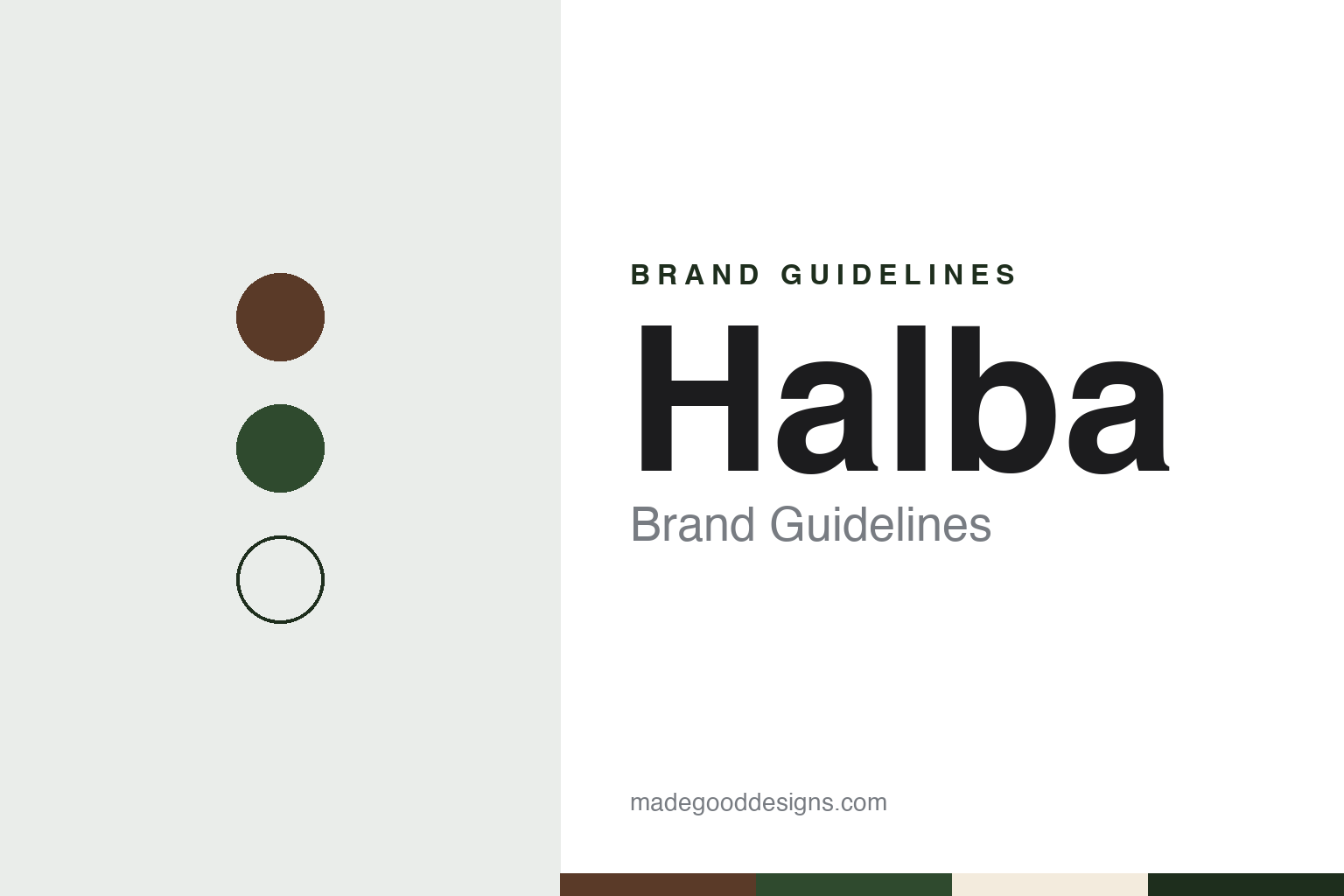
Halba Brand Guidelines
Coop’s Fairtrade chocolate maker, from a Zürich flat to Pratteln.
Aa
Two constants: a Halba cocoa, leaf and cream palette and a plain sans register. Abstract homage — not a Halba product or mark; no wrapper, logo or label is reproduced.
Hallheimer and Baer
Two founders, four employees and a living room in Zürich.
Halba is one of the Swiss chocolate makers many people have eaten without knowing the name: a manufacturer for retailers’ own brands and for industry, owned by the Swiss retailer Coop. German Wikipedia says the company was founded in Zürich on 5 May 1933, the date of its constituent general meeting, by Willy Hallheimer and Werner Baer, and that production began in Baer’s flat with four employees. The company tells the same story — “In 1933, Mr Hallheimer and Mr Baer began making chocolate in a Swiss living room. Since then, the company has borne their names” — which is where HAL-BA comes from.
The partnership did not last. Baer left in 1934 after a legal dispute, German Wikipedia says, and in October 1940 Arnold Müller-Hefti took over the entire share capital. Jakob Aebi-Müller led the firm through the war years, and in May 1955 Hansruedi Müller became chairman and managing director. He moved the company to Wallisellen, north of Zürich, that year and closed the Zürich factory in 1958, turning, in German Wikipedia’s words, a small chocolate-processing business into a modern chocolate factory. In 1967 Halba took over two smaller makers, Käppeli and SpoSa, the former Spoerry & Schaufelberger of Wald in the Zürich Oberland.
Coop arrived as a customer before it became the owner. Halba has produced for Coop since 1960; Coop bought a stake in 1968 and took over the company completely in 1972, the year Felix Giuliani succeeded Müller as head of the business, according to German Wikipedia.
Colour
Fairtrade cocoa, from Honduras to West Africa.
Inside Coop, Halba’s legal form has changed more than its trade. Production in Wald moved to Hinwil at the end of 2000; from 2003 the business traded as Chocolats Halba, and since 2004 it has not been a separate company but a division of Coop, German Wikipedia says. In September 2017 it was combined with Sunray, another Coop division, which the company says began on the outskirts of Basel in 1907, trading and processing imported nuts and dried fruits. The combined business was called Chocolats Halba/Sunray until March 2021, when it was renamed HALBA, the capitalised form it now uses.
Sustainability is the core of its positioning. Since summer 2014 Halba has bought only Fairtrade-certified cocoa beans, German Wikipedia says, citing a 2015 report on Coop’s Fairtrade Easter range. In 2013 it set up its first offshoot in a cocoa-growing country, in Honduras, and Coop’s results documentation for 2020 gives Coop a 75 per cent stake in Chocolats Halba S.A. de C.V. in San Pedro Sula. A joint Halba and Coop project, “Sustainable chocolate from Ecuador,” won the Swiss Ethics Award in April 2018, and with Fairtrade Africa Halba supports a project helping some 2,500 West African farmers move from cocoa monoculture to mixed cultivation, according to German Wikipedia.
Outside groups have ranked it well. In April 2017 the Austrian organisations Südwind and Global 2000 named Halba one of three winners of their ecological and social test of chocolate Easter bunnies, and the company says it took first place in the 2021 Easter Scorecard compiled by Mighty Earth, INKOTA, Green America, Be Slavery Free and the National Wildlife Federation. Its website, as archived in December 2021, said 88 per cent of the chocolate it sold carried a sustainability label.
Typography
Swiss, German and Austrian chocolate.
The seven brands in this group all make chocolate, and they come from two neighbouring countries: Cailler, Frey, Teuscher and Halba from Switzerland, and Ritter Sport, Niederegger and Stollwerck from Germany. Between them they show how differently a chocolate name can be owned and run, even in two neighbouring countries.
Some chocolate makers belong to larger businesses, from food groups to retailers that make their own chocolate for their own shelves, and their brand has to work inside someone else’s system. Others are family firms, where the founder’s name is still on the door and the identity is handed down through generations. And Germany has its own specialities alongside the chocolate bar, such as marzipan, the almond-and-sugar paste that some makers have built a whole tradition around. Read together, the guides show how such different businesses present themselves — on the wrapper, in the shop and online.
Each guide separates what independent sources record from what the company says about itself — who founded it, who owns it now, where its cocoa comes from and where its chocolate is made — and marks plainly what rests only on the company’s own word.
Aa
A plain, modern sans for a maker that works behind other brands. (Specimen set in Outfit, a sans STAND-IN; NOT the Halba logo.)
Halba
A private-label maker that put its own name on the shelf.
The factory is now at Pratteln, near Basel. In 2017 Halba moved into a new plant on the Salina Raurica site with a capacity of 15,000 tonnes a year, part of a Coop investment in Pratteln reported by the Neue Zürcher Zeitung and 20 Minuten in October 2017; the Wallisellen site was given up and sold, and Hinwil passed to Coop’s wholesale business Transgourmet. Halba keeps factory shops, the “Schoggihüsli,” in Pratteln and Hinwil.
Most of what it makes carries someone else’s name. German Wikipedia, citing the company, says roughly 40 per cent of its chocolate goes to the Coop group and the rest to customers in countries including Germany, France, the Netherlands, the United States, Canada, New Zealand and China; it makes Coop’s Swiss Confisa range, “Die gute Schokolade” for the children’s initiative Plant-for-the-Planet, and chocolate for industrial users. In 2021 Coop replaced its Qualité & Prix chocolate with a mid-range, Fairtrade-certified line called Halba – Le Chocolatier Suisse, putting the maker’s own name on the shelf, Horizont reported. In December 2021 the company gave its sales as CHF 300 million and its staff as 385; German Wikipedia, citing a later version of the same page, gives CHF 318 million and 405 employees. Since April 2024 the chief executive has been Réka Szalay, foodaktuell.ch reported.
For a design guide, Halba shows how a retailer-owned private-label maker can turn its sourcing into a consumer brand. Compare Frey, the Swiss chocolate maker owned by Coop’s rival Migros, and Divine Chocolate, a bar built on Fairtrade. For this guide we use cocoa brown, leaf green and a warm cream with a sans, an unofficial interpretation; no product or logo is reproduced.
Explore & save
Keep Halba’s identity on hand — save it to a board in the Made Good inspiration library.
Halba identity set
Pin the Halba cocoa, leaf and cream palette and the plain sans register to your own board.