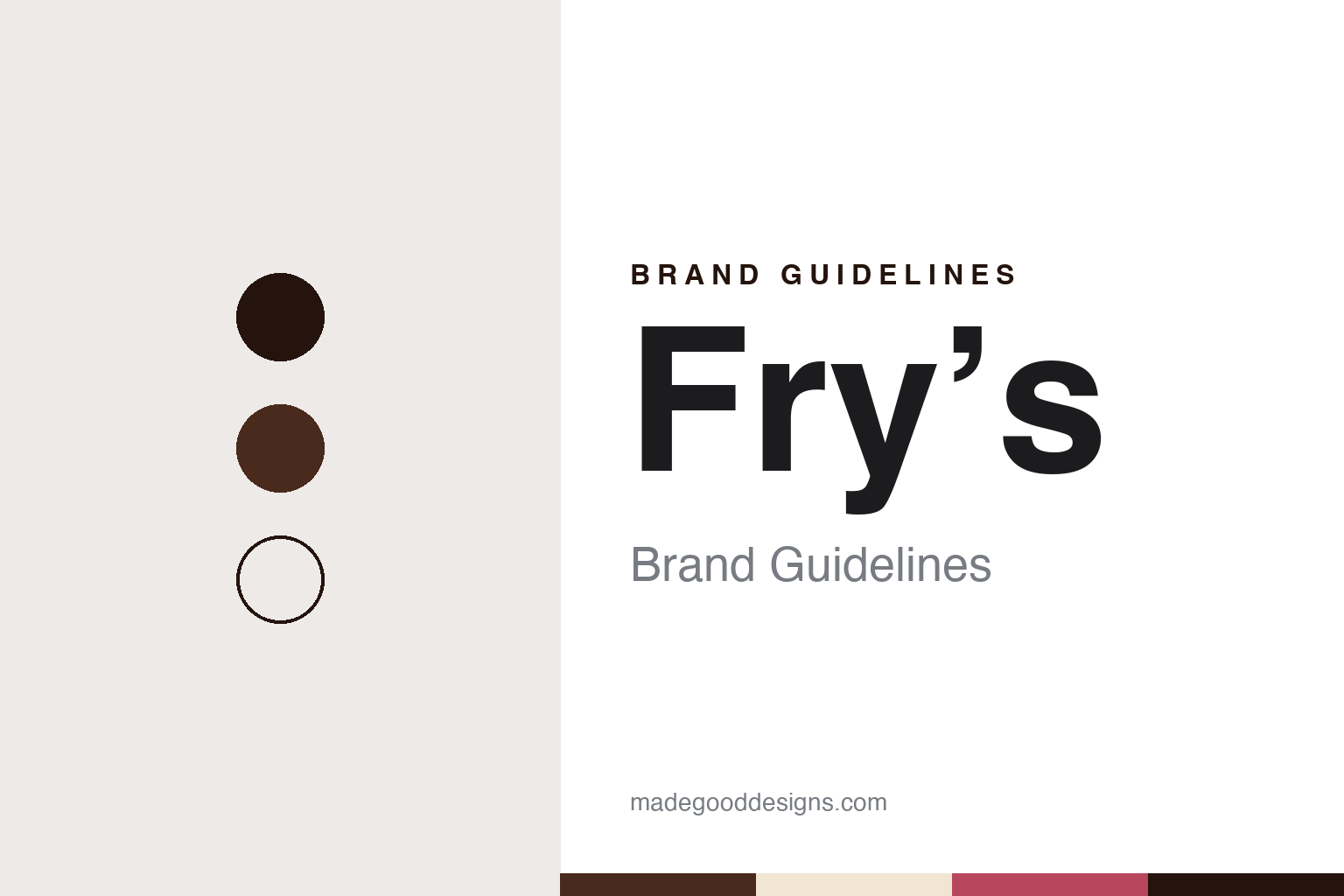
Fry’s Brand Guidelines
The Bristol Quaker firm behind the first chocolate bar.
Aa
Two constants: a Fry’s cocoa, cream and rose palette and a Victorian serif register. Abstract homage — not a Fry’s or Cadbury product or mark; no wrapper, logo or advertisement is reproduced.
Fry, Vaughan & Co.
An apothecary’s shop, a patent and a Bristol family.
Fry’s is one of the oldest names in British chocolate. Its founder, Joseph Fry, a Quaker born in 1728, began making chocolate in Bristol around 1759, English Wikipedia says. In 1761 he and John Vaughan bought a small shop from an apothecary, Walter Churchman, and with it a patent for a chocolate refining process; the business was called Fry, Vaughan & Co. In 1777 the works moved from Newgate Street to Union Street, in the centre of Bristol.
The name changed with the family. After Joseph Fry died in 1787 the firm became Anna Fry & Son, and in 1795 Joseph Storrs Fry took control. He patented a way of grinding cocoa beans with a Watt steam engine, bringing factory methods to what had been a workshop trade. A partnership with a Dr Hunt followed in 1803, and in 1822, when Hunt retired and Joseph Storrs Fry took his sons Joseph, Francis and Richard into partnership, the business became J. S. Fry & Sons. By then it was the largest commercial chocolate maker in Britain, Wikipedia says.
Fry’s was one of three big British chocolate makers founded by Quakers, alongside Cadbury in Birmingham and Rowntree’s in York. In 1896 it became a registered private company, still run by the family, with Joseph Storrs Fry II, a grandson of the first Joseph Storrs Fry, as chairman, and by the First World War it was one of Bristol’s largest employers.
Colour
Chocolate to eat, not only to drink.
For most of its first century Fry’s sold chocolate to be drunk. In 1847 its factory moulded a bar of eating chocolate, sold as Chocolat Délicieux à Manger, which English Wikipedia says is often considered the first of its kind; Cadbury had been selling “French Eating Chocolate” since 1842, so the claim rests on the moulded bar rather than on eating chocolate itself. In 1853 Fry’s made Cream Sticks, an early filled chocolate.
Its lasting product came in 1866: Fry’s Chocolate Cream, a fondant centre in a dark chocolate shell, which Wikipedia calls probably the first mass-produced chocolate bar and, citing the Oxford Companion to Sugar and Sweets, the world’s oldest chocolate bar brand. Peppermint and orange versions followed in 1934. More than 220 products were introduced over the following decades, by Wikipedia’s count, including what it calls the first chocolate Easter egg in Britain, in 1873, and Fry’s Turkish Delight, a rose-flavoured jelly in milk chocolate, in 1914. Output of eating chocolate rose from about 10 tonnes in 1852 to more than 1,100 tonnes in 1880.
Fry’s was also an early advertiser. Its best-known image, the “Five Boys,” showed one boy’s face in five moods captioned “Desperation. Pacification. Expectation. Acclamation. Realization,” ending “It’s Fry’s”; the name was also used for a Five Boys milk chocolate bar from 1902 to 1976. From the late 1950s Fry’s Turkish Delight was sold on television as “Full of Eastern Promise,” a campaign Channel 4 viewers placed 37th in its 2000 poll of the 100 greatest adverts, though Wikipedia notes that the advertisements traded in stereotypes. In the 1960s the model George Lazenby appeared as the “Big Fry” man for Fry’s Chocolate Cream, before he was cast as James Bond.
Typography
Design and documentation.
The seven brands in this group all make or sell chocolate, and they come from two countries: Fry’s, Rowntree’s, Terry’s, Paul A. Young and Willie’s Cacao from England, and Lily O’Brien’s and Butlers from Ireland. Together they span most of the history of chocolate on these islands, from names that were household words long before the modern supermarket to makers who started within living memory.
Some of the oldest names in British chocolate grew out of Quaker family firms, and several of them now belong to multinational groups, so the name on the wrapper and the company behind it can tell two different stories. Ireland has its own tradition of chocolatiers, whose boxes and bars carry an Irish identity to shoppers at home and abroad. And a newer generation of makers has grown up in London shops and Devon workshops, where the founder’s own name and story often do the work a corporate logo would do elsewhere.
Each guide separates what independent sources record from what the company says about itself — who founded it, who owns it now, where its cocoa comes from and where its chocolate is made today — and marks plainly what rests only on the company’s own word.
Aa
A Victorian serif — the register of an 1866 chocolate bar. (Specimen set in Playfair Display, a serif STAND-IN; NOT the Fry’s logo.)
Fry’s
From Union Street to Somerdale — and Poland.
Fry’s stopped being independent in 1919, when it merged with Cadbury to form the British Cocoa and Chocolate Company; the Fry family held 45.44 per cent of the ordinary shares, the chairmanship and four board seats, Wikipedia says. From 1923, under Egbert Cadbury, production began moving out of central Bristol to a greenfield site at Somerdale, near Keynsham, a transfer English Wikipedia says was completed in 1935. The family’s share shrank as the group grew; when Cadbury merged with Schweppes in 1969 one Fry sat on a thirteen-seat board, and after 1981 the Fry’s name was no longer used at Somerdale, though the factory went on making Cadbury products.
In October 2007 Cadbury announced that it would close Somerdale, with the loss of about 500 jobs, and move production to Poland. After Kraft Foods took over Cadbury in 2010 the closure was confirmed, and the factory shut on 31 March 2011; Wikipedia says its machinery went to a sister factory at Skarbimierz, and that Fry’s Chocolate Cream and Fry’s Turkish Delight for Britain and Ireland have been made in Poland since 2010, while the Turkish Delight sold in Australia and New Zealand is made by Cadbury in Australia. In 2012 the housebuilder Taylor Wimpey bought the Somerdale site for homes, a school and shops, and part of the old factory became a retirement village.
J. S. Fry & Sons long ago disappeared into Cadbury; what survives is a brand name. Kraft’s snacks business was renamed Mondelez International in 2012, and Cadbury’s own history page, published by Mondelez United Kingdom, mentions Fry’s only as one of the family firms Cadbury “partnered with.” Wikipedia lists Fry’s Chocolate Cream, Fry’s Peppermint Cream and Fry’s Orange Cream as current lines, sold as Cadbury products alongside Fry’s Turkish Delight. Readers searching online should note that the name is shared by unrelated businesses, among them Fry’s Family Food, a plant-based food maker founded in South Africa, and an American supermarket chain, Fry’s Food Stores.
For a design guide, Fry’s shows how a product name can outlast the company, the factory and the city that made it. Compare Green & Black’s, another British chocolate name now owned by Mondelez, and Côte d’Or, a Belgian heritage bar in the same group. For this guide we use a cocoa brown, a fondant cream and a Turkish-delight rose with a serif, an unofficial interpretation; no product or logo is reproduced.
Explore & save
Keep Fry’s’s identity on hand — save it to a board in the Made Good inspiration library.
Fry’s identity set
Pin the Fry’s cocoa, cream and rose palette and the Victorian serif register to your own board.