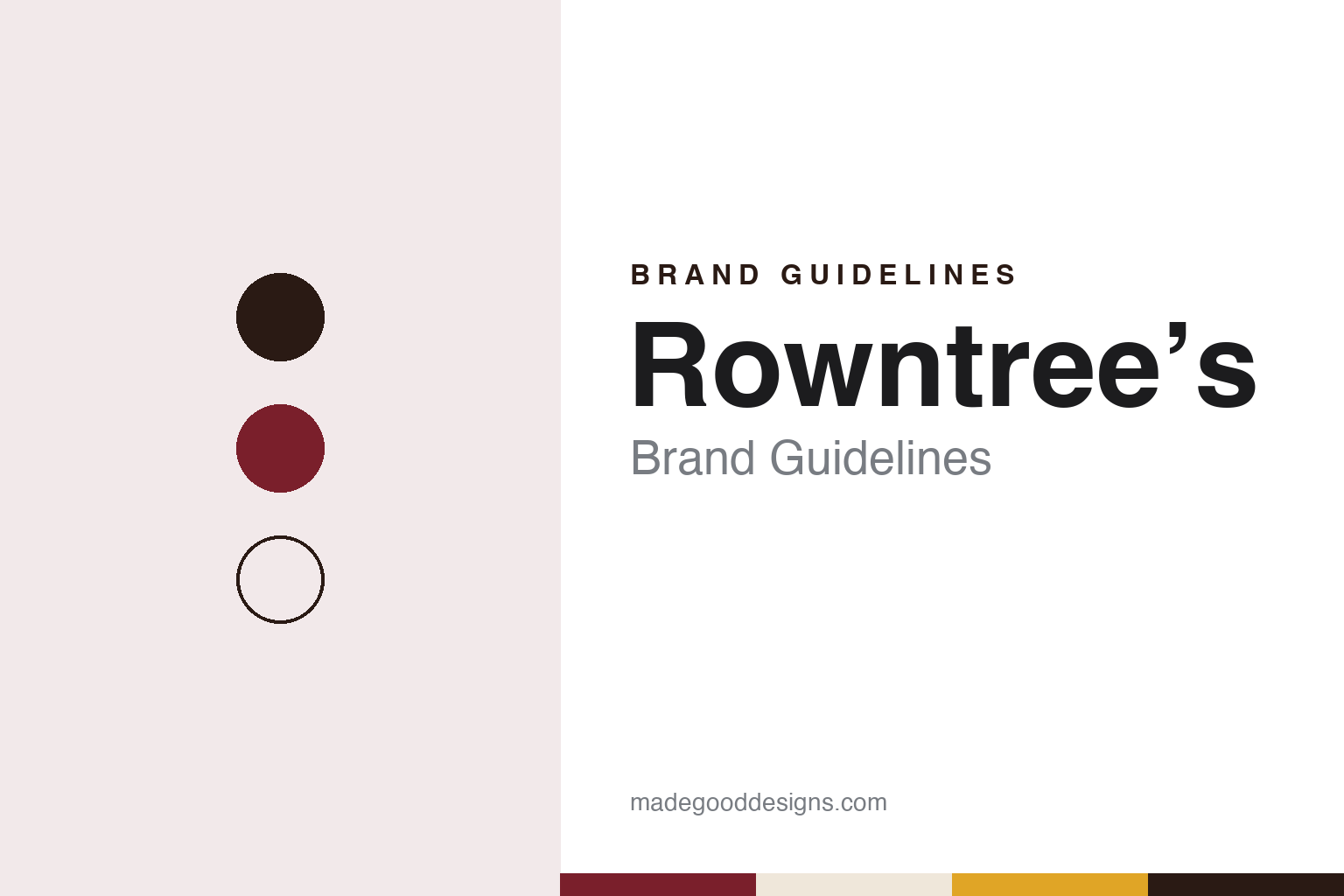
Rowntree’s Brand Guidelines
The York Quaker firm behind Kit Kat, now a Nestlé sweet brand.
Aa
Two constants: a Rowntree’s blackcurrant, stone and pastille palette and a bracketed serif register. Abstract homage — not a Rowntree’s or Nestlé product or mark; no wrapper, logo or advertisement is reproduced.
H. I. Rowntree & Co.
A cocoa business on Castlegate, York.
Rowntree’s began in York in 1862, when Henry Isaac Rowntree, a Quaker, bought out the cocoa business of the Tuke family, another Quaker family, on Castlegate, English Wikipedia says. In 1864 he bought an old iron foundry at Tanner’s Moat, and in 1869 his brother Joseph Rowntree joined him as a full partner in H. I. Rowntree & Co. When Henry died in 1883, Joseph became the sole owner.
Under Joseph Rowntree the business grew from a struggling cocoa maker into one of Britain’s three big Quaker confectioners, alongside Cadbury and Fry’s. He set up a research laboratory in 1889, and in 1890 bought a 20-acre site on Haxby Road, on the edge of York, for a new factory modelled on Cadbury’s at Bournville. The firm became a public company, Rowntree & Co., in 1897. Joseph Rowntree is also remembered for the charitable trusts he founded, which are separate from the confectionery business and still carry his name.
His son Seebohm Rowntree, the social researcher, succeeded him as chairman in 1923 and, Wikipedia says, inherited a company in difficulty; by 1930 it was close to bankruptcy. The recovery came through new products and a move into branded, nationally advertised confectionery.
Colour
Pastilles, then the 1930s bars.
The first of Rowntree’s lasting products was a sweet, not a chocolate. Fruit Pastilles, introduced in 1881, made up about a quarter of the firm’s tonnage by 1887, Wikipedia says, and Fruit Gums followed in 1893. The brand’s present website still calls Rowntree’s “Fruity Favourites Since 1881.”
The 1930s produced the chocolate brands that rescued the company. Black Magic, an assortment, arrived in 1934. In 1935 came Aero, an aerated milk chocolate, and Rowntree’s Chocolate Crisp, a chocolate-covered wafer, renamed Kit Kat Chocolate Crisp in 1937; Rowntree’s had registered the names Kit Cat and Kit Kat in 1911, according to English Wikipedia. Dairy Box, another assortment, followed in 1937, and Smarties were first sold in 1938. Later launches included After Eight mints in 1962 and the Yorkie bar in 1976.
Kit Kat also shows how a wrapper can carry a brand. Its red wrapper turned blue between 1942 and 1947, during wartime rationing, Wikipedia says, and its line “Have a Break, Have a Kit Kat” was written in 1957 by Donald Gilles of the agency JWT in London and first shown on television in 1958. In 1970 Rowntree’s licensed Kit Kat in the United States to Hershey, and Wikipedia says the licence survived the later change of ownership, so Hershey, not Nestlé, still holds the American rights.
Typography
Design and documentation.
The seven brands in this group all make or sell chocolate, and they come from two countries: Fry’s, Rowntree’s, Terry’s, Paul A. Young and Willie’s Cacao from England, and Lily O’Brien’s and Butlers from Ireland. Together they span most of the history of chocolate on these islands, from names that were household words long before the modern supermarket to makers who started within living memory.
Some of the oldest names in British chocolate grew out of Quaker family firms, and several of them now belong to multinational groups, so the name on the wrapper and the company behind it can tell two different stories. Ireland has its own tradition of chocolatiers, whose boxes and bars carry an Irish identity to shoppers at home and abroad. And a newer generation of makers has grown up in London shops and Devon workshops, where the founder’s own name and story often do the work a corporate logo would do elsewhere.
Each guide separates what independent sources record from what the company says about itself — who founded it, who owns it now, where its cocoa comes from and where its chocolate is made today — and marks plainly what rests only on the company’s own word.
Aa
A bracketed serif — the register of a York cocoa house. (Specimen set in DM Serif Display, a serif STAND-IN; NOT the Rowntree’s logo.)
Rowntree’s
From Rowntree Mackintosh to Nestlé.
In 1969 Rowntree merged with John Mackintosh & Co. of Halifax, the maker of Quality Street and Rolo, to form Rowntree Mackintosh. By 1988 it was the world’s fourth-largest chocolate maker, Wikipedia says, and a takeover target. On 13 April 1988 Jacobs Suchard of Switzerland bought 14.9 per cent of its shares in a dawn raid; Nestlé, led by Helmut Maucher, stepped in and won control that June with an offer valuing Rowntree at £2.55 billion. Rowntree’s ceased to exist as a company in 1991, when it became part of Nestlé UK.
The name went with it, slowly. Nestlé first branded the chocolate ranges “Nestlé Rowntree,” then dropped Rowntree from the packaging except on cocoa and the fruit sweets, Wikipedia says. Today Rowntree’s is Nestlé’s name for a family of fruit sweets — Fruit Pastilles, Fruit Gums, Jelly Tots and Randoms — and its website carries the line that Rowntree’s is a registered trademark of Société des Produits Nestlé S.A. The company says its Fruit Pastilles single tubes are the best-selling fruit confectionery product in the UK; we give that as its claim. Kit Kat, Aero and Smarties are sold as Nestlé brands.
Where they are made has changed. The Haxby Road factory in York still makes Kit Kat: in April 2021 Nestlé said it would invest £20 million there “to increase production of KitKat in the city where the brand was first created in 1935,” BBC News reported, while closing its factory at Fawdon, near Newcastle, which had made Fruit Pastilles since 1958. The BBC said 573 jobs were at risk across the two sites, and that Fawdon was then producing 15 brands, among them Fruit Pastilles, Matchmakers and Rolo; in November 2023 Chronicle Live, the Newcastle news site, reported that the factory building was being sold to the bakery business Country Style Foods. In February 2022 The Guardian reported that Fruit Pastilles and Jelly Tots would be made in the Czech Republic once Fawdon closed in 2023; the BBC had reported that Nestlé’s Halifax factory would take on the largest share of Fawdon’s production.
For a design guide, Rowntree’s shows how a company name can shrink to a sub-brand while its products become global names of their own. Compare Terry’s, York’s other great chocolate house, and Thorntons, a British heritage maker now owned by a larger European group. For this guide we use a blackcurrant red, York stone and pastille lemon and lime with a serif, an unofficial interpretation; no product or logo is reproduced.
Explore & save
Keep Rowntree’s’s identity on hand — save it to a board in the Made Good inspiration library.
Rowntree’s identity set
Pin the Rowntree’s blackcurrant, stone and pastille palette and the bracketed serif register to your own board.