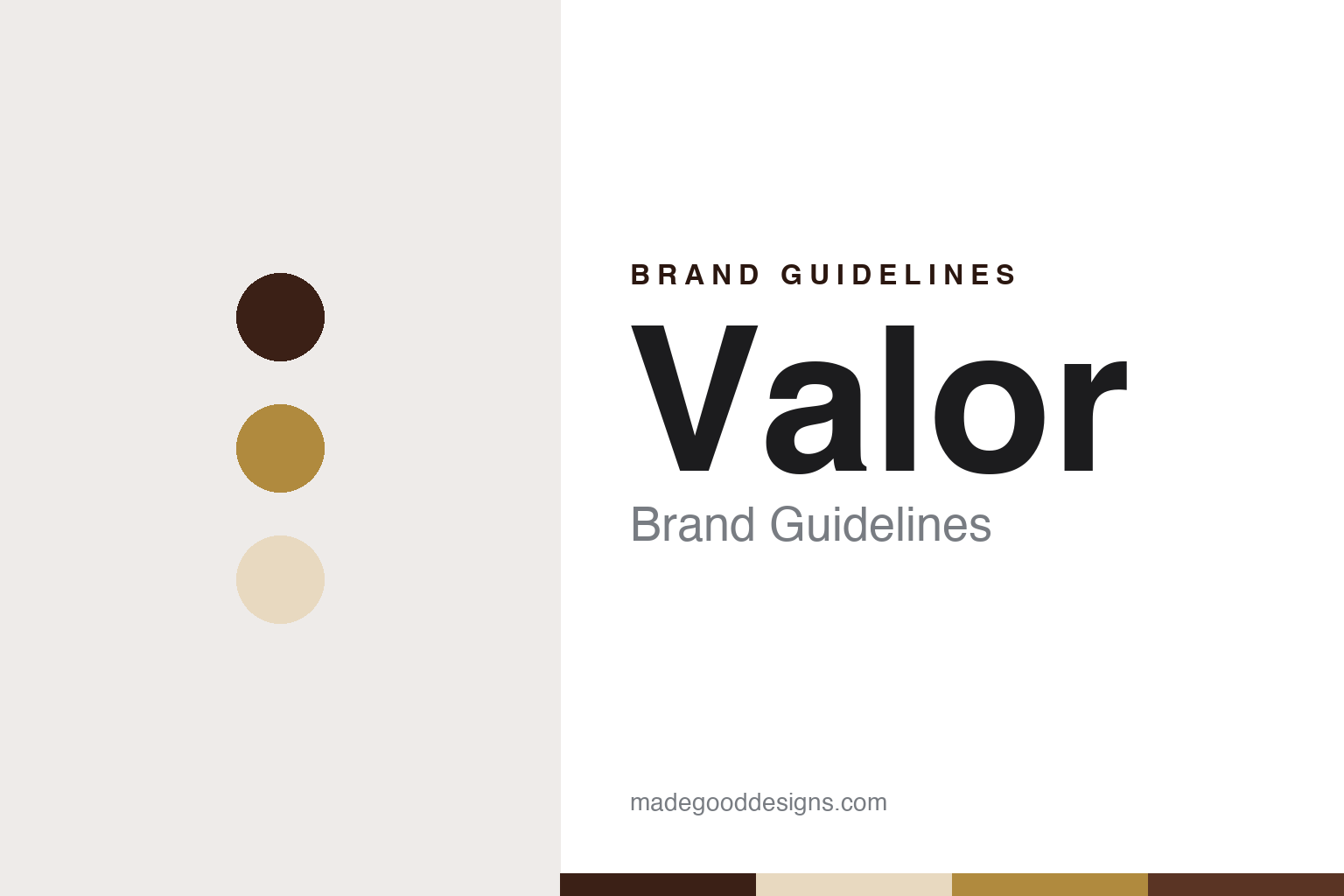
Valor Brand Guidelines
The Villajoyosa family chocolate maker since 1881.
Aa
Two constants: a cacao, almond and gold palette and a heritage serif register. Abstract homage — not a Valor product or mark; no wrapper, logo or bar is reproduced.
Señor Valor
An itinerant chocolatero from the Alicante coast.
Valor is a chocolate maker from Villajoyosa, on the coast of Alicante in south-east Spain, and it dates itself to 1881. That is the year, the company says, when Valeriano López Lloret set up as a chocolatero, although his family had made chocolate in the area for decades before. Spanish Wikipedia says he was known as “Señor Valor,” the nickname that became the brand.
A chocolatero then was a travelling craftsman. Spanish Wikipedia, citing a 1997 University of Alicante study of the town’s chocolate industry by José Daniel Gómez López, describes him hiring out his services to families who wanted chocolate ground in their own homes, and selling in villages of the provinces of Toledo and Cuenca, such as Belmonte and Quintanar de la Orden. He later made chocolate at home, and then at the Ermita de San Antonio, a hamlet about four kilometres from the town.
His son Vicente López Soler took over at the end of the century — in 1891, Spanish Wikipedia says. The company says a mechanical mill replaced the grinding stone and its routes reached Madrid, where its best customers spent Christmas. Between 1916 and 1930, by the company’s account, a mill turned first by a horse and later by a diesel engine took over the grinding, sales moved from households to shops, and a Chevrolet lorry carrying about 1,500 kilos replaced the cart. Electricity reached the Ermita in 1935, and by then Valor employed workers from outside the family.
The Spanish Civil War and the rationing years that followed held the business back; the company says all chocolate factories then worked under state-controlled quotas of raw materials. Growth came in the 1960s. Valor rented a factory at Torrellano, built a new plant in Villajoyosa and moved its machinery there from the Ermita in 1964, the company says. In 1973 it became a sociedad anónima, a public limited company, and it is still run by the López family: Spanish Wikipedia lists Pedro López Mayor as the next head, and after his death in April 2016, reported by Expansión, his son Pedro López López became chief executive.
Colour
Pure chocolate, sugar-free bars and the cup.
Valor’s turning point as a brand came with its Chocolate Puro. The company says it adopted quality as its strategy in 1967 and launched the pure chocolate, made without vegetable fats in place of cocoa butter; Spanish Wikipedia dates the launch to 1968. The company also says it installed its first automatic moulding line in those years, and that the factory reached more than 10,000 kilos per eight-hour shift.
From the late 1970s it built a national sales network, began selling bonbons and started exporting to countries including Argentina, Venezuela and Japan, according to the company. In 1995 it opened a 22,000-square-metre extension in Villajoyosa that included halls for processing cocoa beans, so that, the company says, it roasts beans itself rather than buying ready-made cocoa paste. Its own description of the process runs from beans selected from different parts of the world through roasting, winnowing, grinding, refining to 17 microns and an average of eight hours of conching. On sourcing, the company says all the cocoa beans it uses from African countries carry the Living Income Differential, the premium set by Ghana and Côte d’Ivoire, and that its almonds are local Mediterranean ones.
In the 2000s Valor added a sugar-free range, which the company says took three years of research, and advertised under the lines “Puro placer” and “Placer adulto,” which presented chocolate as an adult pleasure rather than a children’s treat. In 2013 El País reported that Valor led the Spanish market for sugar-free chocolate and for chocolate a la taza, the thick drinking chocolate, and was the largest Spanish brand-owner in the sector, ranked 82nd in the world by Candy Industry with sales of about €103 million in 2012.
Drinking chocolate also gave Valor a retail format. Its first Chocolatería Valor opened in 1984 and franchising began in 1993, Spanish Wikipedia says; the cafés serve chocolate a la taza with churros from a menu of more than 60 items, the company says. Beside the Villajoyosa factory it runs a chocolate museum, which the then Prince and Princess of Asturias visited in 2006, the company’s 125th-anniversary year, ABC reported.
Typography
Chocolate in Italy, Spain and the Netherlands.
The seven brands in this group all make or sell chocolate, and they come from three countries with distinct chocolate habits: Perugina and Baratti & Milano from Italy, Valor and Blanxart from Spain, and Droste, Verkade and Van Houten from the Netherlands. Each country is known for a different way of using cocoa, and those habits shape how the brands present themselves.
In the Netherlands the story is cocoa powder: the pressed, alkalised “Dutch” cocoa that made a drink of chocolate easy to mix, sold in tins and boxes whose graphics became part of the brand. In Italy it is gianduja, chocolate blended with hazelnut paste and associated above all with Piedmont, alongside pralines and boxed gifts. In Spain it is chocolate a la taza, a thick drinking chocolate served in cafés, often with churros, alongside bars made for melting into it. The names here range from century-old firms now owned by large groups to family companies, and some survive mainly as brands.
Each guide separates what independent sources record from what the company says about itself — who founded it, who owns it now, where its cocoa comes from and where its chocolate is made — and marks plainly what rests only on the company’s own word.
Aa
A heritage serif for a brand that dates itself to 1881. (Specimen set in Playfair Display, a serif STAND-IN; NOT the Valor logo.)
Valor
Huesitos, Imperial and a renewed logo.
Valor has grown by buying older names. In July 2013 Mondelēz International agreed to sell its factory at Ateca, in Zaragoza, to Valor together with the Huesitos and Tokke brands, Spanish Wikipedia reports, citing the press of the day. The plant was the former Chocolates Hueso, founded in 1862, which Cadbury Schweppes had bought in 1989, El País reported at the time; Mondelēz had proposed closing it and moving production to Poland earlier in 2013. Valor makes Huesitos there through its subsidiary Chocateca.
In May 2021 Valor completed its first acquisition abroad, Imperial of Vila do Conde, in northern Portugal, Spanish Wikipedia says. Imperial’s own history dates it to 1932, lists its owners as Grupo RAR from 1973 and the fund Vallis Sustainable Investments I from 2015, and records its purchase by Grupo Valor in 2021; its brands include Regina, Pantagruel, Pintarolas and Jubileu. The group therefore makes chocolate in Villajoyosa, Ateca and Vila do Conde.
The brand’s look has been revised in steps. The company says it modernised its logo and wrappers between 2000 and 2005, and in 2016 renewed the logo “after 16 years,” simplifying it for clarity and visibility, with new packaging across the range. It also says it won a 2011 European Candy Kettle Award. No official colours or typeface are published.
For a design guide, Valor shows how a regional family maker can build a national brand on one product — the cup of thick chocolate — and carry it into its own cafés. Compare Blanxart, a Barcelona maker founded in 1954, and Utopick, a newer Spanish bean-to-bar brand. For this guide we use cacao brown, almond cream and a muted gold with a serif, an unofficial interpretation; no product or logo is reproduced.
Explore & save
Keep Valor’s identity on hand — save it to a board in the Made Good inspiration library.
Valor identity set
Pin the Valor cacao, almond and gold palette and the heritage serif register to your own board.