Blanxart Brand Guidelines
The Barcelona bonbon maker of 1954 that turned bean-to-bar.
Aa
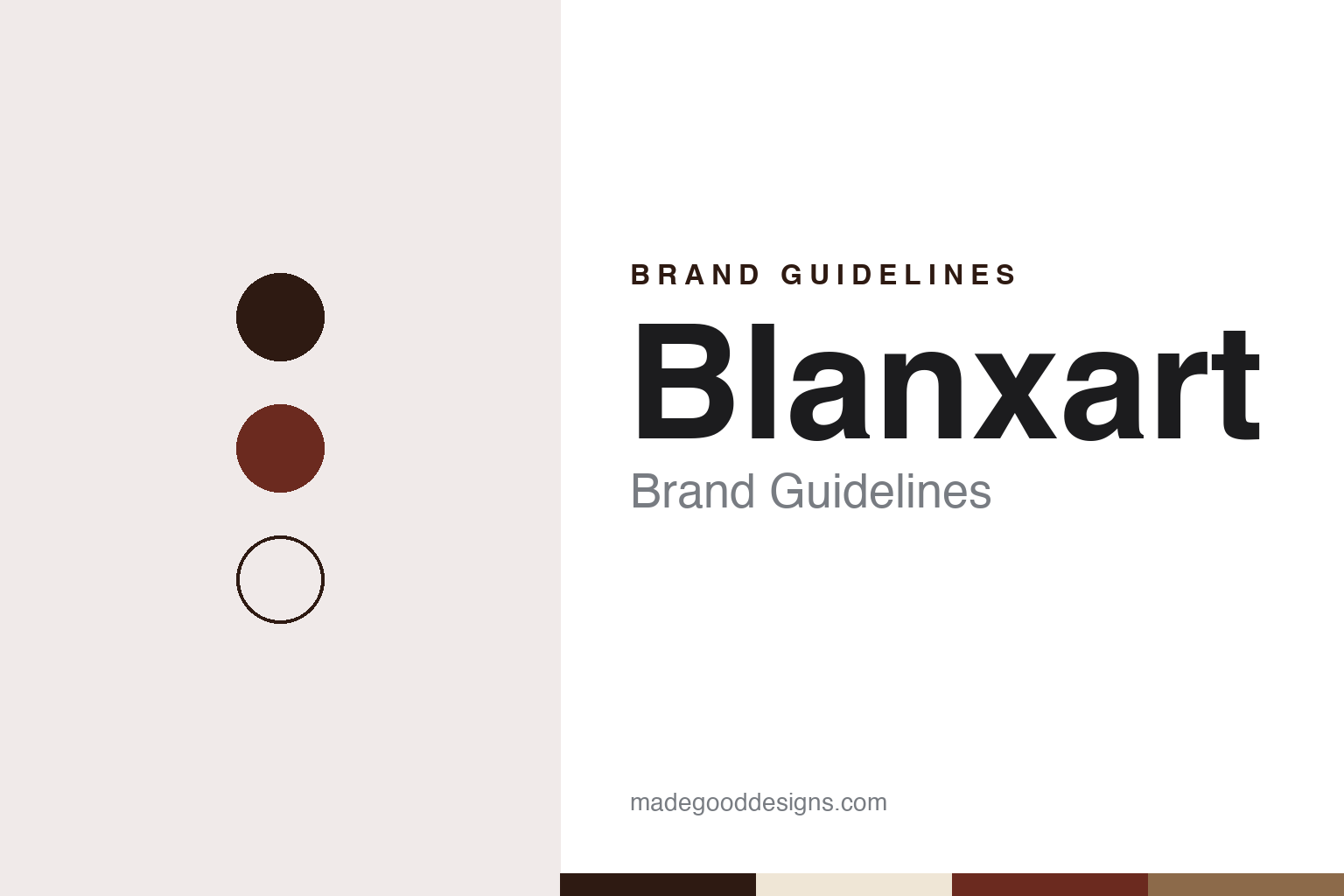
Two constants: a roasted-bean, nib red and parchment palette and a craft serif register. Abstract homage — not a Blanxart product or mark; no wrapper, logo or bar is reproduced.
Bombons Blanxart
A rented workshop in Les Corts.
Blanxart is a chocolate and bonbon maker from Barcelona. Its story, as the company tells it, begins in April 1954, in rented ground-floor premises in the city’s Les Corts district. A version of its website from 2004, preserved by the Internet Archive, describes a master chocolatier who, after a long tour of the best pastry and bonbon shops of the day, left his job at a well-known factory and set up on his own with partners. The current website names him as the master bonbon maker Francesc Agrás and says his journey took him around the best patisseries and bonbon shops of Europe.
The business was called Bombons Blanxart, and its first customers were the trade. The 2004 site says it built its name slowly, with limited resources but a spirit of innovation, by supplying pastry shops and confectioners with bonbons noted for the variety of their recipes, their presentation and their design. Blanxart is a common Catalan surname, found on buildings and schools around Barcelona, but none of the sources we checked explains how the chocolate company came by it, so we do not guess.
The company later moved out of the city. By 2004 its website gave a 1,400-square-metre factory in Sant Joan Despí, a town on the Llobregat just west of Barcelona, as its home, trading then as Bombons Blanxart S.A. It is still there: the legal notice on its website today names Blanxart, S.L.U., in Sant Joan Despí. In 2021 the company announced that the plant had gained IFS Food certification, an international food-safety standard, after what its management described as two years of effort and investment in quality and safety processes.
Blanxart has no Wikipedia article in Spanish, Catalan or English, and the sources we checked give no independent account of who owns it today, so this guide relies on what the company publishes and says so where it does.
Colour
Bean to chocolate, in its own words.
Today Blanxart presents itself as a bean-to-bar maker — “bean to chocolate,” in its own phrase, a process it defines as the craftsman selecting the cocoa beans and turning them into bars and bonbons that he then packs and sells himself. The company says it receives beans in certified sacks and roasts them in its own factory “a la antigua,” the old way, sacrificing volume for quality and watching for the moment the beans open and release their aromas.
After roasting, it says, the beans are cracked and winnowed mechanically into nibs, ground into cocoa liquor and mixed with sugar, hazelnuts, cinnamon and other ingredients, then refined to 22 microns. It describes a “calm” and “reflective” conching, longer than that of “more impatient” makers, after which the chocolate is moulded into bars and bonbons and, for its more creative ranges, finished with toppings added by hand. Finished chocolate is kept in stores held between 12 and 15°C before orders are shipped.
The company’s account of its beans has changed over time. Its founding story says the aim was to bring the best beans from Ghana, Congo and Guayaquil to chocolate. Its current website lists origins in the Congo, Peru, Nicaragua, Brazil and the Dominican Republic: a Forastero grown at the foot of the Mountains of the Moon, a white Criollo from the Piura region of Peru, a Trinitario from the Amazon and a Criollo–Trinitario from Waslala in Nicaragua. It says it buys organic cocoa from small producers and cooperatives carrying internationally recognised ecological labels; we have not seen the certificates and give these as its claims.
The range is split into Classic and Origins lines. In 2019 the company said it would show new bean-to-bar chocolates and new cocoa origins at ISM, the international sweets fair, and in 2021 it launched Origins bonbons: a box of ten, made to five recipes, each from a single origin with its cocoa percentage stated, according to its news pages. Bonbons remain central; the 2004 catalogue was organised around dark, milk, giant and wrapped bonbons alongside bars, dragées and turrón.
Typography
Chocolate in Italy, Spain and the Netherlands.
The seven brands in this group all make or sell chocolate, and they come from three countries with distinct chocolate habits: Perugina and Baratti & Milano from Italy, Valor and Blanxart from Spain, and Droste, Verkade and Van Houten from the Netherlands. Each country is known for a different way of using cocoa, and those habits shape how the brands present themselves.
In the Netherlands the story is cocoa powder: the pressed, alkalised “Dutch” cocoa that made a drink of chocolate easy to mix, sold in tins and boxes whose graphics became part of the brand. In Italy it is gianduja, chocolate blended with hazelnut paste and associated above all with Piedmont, alongside pralines and boxed gifts. In Spain it is chocolate a la taza, a thick drinking chocolate served in cafés, often with churros, alongside bars made for melting into it. The names here range from century-old firms now owned by large groups to family companies, and some survive mainly as brands.
Each guide separates what independent sources record from what the company says about itself — who founded it, who owns it now, where its cocoa comes from and where its chocolate is made — and marks plainly what rests only on the company’s own word.
Aa
A craft serif for a mark the company ties to an altarpiece of the trades. (Specimen set in Cormorant Garamond, a serif STAND-IN; NOT the Blanxart logo.)
Blanxart
A mark drawn from the craft trades.
Blanxart’s most distinctive design fact is its mark. The 2004 website says that from the start the company developed its own style around the brand and a logo inspired by the altarpiece of the craft trades in the Museu d’Arts i Oficis of the Museu d’Història de Barcelona, the city’s history museum. The logo, it said, had identified the company “from the first day” and was used on the wrappers of its products because its design had not changed over time, its symbolism reflecting the company’s philosophy. We have not identified the altarpiece independently, so the link is the company’s own account.
Its current website keeps the craft language. It describes its chocolate as artisan chocolate from select origins and “a chocolate from another century,” and it stresses tradition, slow processes and handwork rather than novelty. The Origins bonbons, the company said in 2021, were made with full control of production, from choosing cocoa from small plantations to slow roasting in its own premises and the finishing and packing of the bonbons. That places Blanxart between two Spanish models: the older chocolate makers that grew out of family workshops, and the newer bean-to-bar makers that sell origin and process. The company does not publish official colours or typefaces, and the palette here is ours.
For a design guide, Blanxart shows how a mid-century confectioner can carry a craft identity into a bean-to-bar story. Compare Valor, the Villajoyosa family maker founded in 1881, and Utopick, a newer Spanish bean-to-bar brand. For this guide we use roasted-bean brown, nib red and parchment with a serif, an unofficial interpretation; no product or logo is reproduced.
Explore & save
Keep Blanxart’s identity on hand — save it to a board in the Made Good inspiration library.
Blanxart identity set
Pin the Blanxart roasted-bean, nib red and parchment palette and the craft serif register to your own board.