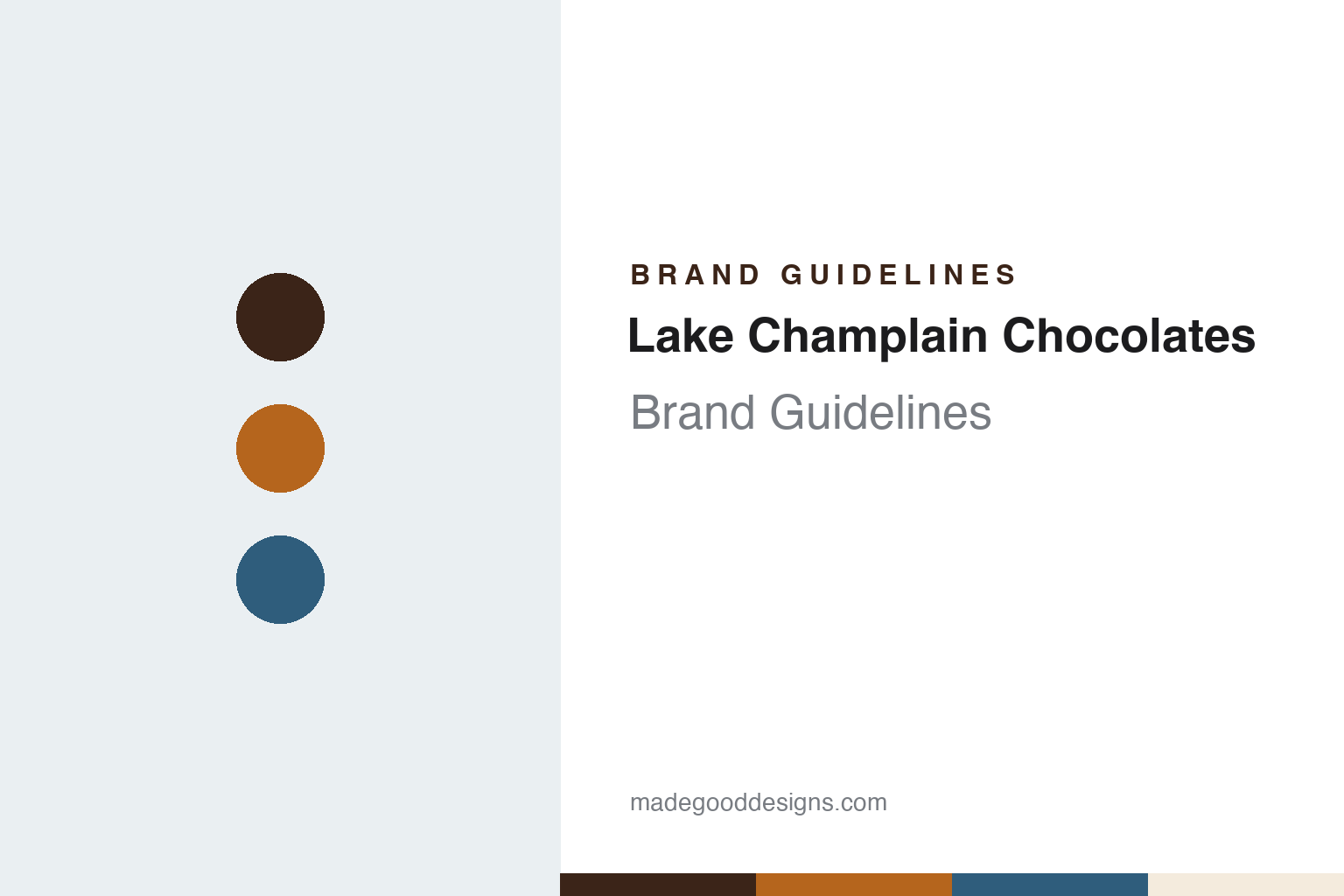
Lake Champlain Chocolates Brand Guidelines
The Vermont chocolatier born from a dare in a restaurant kitchen.
Aa
Two constants: a maple, lake blue and cocoa palette and a classic serif register. Abstract homage — not a Lake Champlain Chocolates product or mark; no chocolate, wrapper or logo is reproduced.
A dare in 1983
A restaurant kitchen in Burlington, Vermont.
Lake Champlain Chocolates began in 1983 in the kitchen of the Ice House Restaurant in Burlington, Vermont, and the company tells its founding story as a dare. Its founder, Jim Lampman, bought his staff boxes of fancy chocolates every year as holiday gifts, the company says, until his pastry chef told him they were mediocre; Lampman dared him to make something better, and the two began making hand-rolled, creamy truffles. Company releases reprinted by Vermont Business Magazine in 2023, the company’s 40th year, repeat the outline: “Born from a dare to do better, Jim Lampman founded Lake Champlain Chocolates.”
The business has stayed with the family. The company describes itself as a multi-generational, family-owned Vermont business and says that Jim Lampman’s son and daughter, Eric and Ellen, now lead it. Eric Lampman is named as president and “second-generation owner” in releases from 2018 and 2023. We found no sale or outside acquisition in the sources we checked, and the company has kept its own name and its base in Burlington’s South End for more than four decades.
The name comes from the lake on Burlington’s waterfront, which a 2020 release calls “the company’s namesake,” and the company says Vermont is “more than just our home; it’s a way of doing things.” It has long bought cream, butter, honey and maple syrup from Vermont producers, and its website names several of them: Cabot butter, organic maple syrup from a sugarbush in Starksboro, honey from Champlain Valley Apiaries in Middlebury and organic cream from the Miller Farm in Vernon.
Colour
A chocolatier, not a bean-to-bar maker.
Lake Champlain Chocolates is open about what kind of maker it is. Its own FAQ calls it a “third-tier chocolate maker,” which it explains as buying “chocolate as a finished ingredient from various suppliers to use in our confections.” The cacao in that chocolate, it says, is “grown primarily in Latin America”; its chocolatiers melt and temper the finished chocolate and add Vermont butter, cream, honey and maple syrup. In other words it is a chocolatier and confectioner working with bought-in chocolate rather than roasting beans — a different model from the bean-to-bar makers covered elsewhere in this library.
It has tried the other model too. In 2012 the company announced Blue Bandana Chocolate Maker, which its own releases described as a micro-batch, bean-to-bar product line founded by Eric Lampman after his first visit to a cocoa farm in 2009. Its first bars were Madagascar 70%, Guatemala 70% and Madagascar Wild Pepper, and in December 2012 the company announced that Blue Bandana had been named a finalist for the 2013 Good Food Awards. We have not established whether the line is still made.
On sourcing, the company says that 100% of the chocolate it uses is fair trade certified, that best-sellers including its Five Star Bars and hot chocolates carry Fair Trade USA certification, and that it is a founding partner of Cacao Verapaz, which it describes as the first specialty exporter of centrally fermented Guatemalan cacao. It is also a certified B Corporation, and says it gives 1% of sales to social and environmental projects. We give these as the company’s own statements.
Production has grown beyond its first home. A December 2018 press release, reprinted by Vermont Business Magazine, announced a new 15,000-square-foot facility in Williston, Vermont, with a custom moulding line and wrapper system, which the company said tripled its capacity; it then put its output at about one million pounds of confections a year, sold in more than 2,000 stores. The original site on Pine Street, which a 2023 release says “previously was home to our entire factory,” was renovated that year as a flagship store with a bakery and an innovation kitchen for the research and development team.
Typography
American chocolate, old and new.
The seven brands in this group are all American: Ethel M, See’s Candies, Russell Stover, Fannie May, Lake Champlain Chocolates, French Broad Chocolates and Endangered Species Chocolate. Together they cover much of the range of American chocolate and candy, from the gift box bought for a holiday to the single bar picked up at a grocery checkout.
American boxed chocolate grew up around the shop front. Many of the country’s candy companies began as a single kitchen or store selling to local customers, and some built chains of their own shops, while others moved into drugstores, supermarkets and seasonal aisles. The assorted box, with its printed lid and its paper map of fillings, became a familiar gift, and regional makers came to be known as much for a place as for a product. More recently, small makers have added bean-to-bar chocolate, cafés and factory tours, and bar brands have used the wrapper itself to carry a story or a cause.
Each guide separates what independent sources record from what the company says about itself — who founded it, who owns it now, where its cocoa comes from and where its chocolate is made — and marks plainly what rests only on the company’s own word.
Aa
A classic serif — warm, regional and unhurried. (Specimen set in Fraunces, a serif STAND-IN; NOT the Lake Champlain Chocolates logo.)
Five Star Bars
Vermont as subject matter.
The products that carry the brand are mostly confections rather than plain bars. The company calls its Five Star Bars® “legendary” and still sells the truffles it started with. Its Chocolates of Vermont are the clearest piece of brand design: four chocolates, the company says, “with iconic designs evoking the natural beauty of Vermont — sugar maple leaves, a beehive with wildflowers, a moonlit lake, and a majestic mountain.” Seasonal lines include chocolate Santas and snowmen. In 2020 a Restorative Moments bar collection came in wrappers that the launch release said evoke “the last slice of the summer sun setting behind the mountains,” with 10% of net profits going to tree planting by Burlington’s Intervale Center. In 2010, English Wikipedia records, the company made a dark chocolate bar with pistachios and red pepper flakes, called Grace Under Fire, with the Vermont singer Grace Potter.
Packaging has a local thread too. The company’s website says its gift boxes are printed by Produlith, a family-run printer in Boucherville, Quebec, “just to our north,” and that it also works with a local label maker. Retail is concentrated in Vermont: four company-owned stores, on Pine Street and Church Street in Burlington, at Waterbury Center on Route 100, and in Stowe, where in 2023 it opened in the former shop of Laughing Moon Chocolates, according to its own release. Beyond those, it says its chocolates are sold at more than 2,000 specialty stores across the United States.
No official colour palette or typeface is published, so the tones here are our own reading of the brand’s Vermont imagery: maple, lake water and dark chocolate.
For a design guide, Lake Champlain Chocolates shows how a regional chocolatier can make its home state the subject of its designs, from maple leaves on a chocolate to a sunset on a wrapper. Compare Taza Chocolate, another New England maker, and Theo Chocolate, an American maker built on fair trade sourcing. For this guide we use maple amber, lake blue and dark cocoa with a serif, an unofficial interpretation; no product or logo is reproduced.
Explore & save
Keep Lake Champlain Chocolates’s identity on hand — save it to a board in the Made Good inspiration library.
Lake Champlain Chocolates identity set
Pin the Lake Champlain Chocolates maple, lake blue and cocoa palette and the classic serif register to your own board.