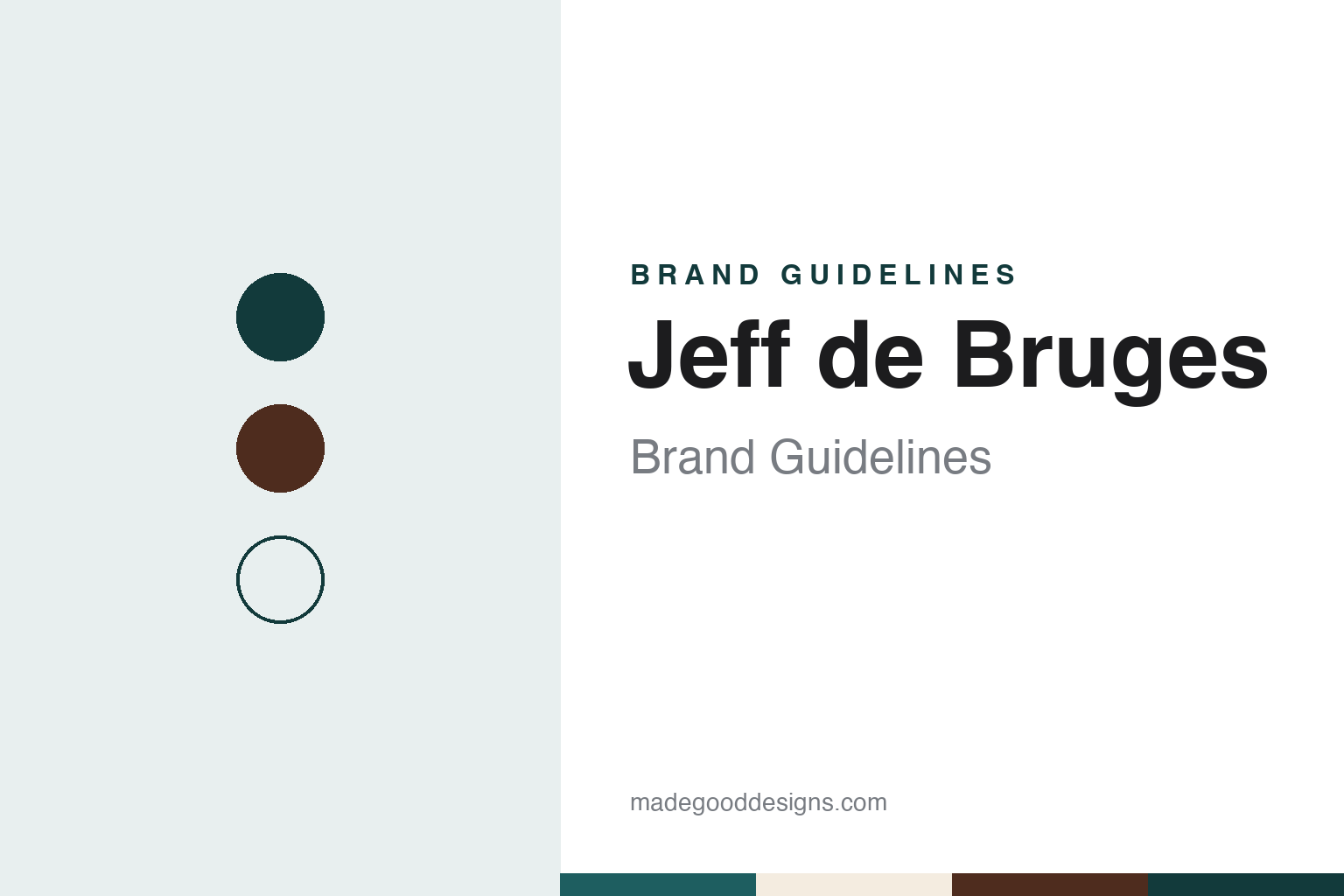
Jeff de Bruges Brand Guidelines
The French chocolate chain named for Bruges and a Brel song.
Aa
Two constants: a Jeff de Bruges teal, brown and cream palette and a bookish serif register. Abstract homage — not a Jeff de Bruges product or mark; no box, shopfront or logo is reproduced.
Chocolatier de proximité
A French founder, a Belgian town and a Brel song.
Jeff de Bruges is a French chain of shops selling Belgian-style chocolates. It was founded in 1986 by Philippe Jambon, French Wikipedia says, citing the company’s legal notice, and its parent company gives the same year. French Wikipedia places its head office at Ferrières-en-Brie, in Seine-et-Marne, east of Paris; the parent’s 2025 annual report lists the company at Marne-la-Vallée, the new town that covers the area.
The founder explains the name himself. In an interview on the company’s website, Jambon says that with a surname like his — jambon is French for ham — he could not put his own name on a chocolate brand. The story “began in Bruges, in Belgium,” he says, “because that is where the brand’s first chocolate factory was,” and his family’s fondness for Jacques Brel and the song “Jef” did the rest. He describes the recipes as a marriage of Belgian chocolate’s indulgence and the “chic” of French chocolate.
The model is the neighbourhood shop. The company calls itself a “chocolatier de proximité depuis 1986,” a local chocolatier since 1986, and its shops are a mix of company-owned branches and franchises, French Wikipedia says. Its website describes customers choosing chocolates one by one to make up a box, alongside seasonal collections, and its parent describes the positioning as “premium accessible.” French Wikipedia says the business is split between two companies: Jeff de Bruges Diffusion, the wholesale supplier, and Jeff de Bruges Exploitation, which holds the shops, offices and warehouses.
Colour
More than 500 shops, and cocoa from Ecuador.
By chocolate-retail standards the network is large. Compagnie du Bois Sauvage’s 2025 annual report, published in March 2026, says Jeff de Bruges has more than 500 shops — 480 in France and nearly 50 abroad — and that its consolidated sales reached €195 million in 2025, with sales across the whole banner, franchisees included, above €315 million. The company has had a Canadian subsidiary since 2013, the same report says, and the June 2026 shareholder newsletter lists its international markets as Europe, the Middle East and Canada.
The range covers three areas, according to that newsletter: chocolate gifts, ice cream and dragées, or sugared almonds. Recent launches named by the parent include a “Divins Desserts” collection and a “Dubai” range, which its first-half 2026 results say has been extended to ice cream. The same results say the brand was re-elected France’s “favourite brand” in its category in early 2026; the survey is not named, so we give that as the company’s claim.
Since 2017 the company has called itself a cacaoculteur, a cocoa grower. Jambon says in the website interview that it decided that year to invest in its supply chain, and the company says the beans for its couverture chocolate come from its own plantations in Ecuador, which it says are Rainforest Alliance certified. Bois Sauvage’s annual report gives the structure: the group holds 28% of an Ecuadorian company, Ecuadorcolat, counting Jeff de Bruges’s share, which owns nearly 1,500 hectares of land planted mainly with cocoa trees, and whose beans go only to its shareholders; it has since bought a further 185-hectare parcel. On its plantation page the company says its farms average 1,200 cocoa trees per hectare, with some 70 kinds of fruit tree grown alongside them for biodiversity. In the first half of 2026, Bois Sauvage reports, Jeff de Bruges also opened a new logistics centre that raises its capacity by half.
Typography
Chocolate and documentation.
The seven brands in this group all sell chocolate, and they come from three countries: Cémoi, Jeff de Bruges, Monbana and À la Mère de Famille from France, Summerbird and Peter Beier from Denmark, and Puccini Bomboni from the Netherlands. They sit at different points in the chocolate trade, from names found on supermarket shelves and in shopping-centre chains to single shops known mainly to the people who walk past their windows.
Some of these businesses are manufacturers, buying cocoa or chocolate in bulk and turning it into bars, drinks and seasonal shapes sold far from where they are made. Others are chocolatiers, who buy finished chocolate from a supplier and use it to make bonbons, truffles and filled pieces by hand, and whose identity rests on a shop, a recipe and a family name as much as on any wrapper. Many sit somewhere between the two, running workshops and shops at once.
Each guide separates what independent sources record from what the company says about itself — who founded it, who owns it now, where its cocoa comes from and where its chocolate is made — and marks plainly what rests only on the company’s own word.
Aa
A bookish serif for a shopfront chocolatier. (Specimen set in Libre Baskerville, a serif STAND-IN; NOT the Jeff de Bruges logo.)
Jeff de Bruges
Wholly owned by Bois Sauvage since April 2026.
Where the chocolates are made is stated less precisely today. French Wikipedia, citing the company’s legal notice, says its products are made in Belgium, except the marshmallow bears, which are made in France; the company’s current pages speak of “our workshops” without naming where they are.
The ownership is well documented. French Wikipedia says 66% of the company belonged to United Belgian Chocolate Makers, a holding of the Brussels-listed investment company Compagnie du Bois Sauvage, which also owns the Brussels chocolatier Neuhaus outright; Bois Sauvage’s annual reports put its stake in Jeff de Bruges at 66% at the end of both 2024 and 2025. On 5 March 2026 Bois Sauvage announced it would buy the remaining 34%, and on 16 April 2026 it said the purchase was complete, making it the sole shareholder. Its first-half 2026 results say the group now wholly owns “its two main chocolate houses, Neuhaus and Jeff de Bruges,” and the two have begun working more closely, sharing some purchasing and systems while each, Bois Sauvage says, keeps its own recipes and identity. Bois Sauvage has set its chocolate division a target of €400 million in sales by 2030.
The chief executive is Dennys Larrieu, whose career, Bois Sauvage says, ran through Galeries Lafayette, Gap, Marks & Spencer and IKKS. He describes the brand as “both cocoa grower and chocolatier, from the bean to the praline.”
For a design guide, Jeff de Bruges shows how a name can carry a place: a French company whose brand points to Bruges. Compare Neuhaus, its sister house under the same owner, and Leonidas, another chain of Belgian praline shops. For this guide we use a deep teal, praline brown and cream with a serif, an unofficial interpretation; no product or logo is reproduced.
Explore & save
Keep Jeff de Bruges’s identity on hand — save it to a board in the Made Good inspiration library.
Jeff de Bruges identity set
Pin the Jeff de Bruges teal, brown and cream palette and the bookish serif register to your own board.