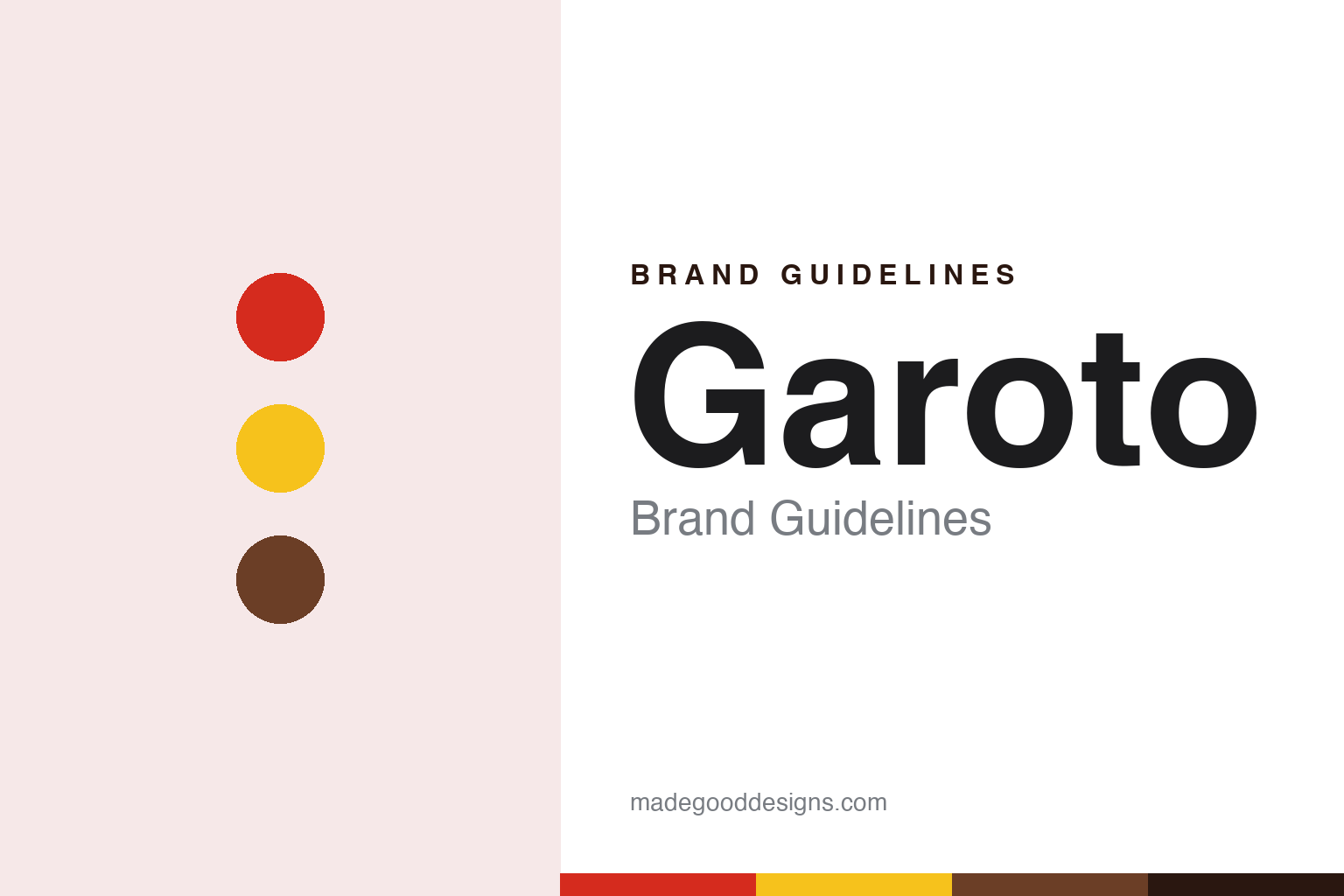
Garoto Brand Guidelines
The Brazilian chocolate maker at the centre of a two-decade antitrust case.
Aa
Two constants: a Garoto red, yellow and cocoa palette and a rounded sans register. Abstract homage — not a Garoto product or mark; no box, wrapper or logo is reproduced.
Mints at the tram stop
A German immigrant’s sweet factory in Espírito Santo.
Garoto began in Vila Velha, in the Brazilian state of Espírito Santo, on 16 August 1929. English Wikipedia says the German immigrant Heinrich Meyerfreund founded it as a sweet factory, H. Meyerfreund & Cia., in a warehouse in the Prainha district, and that its first product was a mint, the Pastilha Garoto, sold at first at Vila Velha’s tram stops and then to shops in the state capital and other cities. The Portuguese word garoto means “boy.”
Chocolate came a few years later. In 1934, English Wikipedia says, Meyerfreund used an inheritance from his parents to buy chocolate-making machines, and two years after that he raised finance for a more modern factory in the Glória district — where Garoto’s industrial site still stands. In 1938 Günther Zennig joined the business, bringing new investment and expanding its production and sales, and the company began selling beyond Espírito Santo. English Wikipedia’s article is short and flagged as needing more citations, so we give these early details as its account.
Two of Garoto’s best-known names date from the late 1940s. Baton, a small chocolate stick, was launched in 1948 as “Leite e Mel” — milk and honey — according to Portuguese Wikipedia, citing the Gazeta de S.Paulo; it took its name from the lipstick, batom, whose shape the original version resembled. The Serenata de Amor bonbon, with a wafer and cashew filling, followed in 1949, Portuguese Wikipedia says.
In 1989 the company marked its 60th anniversary with a running race for its staff and neighbours. It became the Dez Milhas Garoto, a ten-mile road race through Vila Velha and Vitória, the state capital, and Portuguese Wikipedia calls it the most traditional race in Espírito Santo.
Colour
Nestlé, CADE and twenty-one years.
Garoto’s modern history is dominated by one deal. In 2002 the company was bought by Nestlé. In February 2004 Brazil’s competition authority, the Administrative Council for Economic Defence (CADE), ruled that the purchase should be blocked: the combination would have given Nestlé about half of the country’s chocolate market, Confectionery News reported that October, adding that an appeal panel had voted three to two that even selling brands would not preserve competition. InfoMoney later put the 2004 shares at 30.8 per cent for Nestlé and 24.4 per cent for Garoto.
Nestlé went to court instead of selling. According to InfoMoney, a first-instance court suspended CADE’s decision in 2005; in 2009 that ruling was annulled and CADE was ordered to judge the case again; and in 2018 a federal appeals court, the TRF1, rejected Nestlé’s appeal. In the meantime Garoto was owned by Nestlé but run separately, English Wikipedia says. In 2016 CADE drew up terms under which the deal could be approved, including the sale of some brands, and in 2017 O Globo reported that Mondelēz was negotiating to buy brands. The case stayed open, and in April 2023 CADE turned down a Nestlé proposal, Portuguese Wikipedia says, citing UOL.
On 7 June 2023, more than two decades after the purchase, CADE approved it with restrictions, G1 and InfoMoney reported. Under the agreement, as InfoMoney described it, Nestlé may not for five years acquire assets amounting together to 5 per cent or more of Brazil’s chocolate market; must keep investing in the Garoto factory in Vila Velha for at least seven years; must report smaller acquisitions for seven years; and must not act against cuts in chocolate import tariffs or the entry of new competitors for the same period.
“Twenty years were enough to reshape the landscape of rivalry in the chocolate market,” CADE’s president, Alexandre Cordeiro, said, in our translation of InfoMoney’s report. The report noted that the two companies’ combined share had fallen to between 30 and 40 per cent, with competition from Ferrero, Hershey’s, Cacau Show and Kopenhagen.
Typography
Chocolate in Japan and Latin America.
The seven brands in this group all sell chocolate, and they come from three countries: Royce’, Meiji and Morinaga from Japan, Garoto, Cacau Show and Kopenhagen from Brazil, and Ibarra from Mexico. Each guide looks at one name on its own terms, at home first and abroad second.
Chocolate brands reach people in different ways, and the differences show in their design. A mass-market confectioner sells bars and boxes through supermarkets and corner shops, where a wrapper has a moment to be recognised on a crowded shelf. A gift brand sells mainly through its own shops and counters, where the box, the ribbon and the shop itself carry much of the identity. A maker of a traditional product — a tablet bought for the kitchen rather than as a treat — may keep the same carton for decades, so that the package itself becomes the brand. Many firms do more than one of these things at once.
Each guide separates what independent sources record from what the company says about itself — who founded it, who owns it now, where its cocoa comes from and where its chocolate is made — and marks plainly what rests only on the company’s own word.
Aa
A rounded sans — for a red-and-yellow chocolate box. (Specimen set in Rubik, a sans STAND-IN; NOT the Garoto logo.)
Garoto
A yellow box, and a name changed once a year.
Garoto keeps its own name, website and visitor attractions under Nestlé. Its factory in Vila Velha’s Glória district houses the Chocotour, with a museum, café and shop, the company’s website says. Garoto describes itself as one of the ten largest chocolate factories in the world, with about 70 products — bonbon boxes, bars, Easter eggs and chocolate for cooking — sold in more than 50 countries; its biggest successes, it says, are the Caixa Amarela, the yellow box of assorted bonbons, the family-size bars, Baton, Talento and Serenata de Amor. Those are the company’s own claims, and the sources we checked do not say where its cocoa comes from.
Packaging has played its part. Garoto says its Talento tins won an award from ABRE, the Brazilian packaging association, in 2013. That year it also agreed a sponsorship worth 200 million reais with FIFA and the Brazilian football confederation to be the official chocolate of the 2013 Confederations Cup and the 2014 World Cup, O Estado de S. Paulo reported in January 2013. And since 2024 the brand has changed its name once a year: for the Semana Farroupilha, the festival of gaúcho tradition in Rio Grande do Sul, Garoto becomes “Guri” — the southern Brazilian word for a boy — on a limited edition sold only in that state. Portuguese Wikipedia, citing Nestlé, says it was the first time the traditional Garoto logo had been replaced, and that part of the 2024 sales went to the housing charity Habitat to help rebuild homes after that year’s floods.
For a design guide, Garoto shows how a regional maker’s name and products can come through two decades of uncertainty inside a multinational intact. Compare Cacau Show and Kopenhagen, two Brazilian rivals InfoMoney named in its 2023 report. For this guide we use red, yellow and cocoa brown with a sans, an unofficial interpretation; no product or logo is reproduced.
Explore & save
Keep Garoto’s identity on hand — save it to a board in the Made Good inspiration library.
Garoto identity set
Pin the Garoto red, yellow and cocoa palette and the rounded sans register to your own board.