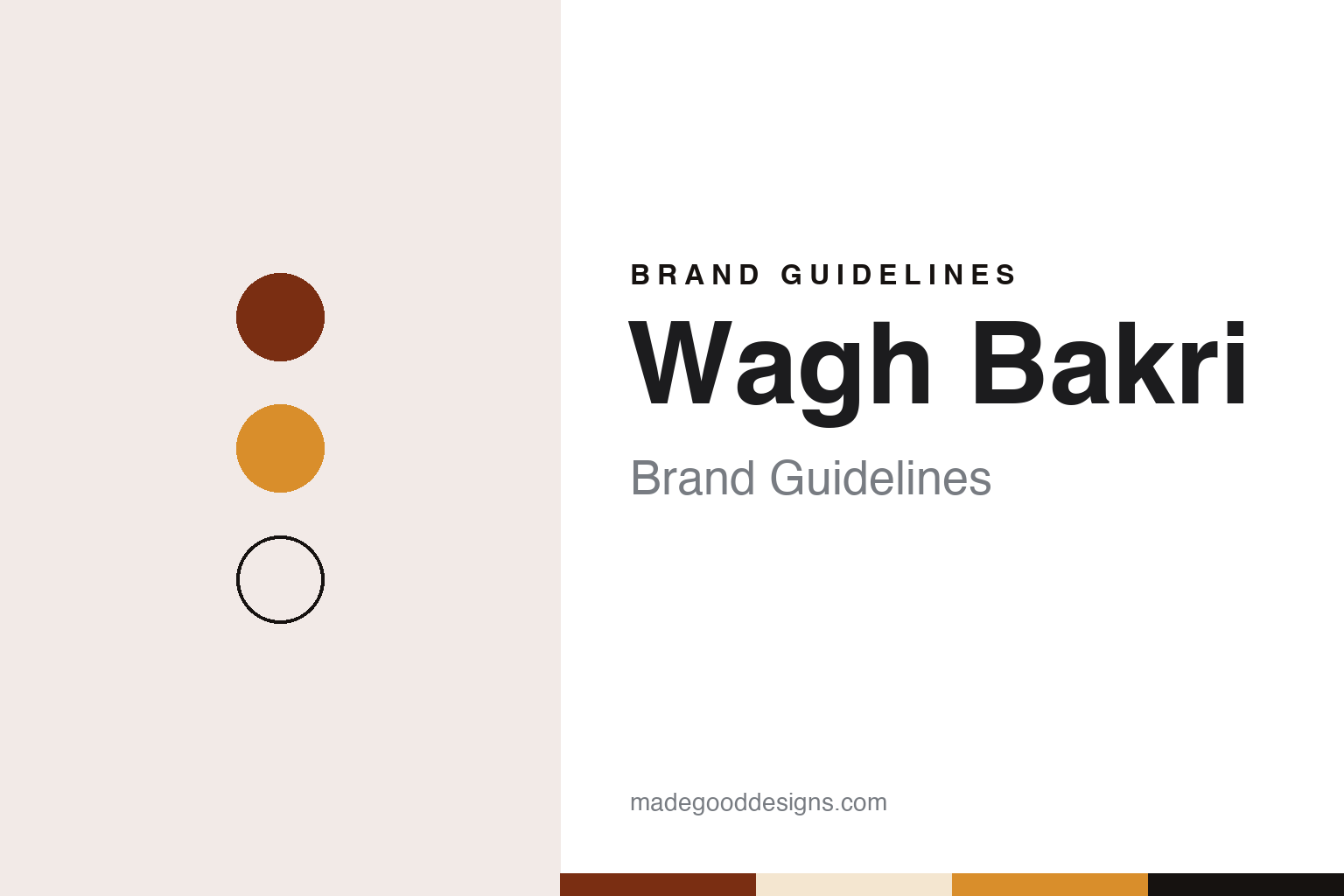
Wagh Bakri Brand Guidelines
The Ahmedabad family tea firm behind the tiger-and-goat cup.
Aa
Two constants: a Wagh Bakri brown and orange palette and a Warm serif register. Abstract homage — not a Wagh Bakri product or mark; no pack, logo or emblem is reproduced.
Since 1892
A tea planter returns to Gujarat.
Wagh Bakri dates itself to 1892 and to South Africa. The company says its founder, Narandas Desai, began that year with a 500-acre tea estate near Durban; Forbes India, in a 2018 profile, says he moved to Durban and “took 500 acres of tea estate on lease to manage and run,” so the two accounts differ on whether he owned or leased it.
Desai came back to India in 1915, Forbes India reports, leaving because of racial discrimination, as the company also says. The company says he returned carrying a certificate from Mahatma Gandhi describing him as an “honest and experienced tea planter”; we give that as the company’s account. According to Forbes India, he worked briefly at a tea estate in Mahabaleshwar, in Maharashtra, before opening the Gujarat Tea Depot Co. shop in Ahmedabad to sell processed tea. Forbes India dates the shop to 1915; the company’s own timeline dates the depot to 1919. The company says the depot set out to sell good tea to working people, especially the city’s textile-mill workers.
The brand name followed in 1934, when, the company says, “Wagh Bakri” was registered. Desai’s sons — Ramdas, Ochhavlal and Kantilal — grew the business to seven shops across Ahmedabad, Forbes India reports.
The modern company was formed by the third generation. In 1980, according to Forbes India, the family moved into packaged tea and turned the partnership firm into Gujarat Tea Processors & Packers Ltd; English Wikipedia gives the incorporation date as 22 September 1980, and the company’s own timeline also places it in 1980.
Colour
A tiger and a goat at one cup.
The name is the brand’s whole idea. Wagh is Gujarati for tiger and bakri for goat, and the logo shows the two animals drinking tea from the same cup. Forbes India describes the emblem as depicting “a tiger (wagh) and a goat (bakri) bridging their differences and sipping tea from the same cup,” in keeping with Gandhian values of equality. The company says the image was meant to represent social harmony and the breaking down of caste and class barriers.
The company names two other emblems on its packs and materials: the Pehelwan, a wrestler figure it says stands for strength and authenticity, and the “Flag of Quality.” It uses the line “Since 1892” as a promise of continuity. It has not published a typeface or colour specification for any of these, and we found none.
The range has grown around the flagship. The company says it launched Good Morning, a premium blend, in 1944; its other brands include Mili, Navchetan and Wagh Bakri Royale. In 2018 Forbes India described Good Morning as competing with Hindustan Unilever’s premium teas, and Mili with Unilever’s Red Label in the popular segment.
Packaging has been recognised in India. The company says Wagh Bakri Royale received a National Award for Packaging at the SIES SOP Star Awards in April 2026; we give that as the company’s report.
Typography
Design and documentation.
The seven brands in this group all sell tea, and their names were founded in five countries: Lipton and Brooke Bond in Britain, Tata Tea and Wagh Bakri in India, Ito En in Japan, Basilur in Sri Lanka, and Salada in Canada. Where a tea brand was founded is only the start of its story, because a name can travel a long way from the city where it began, and the country on its founding record need not be the country where its owner sits today.
A tea brand’s identity is usually carried less by a field than by a blend, a packet and the cup it promises, because the leaf inside may have been grown far from the place where the name on the front was made. That makes the questions behind each name worth asking plainly: who started it, who owns it now, where its leaves are bought, and where its tea is actually blended and packed.
Each guide separates what independent sources record from what the company says about itself — its founding story, its owners over time, where its tea comes from and where it is packed — and marks plainly what rests only on the company’s own word.
Aa
A warm serif for a family heritage brand. (Specimen set in Fraunces, a serif STAND-IN; NOT the Wagh Bakri logo.)
Wagh Bakri
A blender and packer, not a planter.
Wagh Bakri is a blender and packer rather than a grower. Forbes India reported in 2018 that the company had never owned tea estates and bought its tea at auction; an executive director told the magazine that running an estate was “like running a township.” The same profile said the directors tasted 400 to 500 samples a day, adjusting blends to the milk and water of the regions they were sold in.
The tea is packed in Gujarat. The company’s website describes “a fully integrated tea blending and packing facility” and lists three plants run by Gujarat Tea Processors & Packers: at Dholka, in Ahmedabad district, established in 1980 and now making instant tea and coffee premixes; at Khandhli, in Kheda district, established in 2023 for tea; and a plant near Dakor, also in Kheda district, opened in 2025. Its headquarters, the Wagh Bakri House in Ahmedabad, opened in 2006, the company says.
The company grew one state at a time. Forbes India called it India’s third-largest packaged tea company in 2018, with a share of more than 60 per cent in Gujarat, and quoted the family as saying it spent about ten years in Rajasthan and Madhya Pradesh before entering Maharashtra. It also runs cafés: the company says its first Wagh Bakri Tea Lounge opened in Vile Parle, Mumbai, in 2009, followed by Delhi in 2010.
Exports began in 1992, with the United States as the first market, the company says, and a dedicated export department followed in 2007; it now says it sells in more than 60 countries. The business remains in the Desai family: the company’s website names Piyush Desai as chairman and Rasesh Desai as vice-chairman and managing director, and Forbes India reported that the family had never sought outside funding or a stock-market listing.
For a design guide, Wagh Bakri shows how a single image — two animals at one cup — can carry a brand’s whole story. Compare Tata Tea, its larger national rival, and Dilmah, another family tea brand. For this guide we use a dark tea brown, a tiger orange and chai cream with a serif, an unofficial interpretation; no product or logo is reproduced.
Explore & save
Keep Wagh Bakri’s identity on hand — save it to a board in the Made Good inspiration library.
Wagh Bakri identity set
Pin the Wagh Bakri brown and orange palette and the Warm serif register to your own board.