Tata Tea Brand Guidelines
The Tata Finlay venture that became India’s biggest tea brand and bought Tetley.
Aa
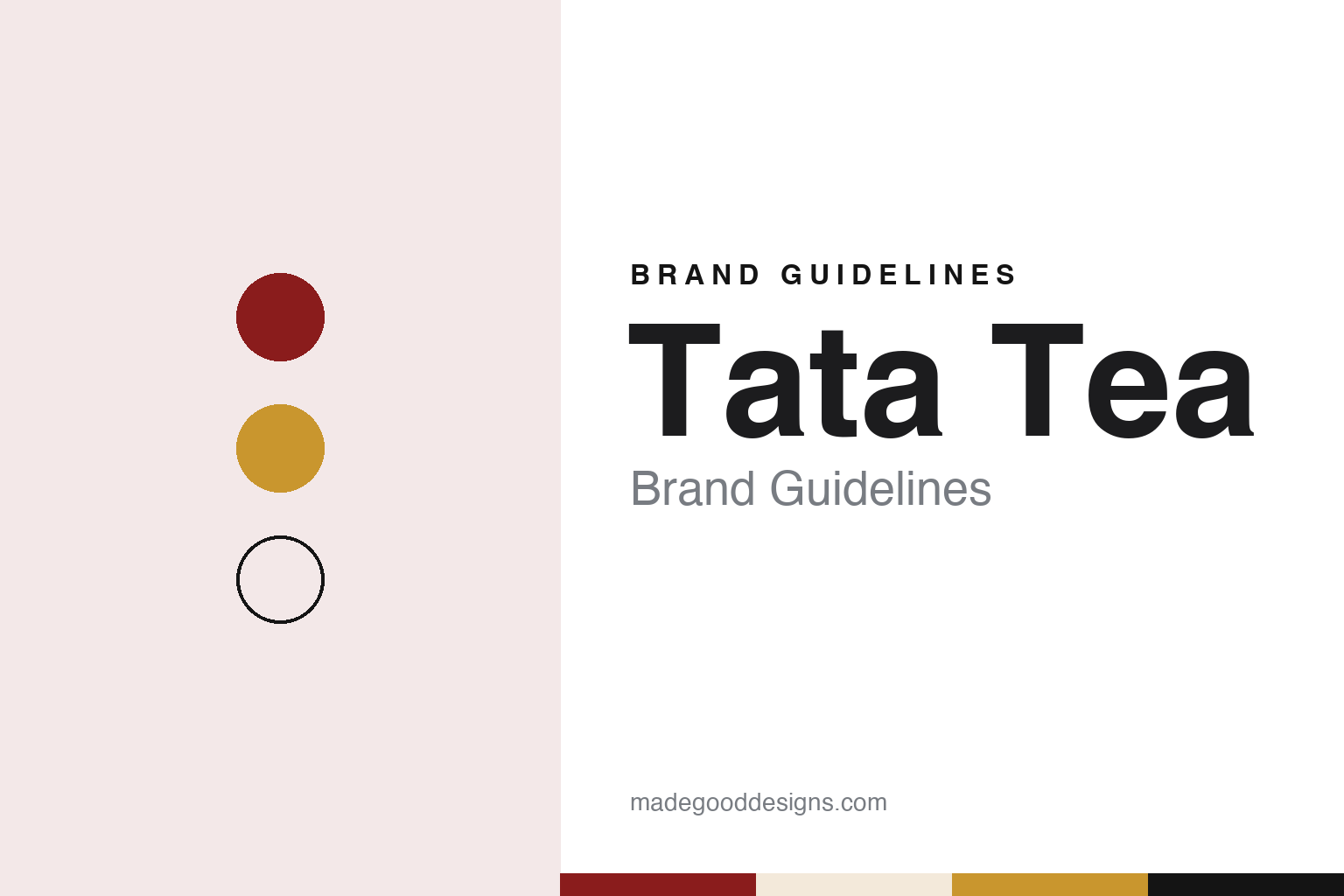
Two constants: a Tata Tea red and gold palette and a Bold sans register. Abstract homage — not a Tata Tea product or mark; no pack, logo or label is reproduced.
Tata Finlay
A Tata company and a Glasgow trading house.
Tata Tea began as a partnership between an Indian conglomerate and a Scottish trading house. According to a company history published by Business Standard, the business was incorporated in 1962 as Tata Finlay Ltd, “with technical and financial collaboration with James Finlay & Co. Ltd., Glasgow,” to develop value-added tea; the milestones page of Tata Consumer Products also gives 1962, while English Wikipedia dates the joint venture to 1964, so the sources differ by two years. In 1976, Business Standard says, Tata Finlay took over James Finlay’s production and marketing operations in India.
The decisive year was 1983. James Finlay sold its shareholding, and, in Business Standard’s words, “Tata Tea was born.” English Wikipedia says the company decided the same year to move from the commodity tea trade into consumer branding, and that the first brand it introduced was Tata Tea, followed by names including Kannan Devan, Agni, Gemini and Chakra Gold.
The company dates its breakthrough to a pack. Tata Consumer Products says that in 1985 Tata Tea “pioneered the packet tea revolution in India,” bringing teas “fresh from the garden directly to consumers in poly packs”; its own list of milestones calls the poly pack “revolutionary.” The brand page says that when Tata Tea started, the packaged tea market in India was dominated by a single large player with more than 70 per cent of it; we give that as the company’s account.
Today Tata Tea is owned by Tata Consumer Products Limited, a listed company whose registered office is in Kolkata and whose corporate headquarters is in Mumbai, according to English Wikipedia and the company’s website; the Tata Group, as promoter, held about a third of its shares in 2024, English Wikipedia reports.
Colour
From Tata Tea Ltd to Tata Consumer Products.
The company that owns the brand has changed its name twice. Tata Tea Ltd became Tata Global Beverages in 2010, its milestones page says, and in February 2020 it became Tata Consumer Products, after the consumer products business of Tata Chemicals — including Tata Salt — was merged into it, The Economic Times reported at the time, as cited by English Wikipedia.
The largest step came abroad. In 1993 Tata Tea formed a joint venture with the British company Allied Lyons, Business Standard records, and in February 2000 it bought the Tetley Group, the British tea company that traces its history to Joseph Tetley & Co. in 1837, for £271 million, according to English Wikipedia. Tata reportedly outbid the American company Sara Lee, and the deal was described at the time as the largest takeover of a foreign company by an Indian company; the BBC, in 2024, called it one of the largest overseas acquisitions by an Indian company at that time. Tetley remains a sister brand in the same group.
At home the portfolio grew around the flagship. Business Standard says the company launched Tata Tea Premium in Hyderabad and Secunderabad in 1997 and the economy brand Agni in 1998; the company’s brand page says the original Tata Tea brand was renamed Tata Tea Premium in 2003 as the range grew, so the two accounts date the Premium name differently. Agni, the company says, is now the second-largest brand in the portfolio, sold in more than 22 Indian states.
The company also changed how it held its gardens. In February 2005, Business Standard records, it transferred 16 tea estates in Munnar, Kerala, to the Kannan Devan Hills Plantations Company, a new company formed by the estates’ management and employees.
Typography
Design and documentation.
The seven brands in this group all sell tea, and their names were founded in five countries: Lipton and Brooke Bond in Britain, Tata Tea and Wagh Bakri in India, Ito En in Japan, Basilur in Sri Lanka, and Salada in Canada. Where a tea brand was founded is only the start of its story, because a name can travel a long way from the city where it began, and the country on its founding record need not be the country where its owner sits today.
A tea brand’s identity is usually carried less by a field than by a blend, a packet and the cup it promises, because the leaf inside may have been grown far from the place where the name on the front was made. That makes the questions behind each name worth asking plainly: who started it, who owns it now, where its leaves are bought, and where its tea is actually blended and packed.
Each guide separates what independent sources record from what the company says about itself — its founding story, its owners over time, where its tea comes from and where it is packed — and marks plainly what rests only on the company’s own word.
Aa
A bold sans for a mass-market pack. (Specimen set in Inter Tight, a sans STAND-IN; NOT the Tata Tea logo.)
Tata Tea
Jaago Re and a pack for every state.
Tata Tea is a large brand in its home market. English Wikipedia calls it the biggest-selling tea brand in India, and the company says that “one in three households in India wakes up to a cup of Tata Tea,” which we give as its own claim. In 2018 Forbes India, citing a 2017 Euromonitor report, put Tata Global Beverages’ share of India’s packaged tea market at about 29 per cent between 2012 and 2016.
Its tea is packed in India across several states. The operations page of Tata Consumer Products lists tea factories and packeting centres in Assam, West Bengal, Kerala — at Pullivasal, near Munnar — Telangana, Odisha and Haryana, and tea-buying offices in Guwahati and Siliguri, as well as in Mombasa, Kenya, and Blantyre, Malawi. The company describes Tata Tea Gold as combining teas from the Assam valley with long leaves from the highlands; it does not publish the make-up of its blends.
The brand’s best-known communication is “Jaago Re” — “wake up” — which the company says was first launched in 2007 on Facebook, urging Indians to question apathy about corruption, voting and gender sensitisation. English Wikipedia records that the campaign began as a voter-registration drive with the civic organisation Janaagraha before turning to corruption.
Packaging has been part of the brand’s regional strategy. When Tata Tea Premium was relaunched in 2019 as “Desh ki Chai”, the company says, the campaign was its first “hyperlocal” one, with “state-wise customized packaging that reflected the symbols of pride for that state” and advertising written for each state. The company has not published a typeface or colour specification for the brand, and we found none.
For a design guide, Tata Tea shows how a commodity business became a consumer brand through a pack and a voice. Compare Tetley, the British brand it bought in 2000, and Wagh Bakri, a family-owned rival from Gujarat. For this guide we use a deep red, gold and milk-tea cream with a sans, an unofficial interpretation; no product or logo is reproduced.
Explore & save
Keep Tata Tea’s identity on hand — save it to a board in the Made Good inspiration library.
Tata Tea identity set
Pin the Tata Tea red and gold palette and the Bold sans register to your own board.