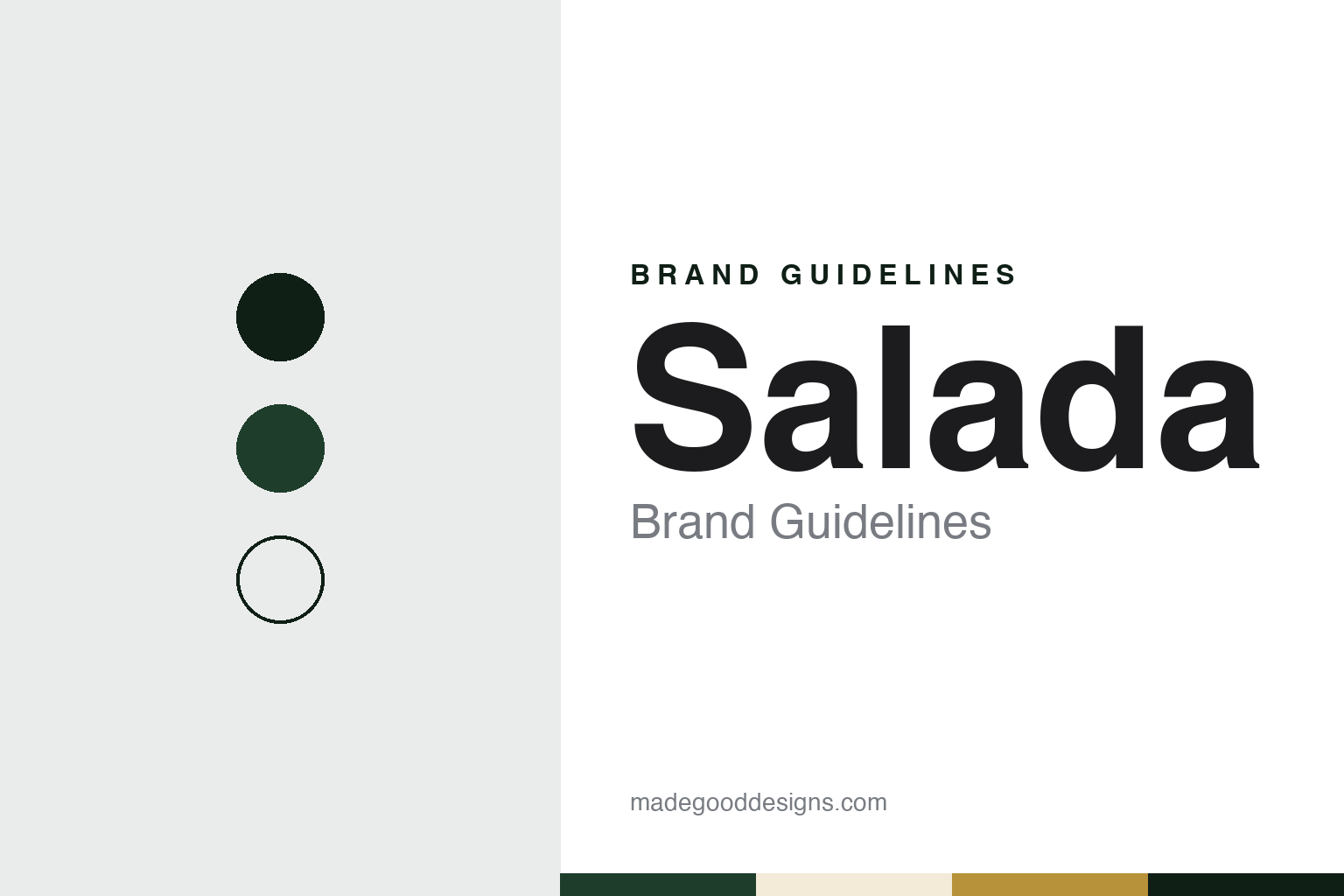
Salada Brand Guidelines
Peter Larkin’s Toronto packet tea, now owned twice over.
Aa
Two constants: a Salada tea green and foil gold palette and a Display serif register. Abstract homage — not a Salada product or mark; no packet, logo or label is reproduced.
A Toronto tea broker
Ceylon tea in a packet.
Salada began in Toronto. Its founder, Peter Charles Larkin, was born in Montreal and spent his early career as a commercial traveller for Tiffin Brothers, a Montreal grocery wholesaler, according to the Dictionary of Canadian Biography. In 1889 he left that firm to set up on his own in Toronto as a tea broker and a wholesaler of sugar, dried fruit and nuts, and by 1891, the biography says, he was advertising Ceylon tea to grocers in 50-pound chests.
The brand dates from 1892. That year, according to the Dictionary, Larkin began blending Ceylon teas and selling them to grocers in pound and half-pound packages as the Golden Teapot Blend, from “The Salada Tea Co., L’td., Ceylon.” The biography adds that no evidence has been found that this Ceylon company was anything other than Larkin’s invention, and that the name was said to come from a tea-growing district in India. The Golden Teapot name was soon dropped, and Salada was left standing as the brand.
Packaging sits at the centre of the brand’s story, and the sources frame it differently. Salada’s American website says Larkin “developed a system of selling tea in foil packages” and calls the result “North America’s first packaged tea.” English Wikipedia credits him with replacing tea sold loose from chests with tea packed in foil. The Dictionary of Canadian Biography is more careful: it says sealed lead-foil packets had begun to replace sales from open chests around 1890, and that Larkin was “neither the first to introduce India and Ceylon teas to Canada nor the first to supply them in packets,” but that he was “certainly the earliest importer to mix his own blends.”
Colour
Agents, advertising and a chain of owners.
Larkin sold through grocers he appointed as agents, backed by heavy newspaper advertising. The Dictionary records more than 200 Toronto grocers stocking Salada by May 1893, nearly 2,000 agents in eastern Canada by May 1895, a Vancouver depot in 1896, and a share of about three-quarters of Canada’s packaged-tea sales. It quotes his advice: “In advertising, be sure you have the right article first, then don’t spare the printer’s ink.” Larkin also patented a machine, the Ideal tea packer, which the biography says let three men turn out 20,000 half-pound packages a week and was bought even by the Thomas J. Lipton Company.
The first American branch opened in Buffalo in 1896, and Boston became the hub of the US business. Larkin ran the company as a sole proprietorship until 1900, when the Salada Tea Company Limited was incorporated. English Wikipedia, citing William Ukers’s All About Tea, says the company had a Boston headquarters and blending and packing plant by 1917. Its building on Stuart Street, by the architects Densmore and LeClear, has bronze doors by the English Arts and Crafts designer Henry Wilson showing the history of the Ceylon tea trade; Wikipedia’s pages on Wilson and on the architects date the building and doors to 1927, and say the doors are still there. The company says it bought the patent for a heat-sealed paper-fibre tea bag in 1930, a claim we give as its own.
The ownership chain is long. Larkin’s son, Gerald, managed the company from the 1920s until he retired in 1957, according to Wikipedia. In June 1957 Salada combined with Shirriff-Horsey, the food company behind Shirriff marmalade: English Wikipedia’s Salada article calls it an acquisition, while its Shirriff article, citing a newspaper report of 30 June 1957, calls it a merger. The combined business was renamed Salada Foods in 1962 and was sold to Kellogg of Canada in 1969. In 1988, Wikipedia says, citing a Toronto Star report of that February, Kellogg’s Salada tea business was bought by Redco Foods, the company making Red Rose in the US under licence from Unilever, and the Canadian side then passed to Unilever, so that each company produced both brands in its own country.
Typography
Tea, by country.
The seven brands in this group all sell tea, and their names were founded in five countries: Lipton and Brooke Bond in Britain, Tata Tea and Wagh Bakri in India, Ito En in Japan, Basilur in Sri Lanka, and Salada in Canada. Where a tea brand was founded is only the start of its story, because a name can travel a long way from the city where it began, and the country on its founding record need not be the country where its owner sits today.
A tea brand’s identity is usually carried less by a field than by a blend, a packet and the cup it promises, because the leaf inside may have been grown far from the place where the name on the front was made. That makes the questions behind each name worth asking plainly: who started it, who owns it now, where its leaves are bought, and where its tea is actually blended and packed.
Each guide separates what independent sources record from what the company says about itself — its founding story, its owners over time, where its tea comes from and where it is packed — and marks plainly what rests only on the company’s own word.
Aa
A display serif for a name printed on a packet. (Specimen set in Libre Caslon Text, a serif STAND-IN; NOT the Salada logo.)
Salada
One name, two owners.
Today the name has two owners. In the United States the brand still belongs to Redco Foods, which English Wikipedia and the trade title World Tea News record as owned since 1995 by Germany’s Teekanne. Since 2018, according to Wikipedia, Salada tea there has been produced under licence by Harris Tea Company, part of Harris Freeman, whose name appears in the copyright line of the American website. That site now leads with green tea and says its leaves come largely from Zhejiang province in China, with some from Argentina — a statement we give as the company’s own.
In Canada, Salada passed with Unilever’s tea business to Lipton Teas and Infusions, the Amsterdam-based company formerly called ekaterra, after CVC Capital Partners completed its purchase of that business in July 2022; Wikipedia cites the Canadian trademark register for that ownership. We could not reach the Canadian website when preparing this guide, so we do not say here where Canadian Salada is blended and packed today. The two countries’ sites sit at different addresses: salada.com is the American one and salada.ca the Canadian.
We found no published brand guidelines and no documented typeface or colour for the Salada mark. The clearest design record in the brand’s history is architectural rather than graphic: the Boston building and Henry Wilson’s doors, commissioned by a tea company to tell the story of its trade.
For a design guide, Salada shows how a sealed packet and a printed name, pushed through agents and newspaper advertising, can carry a brand through many changes of owner. Compare Red Rose, which shares Salada’s split between an American licensee and a Canadian owner, and Teekanne, whose American subsidiary holds the Salada name in the US. For this guide we use a deep tea green and a foil gold with a serif, an unofficial interpretation; no product or logo is reproduced.
Explore & save
Keep Salada’s identity on hand — save it to a board in the Made Good inspiration library.
Salada identity set
Pin the Salada tea green and foil gold palette and the Display serif register to your own board.