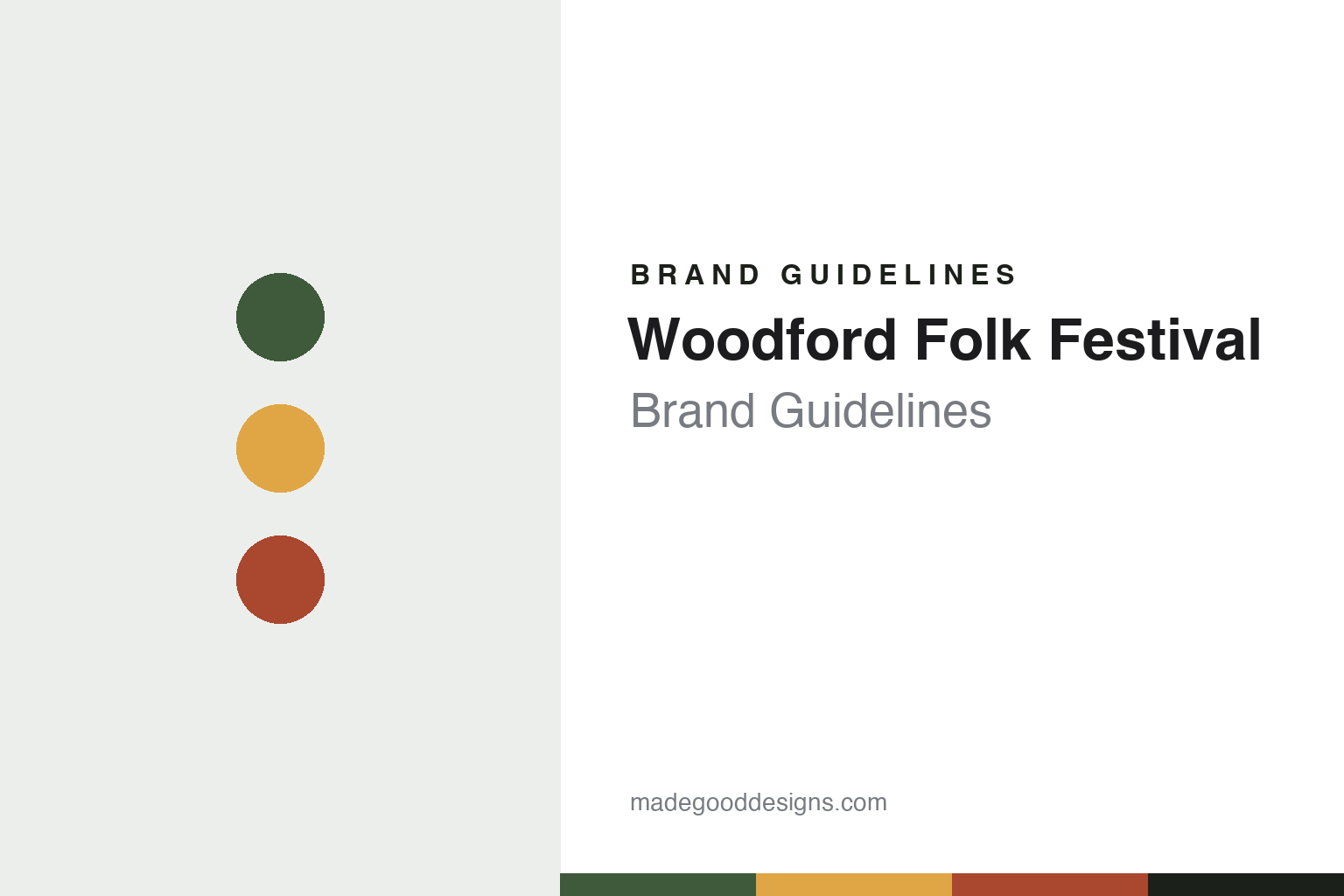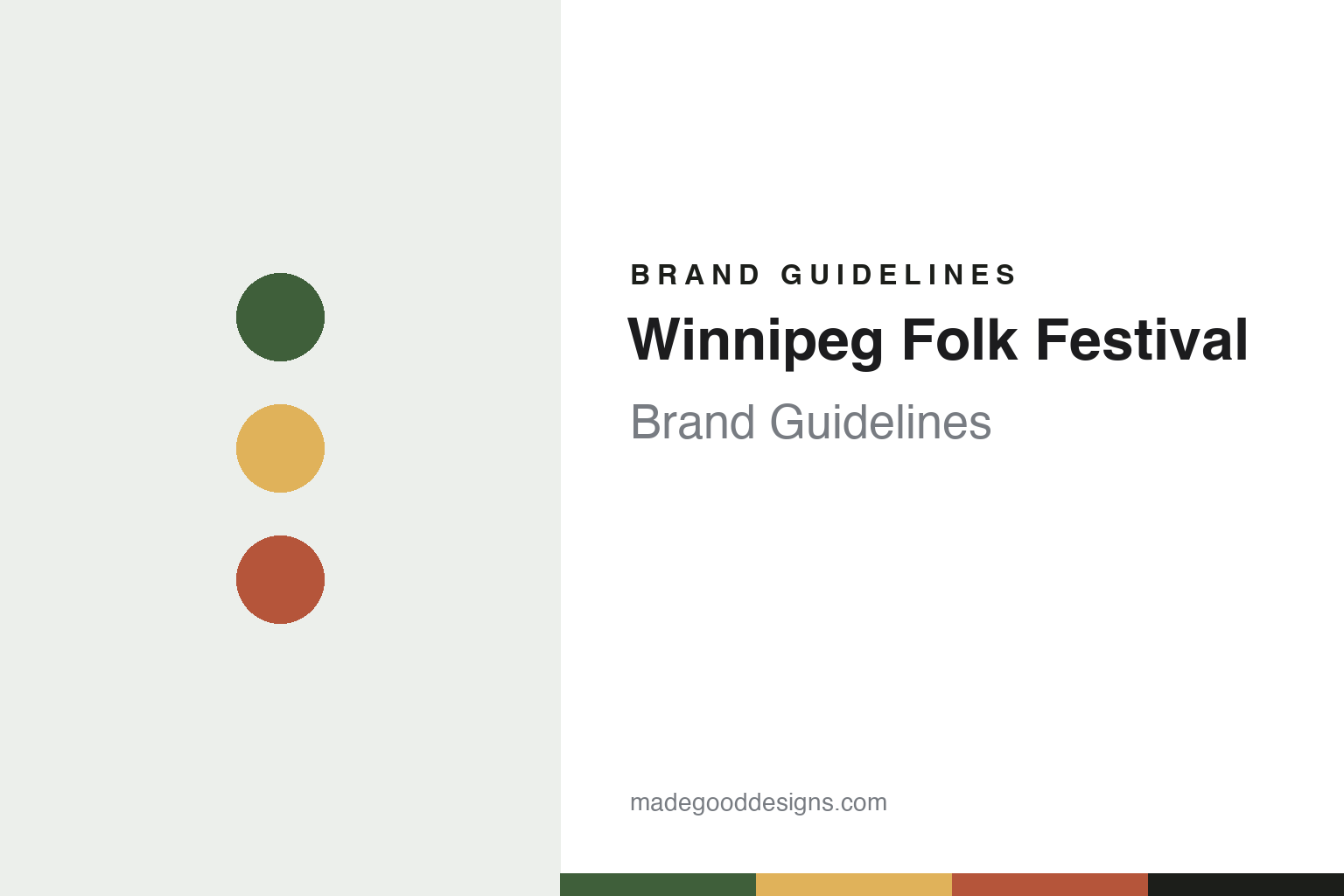
Winnipeg Folk Festival Brand Guidelines
A free centennial weekend in a new park, grown into a July fixture and a year-round society.
Aa
Two constants: an aspen green, wheat gold and big-top red palette and a soft serif register. Abstract homage — not a Winnipeg Folk Festival poster or mark; no logo, artwork or wristband is reproduced.
The Centennial Folksong Festival
A city’s 100th birthday and a brand-new park.
The Winnipeg Folk Festival began as a centennial project. In a history feature published on 6 July 2014, ahead of the 41st festival, the Winnipeg Free Press recounted how Mitch Podolak, then a CBC documentary filmmaker and banjo player, and his co-organiser Colin Gorrie, an architect, organised the Winnipeg Centennial Folksong Festival to mark the city’s 100th anniversary in 1974. Podolak told the paper he had always had a longer-term plan in mind rather than a one-off event.
The site was chosen with care. The Free Press says the pair first looked at La Barriere Park, south of the city, but judged it impractical for the expected traffic, and turned north to Birds Hill Provincial Park, which was then brand new. Gorrie, the architect, designed the original site, walking it with a stick to take soil samples and choose the spot for the main stage. The stages and structures were built at the Transcona rail yards, and many of the first crew came from there.
The first festival opened on 9 August 1974 and ran for three days. The Free Press reported that 42 acts were booked, with the singer Oscar Brand, a former Winnipegger, serving as host, and that admission was free. The main stage, about one and a half metres high, stood at the bottom of a natural amphitheatre, with the audience less than three metres from the performers, while workshop stages were scattered through the site. Podolak recalled that the news of Bruce Cockburn playing helped draw the crowd, and in the end some 22,000 people attended, the paper said. The festival’s about page gives the same estimate of 22,000 over the three-day weekend.
The same feature traces two lasting parts of the festival to those early years: an army of volunteers who take on whatever tasks they are given, and the Hand-Made Village of craftspeople, launched by one of the early contributors. Over the decades, the Free Press noted, the programme broadened beyond folk music towards a wider world-music outlook.
Colour
Nine stages, a big top and a village of makers.
The festival is now held in July. English Wikipedia says it takes place over the second weekend of the month, from Thursday night to Sunday night, and CBC News reported on 11 July 2019 that that year’s festival, the 46th, ran from 11 to 14 July at Birds Hill Provincial Park, where a festival spokesperson said 80,000 visitors would gather over the four days. The festival itself puts its cumulative summer attendance at more than 70,000 a year.
CBC’s 2019 report gives a clear picture of the site. It described nine stages for performances, food vendors, and the Chickadee Big Top for children’s programming; a campground where overnight passes had sold out for the second year running; and the Handmade Village, a temporary home to nearly 50 artisans selling handcrafted jewellery, clothing, pottery and musical instruments. It noted that organisers encouraged volunteers and ticket holders to download the festival app for artist biographies, schedules and a site map, and that a free shuttle called the Folk Fest Express ran to the site.
The programme draws on many traditions. The festival’s artistic director in 2019, Chris Frayer, told CBC that the line-up included more than 75 groups of local and international musicians from countries including the Netherlands, Mexico and Colombia as well as the United States and Canada, with dozens of informal jam sessions besides. He said that year’s edition had an Icelandic focus, reflecting the heritage of many Manitobans, and CBC reported that the festival’s young performers programme, which runs in the weeks before the festival, was in its 20th year. English Wikipedia lists bluegrass, blues, Celtic, indie folk, folk rock, roots, Americana, French-Canadian music, singer-songwriters and children’s performers among its genres.
The festival describes its daytime stages as home to concerts, workshops and family programming, with the Main Stage for evening headliners and a second evening stage, Big Blue @ Night, for more alternative music. Workshops, it says, let artists play with musicians they may never have met, a format it presents as one-time-only collaborations. A family area beside the Chickadee Big Top offers games, crafts, reading, face-painting and puppetry.
Typography
Folk festivals and their settings.
A folk festival is often remembered by where and when it happens before anything else. Some take over a park on the edge of a city in high summer, with marquees pitched on the lawns; others fill a seaside town in late August, spreading concerts, dances and workshops through its halls and streets. Some gather in a concert hall in the depths of winter, some on a hillside in a provincial park, and some on a showground or in a festival village built for the purpose. The setting and the week in the calendar do much of the work a logo does elsewhere.
Where a festival issues an annual poster or programme cover, its look is renewed each year, and the artist behind it, whether an illustrator, a printmaker or a designer, shapes how that edition is remembered. When a festival credits those artists, the run of posters becomes a visual record of the event, edition by edition, and a festival without a fixed mark can still read as one thing across many years.
Behind most of these names stands an organiser that keeps them going: a city council, a folk society, a non-profit association, a trust or a small company, supported in many cases by large teams of volunteers. Organisers can change, and formats with them, while the name stays: the Cambridge Folk Festival, for one, has kept the name it was given in 1965 through several changes of format.
The practical layer is what audiences handle on the day. Programme booklets, stage timetables, wristbands, campsite and site maps, and signs pointing between venues all carry the festival’s type and colour into daily use. This guide looks at each festival through that lens: its setting, its calendar, its organiser and the material its audience reads, set out in plain terms and with our own unofficial palettes.
Aa
A soft, warm serif — a festival programme read on a blanket in a July park. (Specimen set in Fraunces, a serif STAND-IN; NOT the Winnipeg Folk Festival logo.)
Winnipeg Folk Festival
A festival name that became an organisation’s name.
The festival’s name now stands for more than a weekend. The organisation describes itself as having grown from a one-weekend event into a year-round charitable, non-profit arts organisation that presents concerts and events throughout the year; English Wikipedia names its year-round series Hear All Year. The festival says it is run by 24 permanent and contract staff and overseen by a volunteer board of 15, and that nearly 2,700 volunteers contribute more than 60,000 hours a year. CBC put the 2019 volunteer count at more than 2,800.
The site carries much of the identity. The layout has roots in 1974, when the Free Press described a main stage at the foot of a natural amphitheatre and workshop stages scattered across the site; today the Chickadee Big Top and the Handmade Village add their own landmarks, and the festival’s app and site map, mentioned by CBC in 2019, are the practical tools visitors use to move between them. The names themselves are a small naming system: a plain “Main Stage,” a playful “Big Blue @ Night,” a bird for the children’s tent and a “village” for the makers.
The festival’s early structure had an influence beyond Manitoba. English Wikipedia, citing a 2006 Carleton University thesis and a 2011 history in Vue Weekly, says the organisers developed a volunteer-based model that shaped other Canadian festivals, particularly those in Vancouver and Edmonton; Taproot Edmonton records that Podolak helped pitch the Edmonton Folk Music Festival in 1980. CBC Manitoba was named as a sponsor of the festival in CBC’s 2019 report. No published brand guidelines, poster series or credited designer are documented in the sources used here, so the visual notes in this guide are our own.
For a design guide, the Winnipeg Folk Festival shows how a one-off civic celebration can become a permanent name by keeping its park, its volunteers and its makers’ village at the centre. Compare the Edmonton Folk Music Festival, the Alberta festival Podolak helped pitch, and CBC, the broadcaster whose Manitoba service sponsored the 2019 edition. For this guide we use an aspen green, a wheat gold and a big-top red with a serif, an unofficial interpretation; no product or logo is reproduced.
Explore & save
Keep Winnipeg Folk Festival’s identity on hand — save it to a board in the Made Good inspiration library.
Winnipeg Folk Festival identity set
Pin the Winnipeg Folk Festival aspen green, wheat gold and big-top red palette and the soft serif register to your own board.
Source & notes
Frequently Asked Questions
What font can I use to match the Winnipeg Folk Festival look?
This guide describes Winnipeg Folk Festival’s type as “A soft, warm serif — a festival programme read on a blanket in a July park”. Its type specimen is set in Fraunces from Google Fonts as a stand-in; Fraunces is not Winnipeg Folk Festival’s own lettering.
What colours are in the Winnipeg Folk Festival palette?
This guide’s Winnipeg Folk Festival palette is Aspen green #3F5F3A, Campfire ink #1C1E1A, Wheat gold #E0B25A, Big-top red #B5553A and Paper #F6F3EC. The tones are the guide’s own unofficial interpretation, not official Winnipeg Folk Festival hex codes.
When was Winnipeg Folk Festival founded?
Winnipeg Folk Festival was founded in 1974 (Birds Hill Provincial Park, Manitoba, Canada).
Who founded Winnipeg Folk Festival?
Winnipeg Folk Festival was founded by Mitch Podolak and Colin Gorrie in 1974.