Edmonton Folk Music Festival Brand Guidelines
A hillside of tarps above a river valley, every August since 1981.
Aa
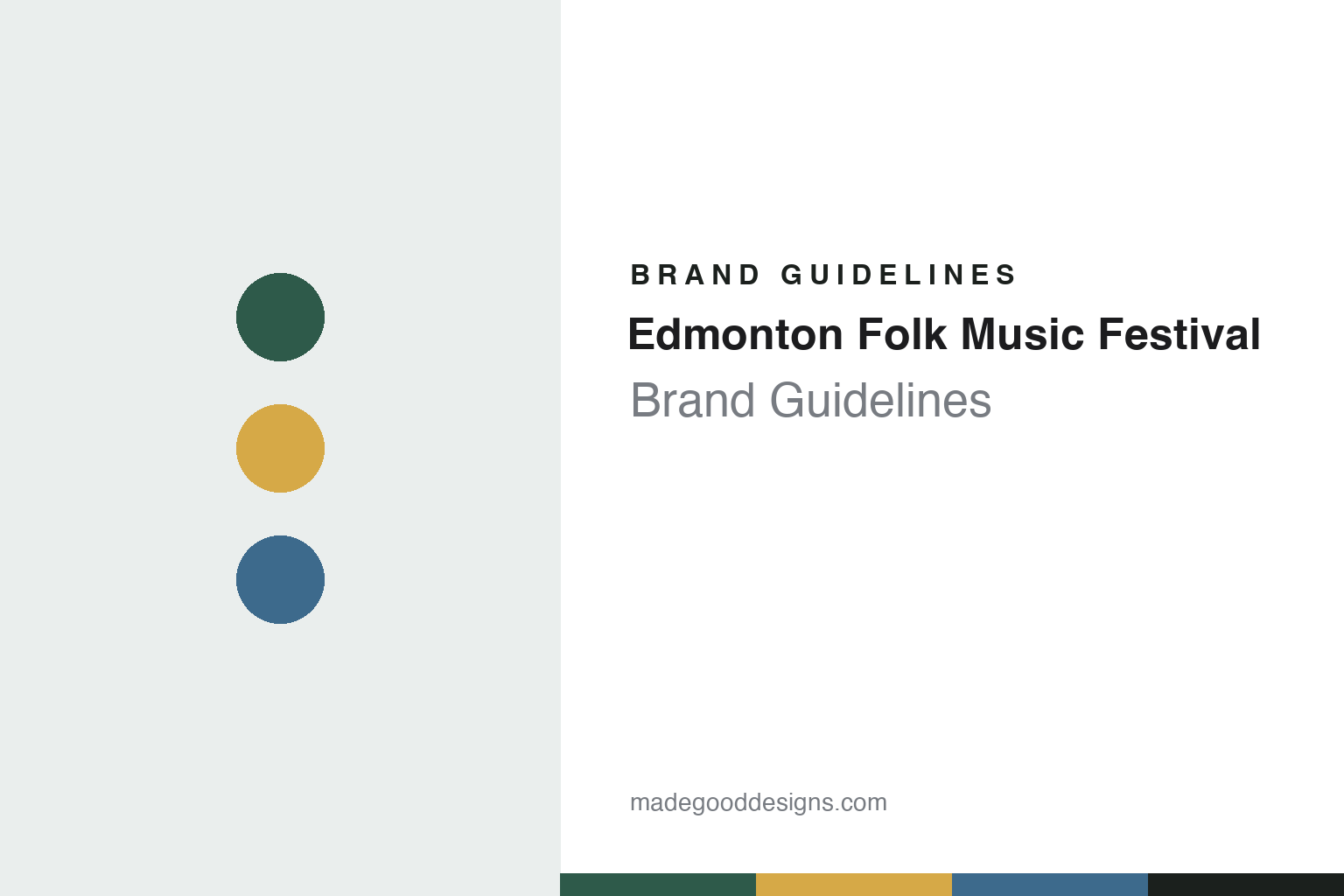
Two constants: a valley green, prairie gold and tarp blue palette and a slab serif register. Abstract homage — not an Edmonton Folk Music Festival poster or mark; no logo, artwork or wristband is reproduced.
An anniversary festival
A one-year celebration that came back the next summer.
The Edmonton Folk Music Festival began in 1980. English Wikipedia says the first edition was organised as part of the celebrations for the 75th anniversary of the province of Alberta, and that it was held that year in Gold Bar Park.
The local news site Taproot Edmonton, in a history note published in June 2025, says the idea for a provincial-anniversary music festival was pitched with the help of Mitch Podolak, who had helped found the Winnipeg Folk Festival. The same piece describes a modest first year built on borrowed resources. Most of the acts came from another anniversary project, a travelling music show that toured the province in a school bus with Sylvia Tyson, Connie Kaldor and Stan Rogers, and the sound equipment came from the same tour.
The festival returned the following year, and that is when it found its ground. English Wikipedia says the second edition, in 1981, moved to the site it has used ever since: Gallagher Park. Taproot Edmonton describes the move as the point at which the festival found a measure of stability, both in its organisation and in its geography.
The festival’s own account of its history is short. It says the event began in 1980 with one staff member and 300 volunteers, and that it is now run by a charitable not-for-profit society with a volunteer force of more than 2,600 people. Since 1989 the festival’s producer has been Terry Wickham, according to English Wikipedia, which lists him in the role from that year; Global News named him as festival producer in reports from 2012 and 2022, and the festival’s website names him today as the producer who selects the artists within a broad musical mandate.
Colour
A hill, a river valley and a lottery.
Gallagher Park is the festival’s most recognisable asset. English Wikipedia describes it as a hillside venue on the southern slope of the North Saskatchewan River valley, looking across to the downtown skyline; in winter the same slope is used by a ski club. The audience seating for the main stage is a natural amphitheatre, so the crowd itself, spread across the grass, forms the picture most people associate with the event. CBC News and Global News both refer to it simply as “the hill.”
The way that hill is shared has become part of the festival’s identity. In a field guide published on 6 August 2015, CBC News described the “tarp lottery” as the festival’s method of deciding who sits where. Every day of the festival, regular visitors arrive early to enter the draw for a spot on the slope; the veteran interviewed by CBC described a group of about twenty friends who each entered separately, with the winner hosting the rest. The same guide pointed to spots near the stage on the centre hill, places halfway up with a clear view of the large video screens, and an area near the top of the hill where family tents were allowed. It also reported that officials expected as many as 13,000 people that year.
The lottery replaced an earlier habit. On 10 August 2012 Global News reported that thousands of people had lined up outside Gallagher Park waiting to claim their place on the hill, but that it was no longer the race of earlier years: that year, the spot was decided by lottery. The same report quoted Wickham saying the festival had sold out in under nine minutes.
The programme runs across several stages. English Wikipedia, citing the Edmonton Sun in 2016, says six stages host workshops and concerts during the day, in addition to the main stage in the evening, and that the festival has run over four days since 2011. It lists folk, Celtic, bluegrass, blues, gospel, roots and worldbeat among the genres, with most performers coming from Canada, the United States and the United Kingdom, alongside local Edmonton musicians.
The festival’s run has had one break. On 15 February 2022 Global News reported that the festival would return to Gallagher Park from 4 to 7 August 2022 after a two-year absence. In June 2025 CBC News announced its sponsorship of the 46th festival, held on the hill from 7 to 10 August 2025.
Typography
Folk festivals and their settings.
A folk festival is often remembered by where and when it happens before anything else. Some take over a park on the edge of a city in high summer, with marquees pitched on the lawns; others fill a seaside town in late August, spreading concerts, dances and workshops through its halls and streets. Some gather in a concert hall in the depths of winter, some on a hillside in a provincial park, and some on a showground or in a festival village built for the purpose. The setting and the week in the calendar do much of the work a logo does elsewhere.
Where a festival issues an annual poster or programme cover, its look is renewed each year, and the artist behind it, whether an illustrator, a printmaker or a designer, shapes how that edition is remembered. When a festival credits those artists, the run of posters becomes a visual record of the event, edition by edition, and a festival without a fixed mark can still read as one thing across many years.
Behind most of these names stands an organiser that keeps them going: a city council, a folk society, a non-profit association, a trust or a small company, supported in many cases by large teams of volunteers. Organisers can change, and formats with them, while the name stays: the Cambridge Folk Festival, for one, has kept the name it was given in 1965 through several changes of format.
The practical layer is what audiences handle on the day. Programme booklets, stage timetables, wristbands, campsite and site maps, and signs pointing between venues all carry the festival’s type and colour into daily use. This guide looks at each festival through that lens: its setting, its calendar, its organiser and the material its audience reads, set out in plain terms and with our own unofficial palettes.
Aa
A sturdy slab serif — a printed timetable read on a hillside. (Specimen set in Bitter, a serif STAND-IN; NOT the Edmonton Folk Music Festival logo.)
Edmonton Folk Music Festival
A calendar fixed to a weekend, a site fixed to a slope.
The festival’s identity rests on two constants: a date and a place. Its website says the festival always takes place on the weekend following the August long weekend, and gives the 2026 dates as 6 to 9 August 2026; the same page describes it as taking place every August on Gallagher Hill. That pairing of a fixed weekend and a fixed hill is what regular visitors plan around, and it is the clearest thing a design system for the festival has to carry.
The name has a short form as well as a long one. English Wikipedia notes that the event is often called the Edmonton Folk Fest, and local coverage in Global News and CBC News uses “Folk Fest” in headlines. For a designer, that means a formal title for print and a shorter, friendlier form for signage, merchandise and social channels.
The practical layer is built around the slope. The tarps that cover the hill each day, the lottery that decides where they go, the large screens that let people halfway up see the stage and the family area near the top, all described in CBC’s 2015 guide, make up the festival’s visual vocabulary as much as any poster. The festival’s own scale is part of that picture too: a society that began with one staff member now depends on more than 2,600 volunteers, the festival says, so for a designer, crew identification and site signage are working parts of the identity. No published brand guidelines, poster series or credited designer are documented in the sources used here, so the visual notes in this guide are our own.
The festival’s links to its western neighbour are part of its story. Taproot Edmonton credits Mitch Podolak, who had helped found the Winnipeg Folk Festival in 1974, with helping to pitch the Edmonton festival.
For a design guide, the Edmonton Folk Music Festival shows how a hillside, a fixed weekend and a daily ritual for claiming space can carry an event’s identity for more than four decades. Compare the Winnipeg Folk Festival, the prairie festival whose founder helped pitch Edmonton’s, and CBC, the public broadcaster that sponsored the 2025 edition. For this guide we use a valley green, a prairie gold and a tarp blue with a serif, an unofficial interpretation; no product or logo is reproduced.
Explore & save
Keep Edmonton Folk Music Festival’s identity on hand — save it to a board in the Made Good inspiration library.
Edmonton Folk Music Festival identity set
Pin the Edmonton Folk Music Festival valley green, prairie gold and tarp blue palette and the slab serif register to your own board.
Source & notes
Frequently Asked Questions
What font can I use to match the Edmonton Folk Music Festival look?
This guide describes Edmonton Folk Music Festival’s type as “A sturdy slab serif — a printed timetable read on a hillside”. Its type specimen is set in Bitter from Google Fonts as a stand-in; Bitter is not Edmonton Folk Music Festival’s own lettering.
What colours are in the Edmonton Folk Music Festival palette?
This guide’s Edmonton Folk Music Festival palette is Valley green #2E5A4A, Hill ink #1B201D, Prairie gold #D6A947, Tarp blue #3D6A8C and Paper #F5F2EA. The tones are the guide’s own unofficial interpretation, not official Edmonton Folk Music Festival hex codes.
When was Edmonton Folk Music Festival founded?
Edmonton Folk Music Festival was founded in 1980, in Edmonton, Alberta, Canada.