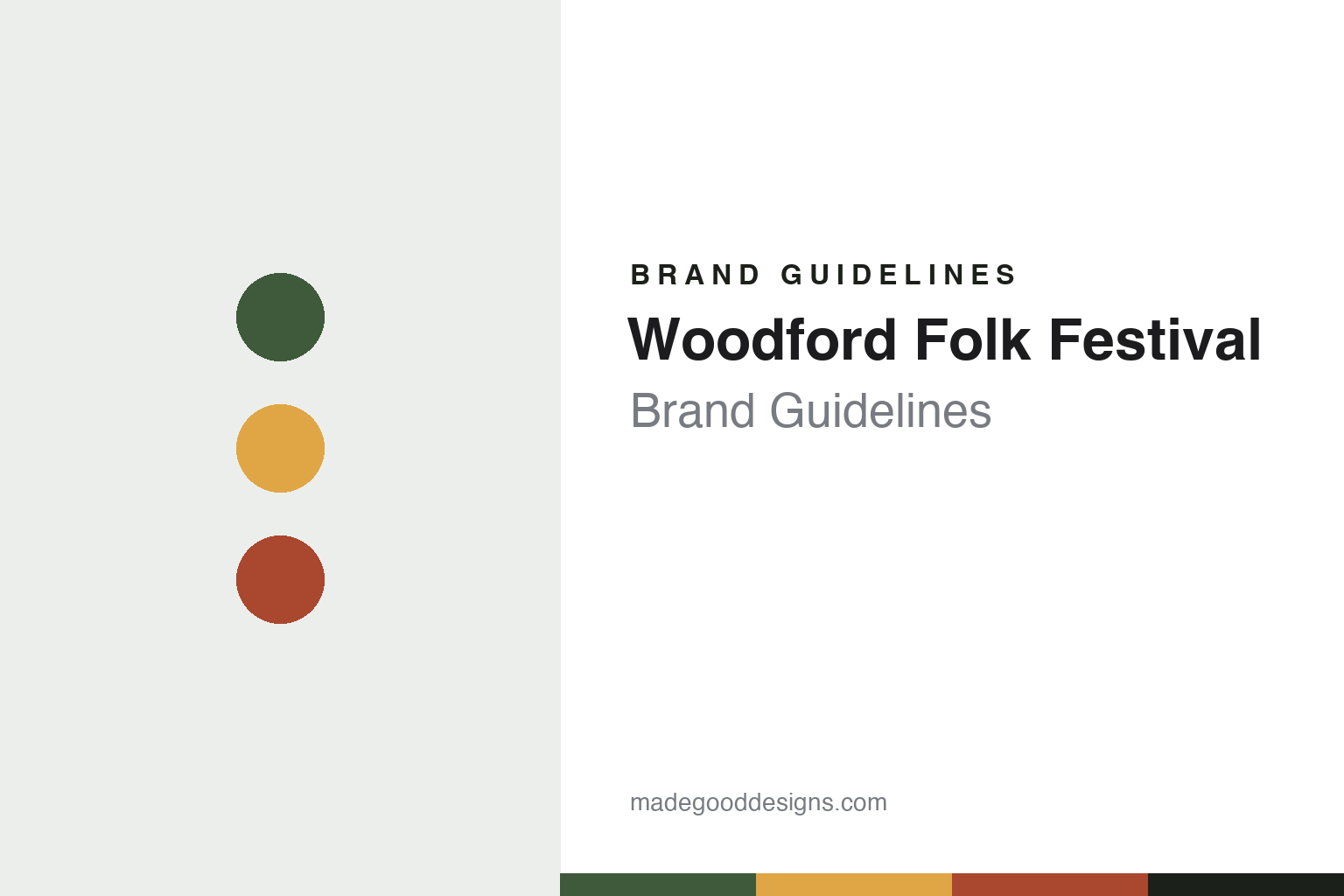
Woodford Folk Festival Brand Guidelines
A folk festival that moved onto a farm, planted it out and turned it into a village for the turn of the year.
Aa
Two constants: a gum-leaf green, lantern amber and ember red palette and a rounded geometric sans register. Abstract homage — not a Woodford Folk Festival poster or mark; no logo, artwork or wristband is reproduced.
From a showground to a farm
A hinterland folk festival that outgrew its first home.
The Woodford Folk Festival began under another name. The Queensland Historical Atlas, in an essay published in 2010, says the Queensland Folk Federation first held the festival at the Maleny Showgrounds in the Sunshine Coast hinterland over the Easter weekend of 1987, as the Maleny Folk Festival. The atlas describes it as growing out of the existing folk movement and the ideas of Bill Hauritz. Sunshine Coast News reported in March 2023 that Hauritz founded the not-for-profit organisation behind the event in 1985 and went on to found the festival in 1987; that organisation is now called Woodfordia Inc.
By 1994, the atlas says, the festival had outgrown the Maleny site. After a search for a new home it was re-established on a former dairy farm outside the township of Woodford, about 20 kilometres from Maleny; Sunshine Coast News describes the land Hauritz led the move to as a degraded former dairy farm of about 200 hectares. The first festival on the new site ran over the Christmas and New Year season, from 27 December 1994 to 1 January 1995, and those six days have stayed the festival’s fixed slot. The Fire Event, a closing ceremony on New Year’s Day, had been developed at the Maleny festival and moved with it, English Wikipedia says.
The organisation and the site share a name. Woodfordia is both the festival grounds and, since the Queensland Folk Federation took its present name, the organiser’s title. English Wikipedia says the land is owned by the Moreton Bay Regional Council and leased back to the organisation for 50 years, while the organisation owns the infrastructure and improvements on it.
Colour
Directors, editions and a calendar fixed at the turn of the year.
Hauritz led the festival as director for 35 editions. Sunshine Coast News reported in March 2023 that he stood down after the 2022–23 festival, the first held after a two-year break, and that he stayed on with the organisation as vice-president. The paper said the festival’s general manager, Amanda Jackes, described there as a co-founder of Woodfordia who had been general manager for 22 years, took over as director. It put attendance at that edition at more than 120,000 people over the six days.
The festival keeps its count of editions. In October 2025 Beat Magazine reported the programme for the 38th edition, from 27 December 2025 to 1 January 2026, with more than 1,500 performances and workshops across the grounds. The bill mixed Australian songwriters and bands with performers from South Africa, Canada, Kenya, Scotland and Papua New Guinea, from traditional rhythms to trapeze and comedy. English Wikipedia likewise lists circus, cabaret, comedy, street performance, workshops and debate among the festival’s strands alongside music.
The rest of the year at Woodfordia has its own events. The 2010 atlas essay names two other annual gatherings on the site run by the same organisation: The Planting, a weekend in May devoted to planting and improving the festival grounds, and The Dreaming, a festival in June that showcases Indigenous arts and culture from Australia and around the world.
Typography
Folk festivals and their settings.
A folk festival is often remembered by where and when it happens before anything else. Some take over a park on the edge of a city in high summer, with marquees pitched on the lawns; others fill a seaside town in late August, spreading concerts, dances and workshops through its halls and streets. Some gather in a concert hall in the depths of winter, some on a hillside in a provincial park, and some on a showground or in a festival village built for the purpose. The setting and the week in the calendar do much of the work a logo does elsewhere.
Where a festival issues an annual poster or programme cover, its look is renewed each year, and the artist behind it, whether an illustrator, a printmaker or a designer, shapes how that edition is remembered. When a festival credits those artists, the run of posters becomes a visual record of the event, edition by edition, and a festival without a fixed mark can still read as one thing across many years.
Behind most of these names stands an organiser that keeps them going: a city council, a folk society, a non-profit association, a trust or a small company, supported in many cases by large teams of volunteers. Organisers can change, and formats with them, while the name stays: the Cambridge Folk Festival, for one, has kept the name it was given in 1965 through several changes of format.
The practical layer is what audiences handle on the day. Programme booklets, stage timetables, wristbands, campsite and site maps, and signs pointing between venues all carry the festival’s type and colour into daily use. This guide looks at each festival through that lens: its setting, its calendar, its organiser and the material its audience reads, set out in plain terms and with our own unofficial palettes.
Aa
A rounded geometric sans — a festival village on a hillside. (Specimen set in Outfit, a sans STAND-IN; NOT the Woodford Folk Festival logo.)
Woodford Folk Festival
A village of tents, lanterns and ceremonies.
Woodford’s identity is built around a place it shaped for itself. The Queensland Historical Atlas describes a festival streetscape of gravel lanes lined with tents, colourful flags and lanterns, with handicraft and food stalls, buskers and roving bands moving through the lantern-lit streets, and very few permanent buildings. It says new structures on the site are meant to follow a long-range plan that asks for buildings that are architecturally pleasing and fit the landscape, with the Glass House Mountains as the backdrop.
The calendar gives the event its ceremonies. The atlas describes a welcome ceremony from the Jinibara people at the start of the festival and three minutes of silence on New Year’s Eve. English Wikipedia adds a sunrise ceremony on the hilltop on New Year’s Day and the Fire Event that evening on the grassed amphitheatre hillside, a staged show of dance, music and theatre that ends with a large structure being burned to mark the new year. In its 2025 announcement Beat Magazine referred to the New Year’s Day programme as the Renewal Ceremony.
Everyday wayfinding follows the same village logic. The 2025 report named Tent City as the on-site campground and the Tinlids Children’s Festival as the dedicated programme for younger visitors. The atlas mentions a circus tent called Circadia and an environment venue called the GREENhouse, and records the colloquial phrase “The People’s Republic of Woodford” for the festival community.
Woodford also has a dated link to Victoria. Sunshine Coast News reported in 2023 that the founder of the Port Fairy Folk Festival sits on the management committee of Woodfordia Inc.
For a design guide, Woodford Folk Festival shows how a festival can grow its identity from a site it holds on a long lease, a fixed six-day slot and a set of yearly ceremonies, rather than from a single logo. Compare Port Fairy Folk Festival, the Victorian folk festival linked to Woodfordia through its founder, and Splendour in the Grass, another Australian festival guide in this series. For this guide we use a gum-leaf green, a lantern amber and an ember red with a sans, an unofficial interpretation; no product or logo is reproduced.
Explore & save
Keep Woodford Folk Festival’s identity on hand — save it to a board in the Made Good inspiration library.
Woodford Folk Festival identity set
Pin the Woodford Folk Festival gum-leaf green, lantern amber and ember red palette and the rounded geometric sans register to your own board.
Source & notes
Frequently Asked Questions
What font can I use to match the Woodford Folk Festival look?
This guide describes Woodford Folk Festival’s type as “A rounded geometric sans — a festival village on a hillside”. Its type specimen is set in Outfit from Google Fonts as a stand-in; Outfit is not Woodford Folk Festival’s own lettering.
What colours are in the Woodford Folk Festival palette?
This guide’s Woodford Folk Festival palette is Gum-leaf green #3E5A3A, Hillside ink #1C201A, Lantern amber #E0A646, Ember red #A9472F and Dust paper #F4F0E6. The tones are the guide’s own unofficial interpretation, not official Woodford Folk Festival hex codes.